Impossible Inventions · Engineering
The Bomb Three Pigeons Were Trained to Steer
Strapped into the nose of a glide bomb, a pigeon stares at a small glowing screen showing the ground rushing up ahead. It sees the silhouette of a ship and pecks at it — hard, fast, without hesitation. Its pecks tug at wires connected to the bomb's fins. The bomb turns. This was not a prank or a thought experiment. It was a real weapons program, funded by the United States government, and the man who built it was one of the most influential psychologists of the twentieth century.
By the Curiosities Desk · · 5 min read · Filed under Engineering · Today’s round
Part of The Animals Hired for a Job
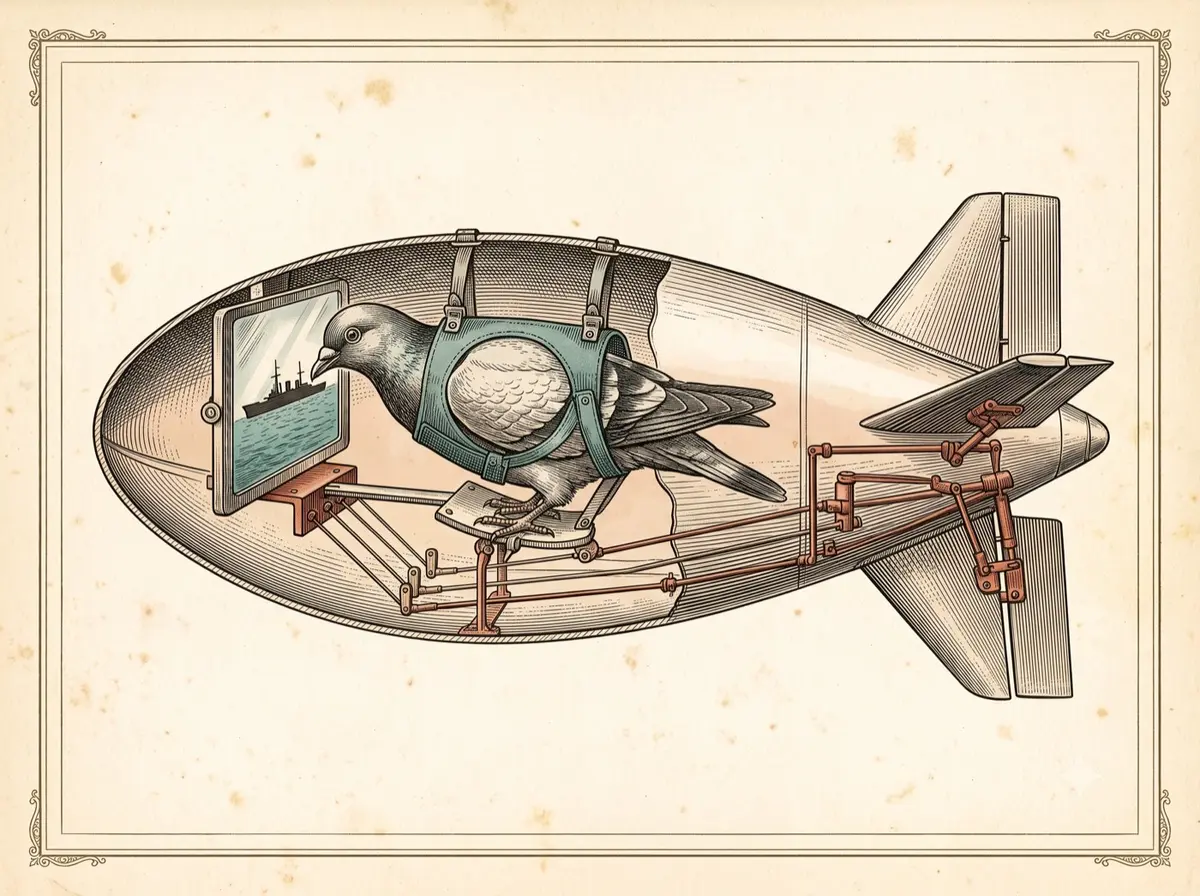
What happened: Project Pigeon
In 1940, B. F. Skinner was a psychology professor, first at the University of Minnesota, already known for his work on operant conditioning — the idea that behavior can be reliably shaped by controlling its consequences, typically through rewards. Watching birds wheel and correct their flight paths in the sky, Skinner had an idea he later described this way: “Suddenly I saw them as ‘devices’ with excellent vision and extraordinary maneuverability. Could they not guide a missile? Was the answer to the problem waiting for me in my own backyard?”
At the time, guided weapons were guesswork. Radar-based guidance was still primitive, and pilots trying to hit precise targets, like ships, often had to fly dangerously close to do it. Skinner started small: he harnessed pigeons so that their pecking motions, aimed at a food dish, would steer a little rolling cart toward a target. It worked. He progressively trained the birds to track pictures of ships projected onto a moving screen, rewarding faster and more accurate pecking with grain. One bird, according to Skinner’s own later account, pecked more than 10,000 times in 45 minutes without losing focus.
The military was not initially interested — Skinner’s funding requests were turned down twice. But General Mills, the food company, gave him lab space on the top floor of a Minneapolis flour mill and some early funding, and in June 1943 the Office of Scientific Research and Development steered a small contract his way. Later, the National Defense Research Committee added $25,000, still viewing the whole concept, in Skinner’s words, with real skepticism.
The final design used “Pelican,” an unpowered glide bomb developed by the National Bureau of Standards (the same airframe later adapted for the radar-guided “Bat” bomb). Inside the nose cone, three lenses projected an image of the target onto a small screen. One to three trained pigeons, sealed inside separate compartments, pecked at the image. If the target drifted off-center, so did the pigeons’ pecks, and sensors on the pivoting screen converted that movement into signals for the bomb’s control surfaces, correcting its course. When more than one pigeon disagreed about the target, the majority ruled — a built-in vote among three biological pilots.
Test after test, the pigeons performed. They tracked targets steadily through noise, vibration, shifting light, and simulated free-fall. Yet on October 8, 1944, the project was shut down. The military’s own assessment noted the birds worked — the objection was that pursuing the idea further would delay other guidance projects considered more likely to reach combat use soon. Skinner later put it more bluntly: “our problem was no one would take us seriously.” The Navy briefly revived the concept in 1948 as “Project Orcon” (short for “organic control”), before canceling it for good in 1953, once electronic guidance systems had proven reliable enough to replace the birds.
Why it was strange: Project Pigeon
It’s not just that pigeons were considered for a weapons system — it’s that they worked, by the military’s own testing, and were rejected anyway partly because a bird flying a bomb was too strange a picture to take seriously, even during a war where far stranger things were being tried. A psychologist studying reward and behavior ended up building one of the more functional guidance systems of the era, using nothing but grain, patience, and birds trained one peck at a time. The pigeons weren’t a metaphor for automation — they briefly were the automation.
It shares a shelf with The Rat-Tail Bounty That Turned Hanoi Into a Rat Farm, in The Animals Hired for a Job.
What scientists learned: Project Pigeon
Project Pigeon was, above all, a rigorous demonstration of operant conditioning: that complex, precise, and reliable behavior can be built up gradually by reinforcing small steps toward a goal. That principle became a cornerstone of behavioral psychology. The project also stumbled onto an engineering idea ahead of its time: using multiple independent units and a majority vote to make a system more reliable than any single unit alone. That’s the same logic behind redundant sensors and voting logic used in modern safety-critical control systems, even though Skinner’s birds got there with grain rewards rather than circuit boards.
The same thread — World War II — continues in The Bomb Full of Sleeping Bats That Burned Down Its Own Air Base.
How it reaches us today: Project Pigeon
The specific pigeon-guided missile never saw combat, but the underlying ideas outlasted it. Multiple-sensor, majority-vote architectures are now standard in fields where failure isn’t an option, including aircraft fly-by-wire systems, which often run several independent computers and compare their outputs before acting. And Skinner’s wartime fascination with shaping behavior through immediate, structured feedback fed directly into his postwar “teaching machines,” early mechanical devices that walked students through problems step by step, rewarding correct answers instantly. That concept — breaking a skill into small steps with immediate feedback — is a direct ancestor of today’s adaptive learning software and much of the reward-driven design built into educational apps.
Also in The Animals Hired for a Job: The Nuclear Landmine Britain Planned to Keep Warm With Live Chickens.
Fun fact: Project Pigeon
In 2024, eighty years after the project was shelved, Skinner was awarded a posthumous Ig Nobel Peace Prize for Project Pigeon. His daughter, Julie Vargas, accepted on his behalf, joking that even the B. F. Skinner Foundation “fails to put a missile on its hat” — his pigeon-guided bomb had finally gotten more recognition than his more famous work on reinforcement schedules.
Sources: Project Pigeon
- Skinner, B. F. “Pigeons in a Pelican.” American Psychologist 15, no. 1 (1960): 28–37. (Primary source — Skinner’s own account of the project.)
- “Project Pigeon.” Wikipedia, accessed July 2026.
- Stromberg, Joseph. “B.F. Skinner’s Pigeon-Guided Rocket.” Smithsonian Magazine, August 18, 2011.
- Hauptman, Max. “That Time the Army Tried to Develop a Missile Guided by Pigeons.” Task & Purpose, November 7, 2022.
- “Project Pigeon (Orcon).” B. F. Skinner Foundation, accessed July 2026.
Related stories: Project Pigeon
- Part of The Animals Hired for a Job
- The Bomb Full of Sleeping Bats That Burned Down Its Own Air Base — Bats carrying tiny incendiaries burned down the base that built them
- Nikola Tesla and the Pigeon He Loved — The inventor of AC power fell in love with a pigeon
- The Movie Star Who Patented a Secret Weapon the Navy Rejected — A movie star patented frequency hopping; the Navy shrugged