The Scientist Behind It · Physics
Nikola Tesla and the Pigeon He Loved
The man who helped electrify the modern world spent his final years nearly broke, living out of New York hotel rooms — and pouring his money, attention, and something close to devotion into the city's pigeons. One white pigeon in particular, he said, mattered to him more than almost anything.
By the Curiosities Desk · · 4 min read · Filed under Physics · Today’s round
Part of Creatures That Changed Science
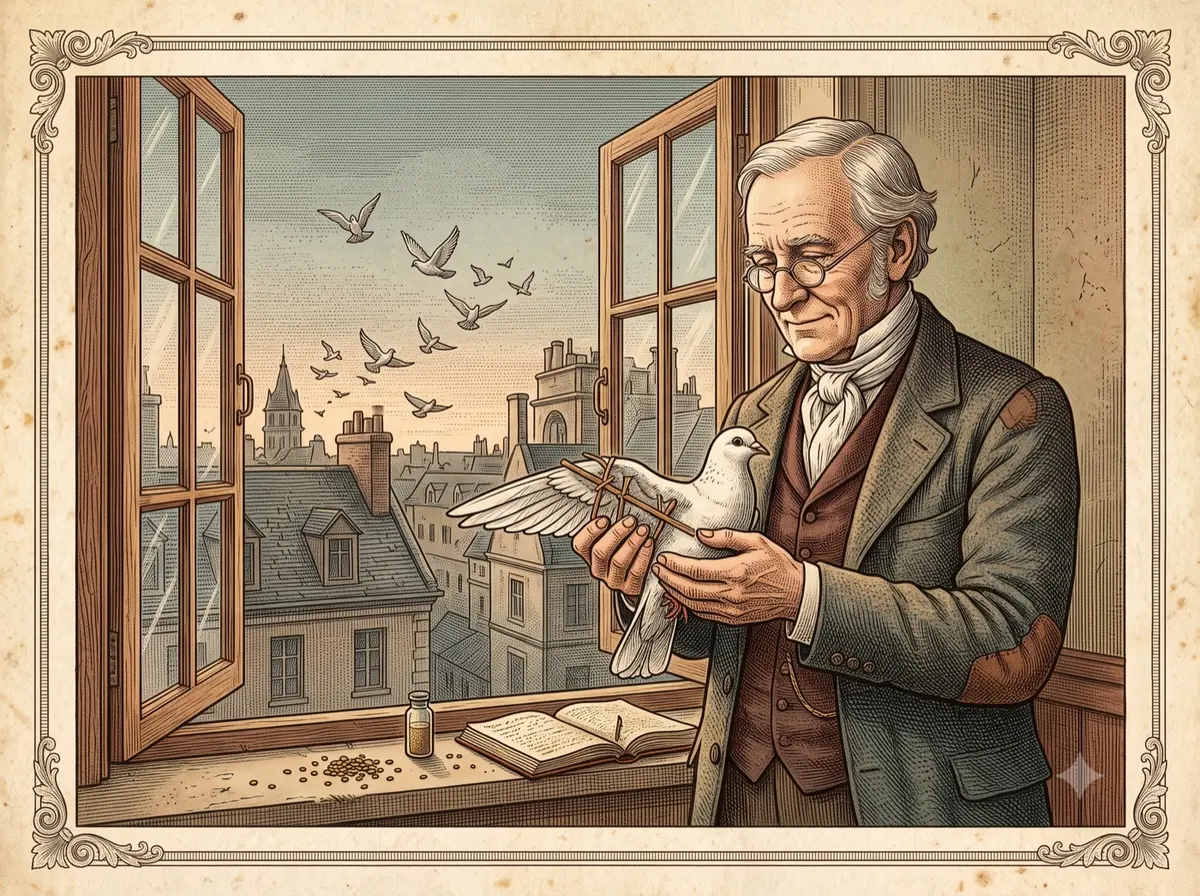
What happened: Nikola Tesla and the Pigeon He Loved
Nikola Tesla was one of the most important inventors in history, the mind behind the alternating-current systems that still carry electricity into homes today. But the same brilliance came bundled with intense compulsions and an unusual emotional life. In his later decades — he lived in New York hotels from 1900 until his death in 1943 — Tesla developed a deep attachment to pigeons.
He walked to the park to feed them every day. He fed them at his hotel window, took injured birds back to his room, and nursed them back to health. He grew especially devoted to one white pigeon, and by his own account spent over $2,000 — a small fortune at the time — caring for her, even building a special device to support her comfortably while her broken wing and leg healed. His biographer John O’Neill recorded Tesla describing a love for this bird in startlingly human terms, saying that as long as he had her, there was a purpose to his life.
Why it was strange: Nikola Tesla and the Pigeon He Loved
The contrast is what makes the story unforgettable. Here was a man who could visualize entire machines in his head, who dined with Mark Twain and was congratulated by Albert Einstein on his 75th birthday, who was once on the cover of Time — and he was being evicted from hotels partly because of complaints about the pigeons he kept. He left the St. Regis in the 1920s, the Hotel Pennsylvania in 1930, and the Hotel Governor Clinton in 1934, trailing unpaid bills and feathers behind him.
Tesla’s habits were full of these contradictions. He was famously germ-averse, counted things compulsively, and disliked being touched, yet he opened his rooms to wild birds. The pigeon obsession wasn’t a quirk bolted onto a tidy genius; it was part of the same intense, pattern-seeking, deeply feeling mind that produced his inventions.
It shares a shelf with The Astronomer With a Metal Nose and a Beer-Drinking Elk, in Creatures That Changed Science.
What scientists learned: Nikola Tesla and the Pigeon He Loved
This story is less about a scientific discovery than about the scientists themselves. Tesla’s life is a vivid reminder that the people who reshape our understanding of the world are whole human beings — sometimes lonely, eccentric, and driven by attachments that have nothing to do with their work. Historians and biographers have used Tesla’s later years to push back against the myth of the coldly rational inventor, and to think more honestly about how mental health, isolation, and obsession can sit alongside extraordinary creativity.
Also in Creatures That Changed Science: The Baby-Blue Blood of the Horseshoe Crab That Keeps Every Vaccine Safe.
How it reaches us today: Nikola Tesla and the Pigeon He Loved
Tesla has become a cultural icon — his name graces a car company, a unit of magnetic field strength, and countless documentaries. The pigeon story endures because it humanizes him. It’s a useful corrective to the way we mythologize geniuses: the man whose ideas light our cities spent his nights tending to a bird, and found meaning there.
Another from Creatures That Changed Science: Acoustic Kitty: The CIA Wired a Live Cat for Sound to Spy on the Soviets.
Fun fact: Nikola Tesla and the Pigeon He Loved
The “tesla” — the SI unit of magnetic flux density — is named in his honor. So is the magnetic field measurement on every MRI machine, which is rated in teslas.
Sources: Nikola Tesla and the Pigeon He Loved
- “Nikola Tesla,” Wikipedia — https://en.wikipedia.org/wiki/Nikola_Tesla
- John J. O’Neill, Prodigal Genius: The Life of Nikola Tesla (1944) — the original source for Tesla’s quotes about the white pigeon
- Marc Seifer, Wizard: The Life and Times of Nikola Tesla (1996)
Related stories: Nikola Tesla and the Pigeon He Loved
- Part of Creatures That Changed Science
- The Bomb Three Pigeons Were Trained to Steer — B. F. Skinner trained pigeons to fly missiles to their targets
- The Pigeon Mess That Turned Out to Be the Echo of the Big Bang — An inexplicable hiss turned out to be the echo of the Big Bang
- The Scientist Who Weighed the Earth but Couldn’t Speak to His Housekeeper — He weighed the Earth but could barely speak to anyone