The Scientist Behind It · Space
The Astronomer With a Metal Nose and a Beer-Drinking Elk
Tycho Brahe, born in 1546, had a hole where the bridge of his nose used to be, glued on a metal replacement every morning, kept a pet elk that died from beer, and ate dinner beside a man he believed could see the future. He was also the most precise observer of the night sky in human history up to that point — and the data he left behind cracked open the laws that govern the planets.
By the Curiosities Desk · · 5 min read · Filed under Space · Today’s round
Part of Creatures That Changed Science
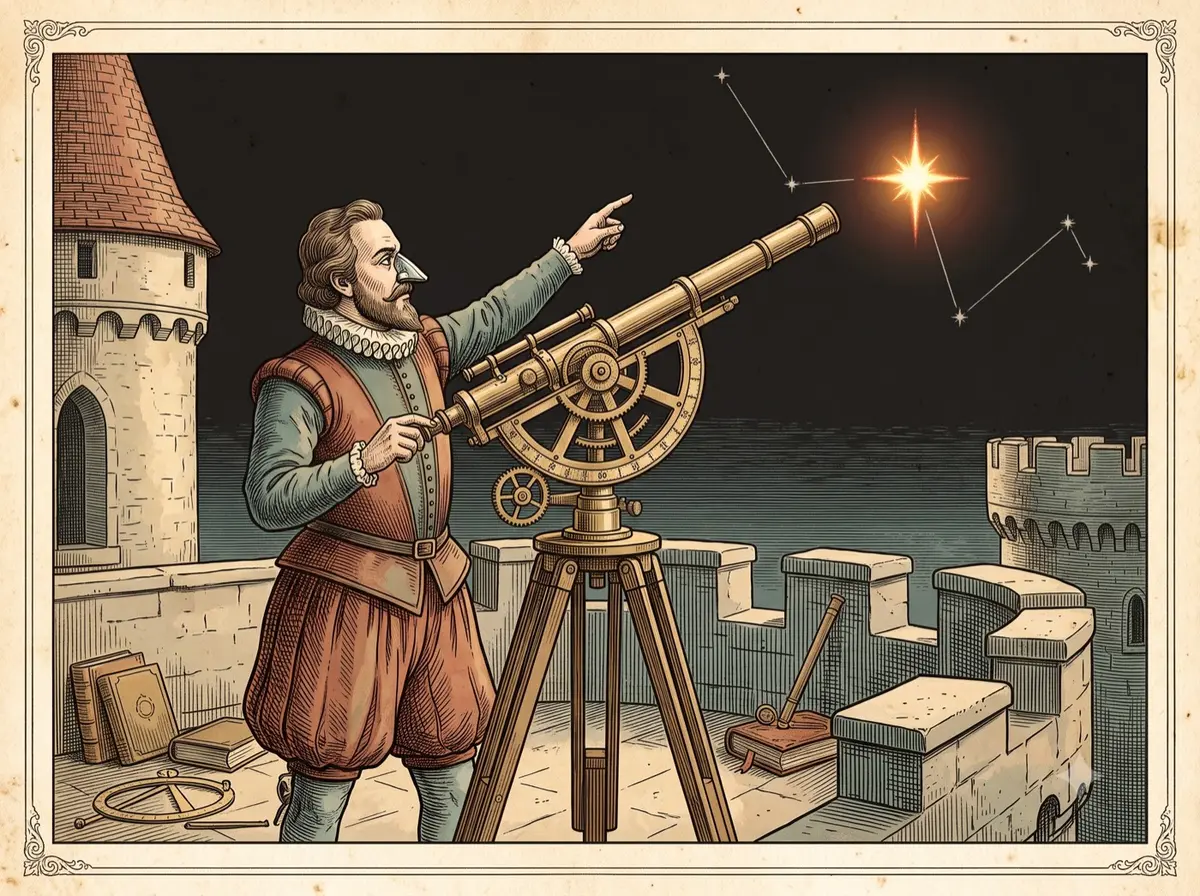
What happened: The Astronomer With a Metal Nose and a Beer-Drinking Elk
Tyge Ottesen Brahe — known to history by the Latinized “Tycho” — was born on 14 December 1546 at Knutstorp Castle in Scania, then part of Denmark. He came from the high nobility and was expected to study law. Instead he fell in love with the sky.
The face came first. On 29 December 1566, at age twenty, Tycho fought a sword duel in the dark with his third cousin, a fellow Danish nobleman named Manderup Parsberg. The two had been drinking at an engagement party weeks earlier and had quarreled over which of them was the better mathematician. The duel settled nothing about math, but it cost Tycho the bridge of his nose. For the rest of his life he wore a prosthetic, held in place with paste or glue.
Then came the star. In 1572 Tycho noticed a brand-new point of light in the constellation Cassiopeia, brighter than any star or planet. We now call it a supernova — the explosive death of a star — and astronomers still refer to it as “Tycho’s Supernova.” In his 1573 book De nova stella (“On the New Star”), he showed the new light sat far beyond the Moon, in the supposedly perfect and unchanging heavens. He did it again with the Great Comet of 1577, proving comets were not local weather in the upper air but objects moving through deep space.
King Frederick II of Denmark was impressed enough to hand Tycho an entire island, Hven, plus the money to build Uraniborg, the first great observatory in Christian Europe. From roughly 1576 to 1591 Tycho turned the island into a research institute, complete with workshops, a paper mill, and later an underground observatory called Stjerneborg, built when he realized his instruments above ground weren’t steady enough.
Life on Hven was as eccentric as its owner. Tycho kept a tame elk; according to the philosopher Pierre Gassendi, the animal died after drinking too much beer at a nobleman’s house in Landskrona, falling down a staircase. A second resident of Uraniborg was a man with dwarfism named Jeppe, whom Tycho believed could predict the future, including which sick islanders would recover and which would die.
In 1597 a new king, Christian IV, pushed Tycho out of Denmark. He landed in Prague as imperial astronomer to Emperor Rudolf II and, in the last year of his life, took on a brilliant, difficult young assistant named Johannes Kepler.
Why it was strange: The Astronomer With a Metal Nose and a Beer-Drinking Elk
For nearly two thousand years, European thinkers had taken Aristotle at his word: the heavens were eternal and incorruptible, and any change — a new star, a passing comet — had to be happening in Earth’s own atmosphere. Tycho’s measurements quietly demolished that. A nobleman with a glued-on nose, peering through brass instruments on a small Danish island, gathered enough evidence to show that the sky itself could change.
Stranger still is the gap between the man and the work. The biography reads like tabloid material — duels, a drunk elk, a court fortune-teller. The science reads like the opposite: obsessive, methodical, almost inhuman in its patience. Both were the same person.
It shares a shelf with Nikola Tesla and the Pigeon He Loved, in Creatures That Changed Science.
What scientists learned: The Astronomer With a Metal Nose and a Beer-Drinking Elk
Tycho worked before the telescope existed, yet he pushed naked-eye astronomy to its absolute physical limit. He has been called the greatest pre-telescopic astronomer, and for good reason: his positional measurements of stars and planets were far more accurate and consistent than anything before them.
He used that data to build his own model of the cosmos — the “Tychonic system,” a hybrid in which the Sun and Moon orbit a stationary Earth while the other planets orbit the Sun. He got the architecture wrong. But the observations were so good that they outlived his theory.
After Tycho died, Kepler inherited the records, including years of meticulous measurements of Mars. Mars had a stubbornly un-circular path that no one could fit to the perfect circles tradition demanded. Because Tycho’s numbers were too precise to fudge, Kepler was eventually forced to abandon circles altogether — and concluded the planets move in ellipses. That insight became the first of Kepler’s three laws of planetary motion, the foundation Isaac Newton later built gravity upon.
Also in Creatures That Changed Science: The Teenager Who Sent Two Spiders to Spin Webs in Space.
How it reaches us today: The Astronomer With a Metal Nose and a Beer-Drinking Elk
Every spacecraft trajectory, every prediction of where a planet will be on a given night, every GPS fix that depends on orbital mechanics traces back through Newton to Kepler — and Kepler’s laws were only possible because of Tycho’s data. The metal-nosed eccentric on his island built the observational bedrock of modern celestial mechanics.
His life also stands as an early model of “big science”: state-funded, instrument-heavy, run as a team enterprise with assistants and craftsmen. Uraniborg looked a lot more like a modern research lab than like a lone genius scribbling by candlelight.
Another from Creatures That Changed Science: The 23 Cats the RAF Parachuted Into Borneo to Fight a Rat Plague.
FAQ
Did Tycho Brahe’s elk die from beer?
Yes, according to the philosopher Pierre Gassendi. Tycho Brahe kept a tame elk, and it died after drinking too much beer at a nobleman’s house in Landskrona and falling down a staircase. Tycho was born in 1546.
Who was Tycho Brahe?
Tycho Brahe was a Danish astronomer, born Tyge Ottesen Brahe on 14 December 1546. He lost the bridge of his nose in a 1566 sword duel and wore a metal prosthetic. His observations of the sky were the most precise made before the telescope, and Johannes Kepler used them to work out the laws of planetary motion.
Fun fact: The Astronomer With a Metal Nose and a Beer-Drinking Elk
Tycho died on 24 October 1601, eleven days after a banquet in Prague. By Kepler’s first-hand account, Tycho had refused to leave the table to relieve himself because doing so would breach etiquette; afterward he could barely urinate, and died in agony. For centuries some suspected mercury poisoning — even murder, with Kepler himself among the rumored suspects. In 2010 a team led by Jens Vellev exhumed the body, and in 2012 reported there was nowhere near enough mercury to have killed him. The likeliest culprit was something far more ordinary: a failed bladder. As for the famous nose, chemical analysis of the exhumed remains found his everyday prosthesis was made not of the gold and silver of legend, but of humble brass.
Sources: The Astronomer With a Metal Nose and a Beer-Drinking Elk
- Tycho Brahe — Wikipedia (cross-referenced against its underlying citations)
- Tycho Brahe — Encyclopaedia Britannica
- Tycho Brahe — The Galileo Project, Rice University
- “No Poison Killed Tycho Brahe” — Aarhus University / ScienceDaily, 2012
- Kepler’s Laws of Planetary Motion — NASA
Related stories: The Astronomer With a Metal Nose and a Beer-Drinking Elk
- Part of Creatures That Changed Science
- The Astronomer Who Spent Eleven Years at Sea to Watch Venus Cross the Sun — and Missed It Anyway — Eleven years at sea to watch Venus cross the Sun, and then clouds
- The Geologist Who Tried to Eat His Way Through the Entire Animal Kingdom — A geologist who tried to taste his way through the animal kingdom
- The Scientist Who Weighed the Earth but Couldn’t Speak to His Housekeeper — He weighed the Earth but could barely speak to anyone