Strange Animals Scientists Studied · Space
The Dung Beetles Scientists Fitted With Tiny Hats to Prove They Steer by the Milky Way
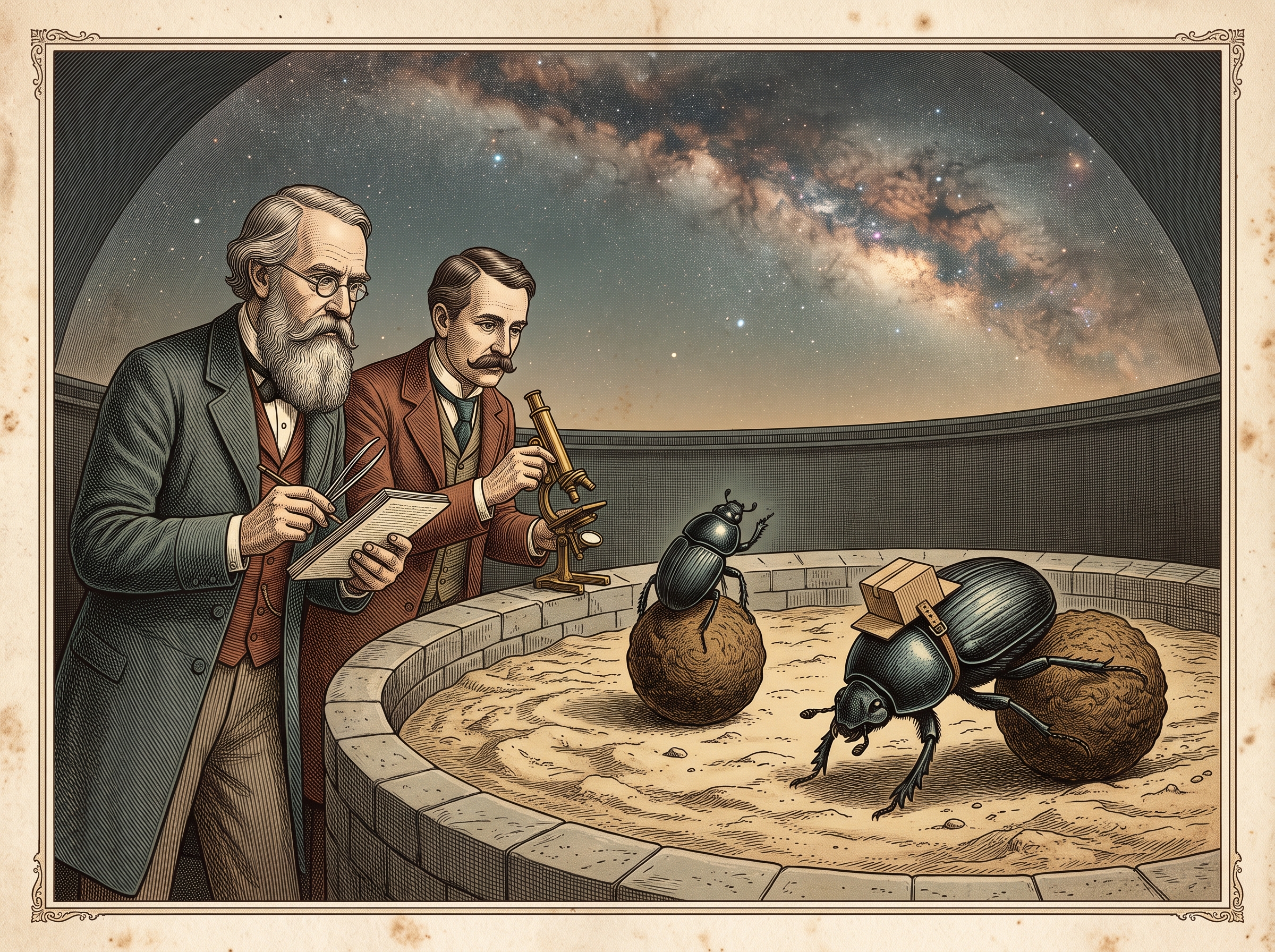
For a study published in January 2013, a team of biologists took over the dome of the Johannesburg Planetarium and switched the stars on and off for an audience of dung beetles. Out in the field, some of their beetles had already worn tiny cardboard caps. Every one of them was pushing a ball of dung. The question sounded like a punchline: could an insect with a tiny brain find its way by the galaxy?
By the Curiosities Desk · · 5 min read · Filed under Space · Today’s round
What happened?
The African dung beetle Scarabaeus satyrus has one overriding goal after dark. It finds a fresh pile of dung, sculpts a ball, and rolls it away as fast and as straight as it can. The straight line matters. A pile of dung is a crowded, competitive place, and a beetle that wanders in a circle risks ending up right back where it started, next to rivals ready to steal its prize. Marcus Byrne of the University of the Witwatersrand (Wits) in Johannesburg summed up the beetles’ priorities: they just need to get away from “the bun fight at the poo pile.”
Researchers already knew the beetles used the sky. Earlier work by Marie Dacke of Lund University in Sweden and her colleagues showed that dung beetles steer by the sun, the moon, and polarized light, which is light whose waves vibrate mostly in one direction and form a pattern across the sky. A 2012 study led by Emily Baird found that before setting off, a beetle climbs on top of its ball and spins around in a little “dance,” apparently taking a reading of the sky.
But one observation didn’t fit. On clear, moonless nights, the beetles still rolled in straight lines. Stars were the obvious suspect, except that Dacke’s own 2003 research had suggested beetles lost their way under starlight alone. Something was off.
So the team designed a set of experiments. Out in the field in South Africa, they released beetles in the middle of a circular arena of flattened sand, surrounded by a featureless wall so no trees or rocks could serve as landmarks. They timed how long each beetle took to reach the edge. Then they changed what the beetles could see. Some rolled under a moonlit sky, some under stars alone, some under clouds. And some wore small cardboard caps that blocked the upward-facing parts of their eyes, leaving their downward view clear.
The results were striking. According to the researchers’ reported averages, beetles crossed the arena in about 20 seconds under the moon and about 40 seconds under a moonless, starry sky. Under clouds, or wearing their caps, they took roughly three times as long, wobbling and looping as they went.
That pointed to the stars, but the field couldn’t show which part of the sky mattered. For that, the team needed a sky they could control. They moved into the Wits-run Johannesburg Planetarium and tested the beetles under different projected skies: a full starry sky, only the brightest stars, only the diffuse band of the Milky Way, and total darkness. In the dark, the beetles meandered. With only the Milky Way overhead, they rolled nearly as straight and as fast as they did under the full sky.
Dacke, Baird, Byrne, Clarke Scholtz, and Eric Warrant published their findings in Current Biology in January 2013 under a title that doubled as a headline: “Dung Beetles Use the Milky Way for Orientation.”
Why was it strange?
Humans, some birds, and seals were already known to orient by the stars. All of them have relatively large eyes and brains. A dung beetle’s eyes are far too small to pick out individual stars or recognize constellations. Nobody expected an insect to use the night sky this way, and no animal of any kind had been shown to use the Milky Way itself.
The experiment also solved the mystery of Dacke’s earlier result. Her 2003 tests had been run in October, when the Milky Way sits low in the South African sky, too low for the beetles to use well. The beetles hadn’t failed at star navigation. They had simply been tested in the wrong season.
The same thread — Ig Nobel Prize — continues in The Wombat That Proved You Can Fit a Square Peg Through a Round Hole.
What did scientists learn?
The beetles don’t read the galaxy like a map. They use it like a stripe of paint across the ceiling. The Milky Way forms a band of light with a gradient, bright along its center and fading toward darker sky on either side. That gradient gives the beetle a fixed reference to hold its bearing against.
It works because the Milky Way is so far away. A moth that keeps a constant angle to a nearby candle ends up spiraling around it, because the angle changes as the moth moves. A celestial light doesn’t shift as a beetle crosses a few meters of sand, so keeping a steady angle to it produces a straight path. The beetle doesn’t care which direction it goes. It just needs to keep going the same way.
The work, first reported in 2013, was the first convincing demonstration that insects can use the starry sky for orientation at all. Later that year, the team received an Ig Nobel Prize in the combined Biology and Astronomy category. The Ig Nobels honor research that makes people laugh and then think, and this study did both.
Elsewhere in the space stories: The Giant Space Mirror Russia Built to Turn Night Into Day — and the Antenna That Snagged the Sequel.
How does it affect us today?
The beetles have become a model for how a tiny nervous system can solve a hard navigation problem, and that interests engineers designing small robots and drones that need to find their way without GPS or heavy processors.
They have also become a warning. In a 2021 study in Current Biology, a team including Dacke and Byrne tested the same species on a rooftop in central Johannesburg. City skyglow washed out the Milky Way, leaving only a few bright stars. Instead of rolling straight, many beetles abandoned the sky and headed toward streetlights and lit buildings. The finding added the beetles to a growing list of nocturnal animals whose ancient cues are being drowned out by artificial light.
Another creature that ended up in the notes: Laika: The Moscow Stray Who Orbited Earth, and the Truth Hidden for 45 Years.
Fun fact
The beetles were so devoted to their dung balls that the tiny cardboard caps didn’t stop them from pushing on. As Dacke told Science News, under all circumstances they “just want to roll the ball in a straight line.”
Sources
- Dacke, M., Baird, E., Byrne, M., Scholtz, C. H., & Warrant, E. J. (2013). “Dung Beetles Use the Milky Way for Orientation.” Current Biology, 23(4), 298–300.
- Wits University. (2013, January 24). “Dung beetles follow the Milky Way: Insects found to use stars for orientation.” ScienceDaily.
- Baird, E., Byrne, M. J., Smolka, J., Warrant, E. J., & Dacke, M. (2012). “The Dung Beetle Dance: An Orientation Behaviour?” PLoS ONE, 7(1), e30211.
- Milius, S. (2013, January 24). “Dung beetles steer by the Milky Way.” Science News.
- Foster, J. J., et al. (2021). “Light pollution forces a change in dung beetle orientation behavior.” Current Biology, 31(17), 3935–3942.