Strange Animals Scientists Studied · Space
The Two Tortoises That Flew Around the Moon Before Any Human Did
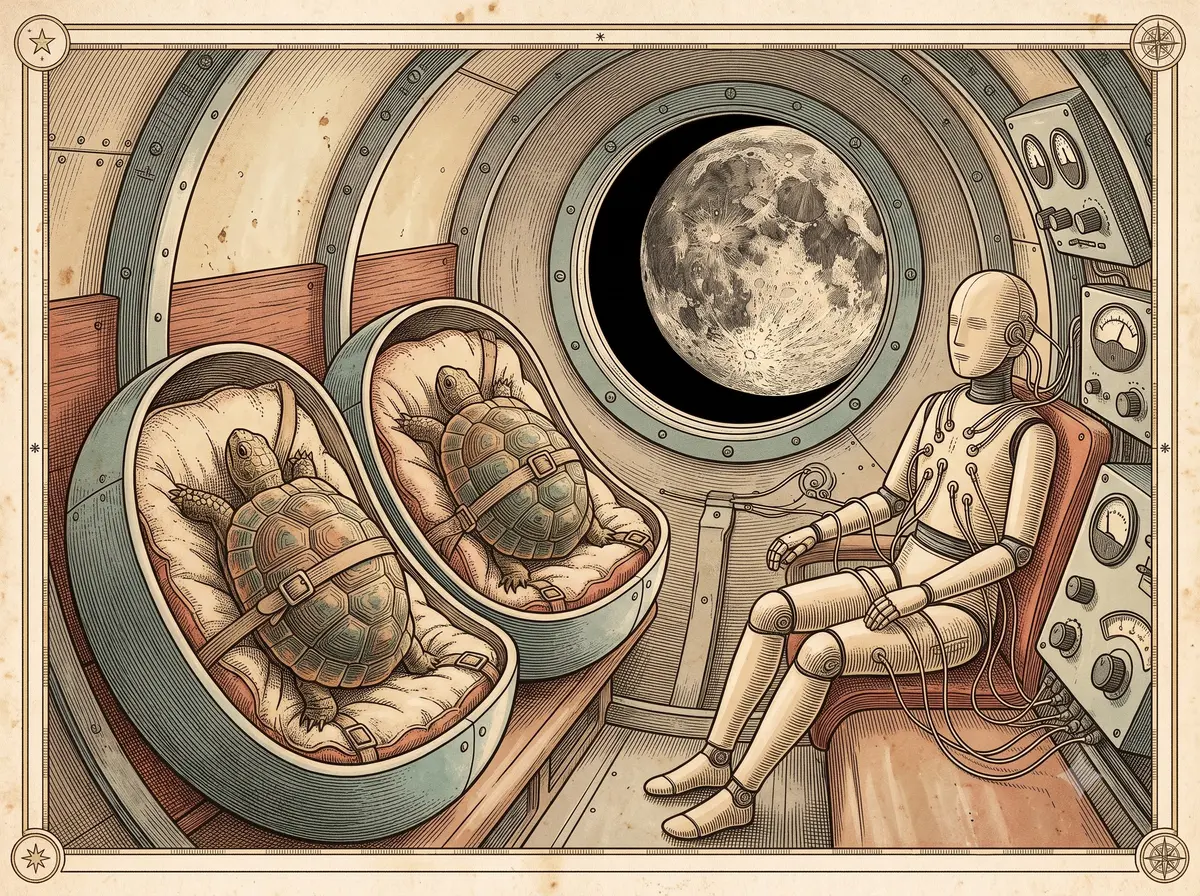
On 21 September 1968, a scorched metal capsule bobbed in the dark of the Indian Ocean, 65 miles from the nearest Soviet ship. Inside, strapped down beside a mannequin full of radiation sensors, were two steppe tortoises. They had just flown around the far side of the Moon and come home — the first living things from Earth ever to do it. Three months later, three American astronauts would follow.
By the Curiosities Desk · · 5 min read · Filed under Space · Today’s round
Part of Creatures That Changed Science
What happened: The Two Tortoises That Flew Around the Moon Before Any Human Did
By the summer of 1968 the Soviet lunar program was running out of runway. The Zond project — a stripped-down version of the Soyuz 7K-L1 spacecraft, designed to loop two cosmonauts around the Moon and back — had produced one partial success and a string of failures. In April a bad abort command shut down a Proton rocket mid-ascent. In July, an upper stage exploded on the pad and killed three people. Sending cosmonauts on the next attempt was judged too risky, so the flight went up uncrewed.
Almost uncrewed. The spacecraft carried a biological payload assembled to test what deep-space radiation does to living tissue: fruit fly eggs, plant cells, a wildflower called Tradescantia, green algae, bacteria — and two Russian tortoises (Agrionemys horsfieldii, also called steppe or Horsfield’s tortoises), each weighing between 340 and 400 grams. Soviet scientists picked tortoises for an unglamorous reason: they were easy to strap down tightly. Twelve days before launch, the two flight tortoises were secured inside the capsule and cut off from food and water. A matched pair of control tortoises on the ground was starved on the same schedule, so any difference between the two groups could be attributed to the flight rather than the fasting.
Zond 5 lifted off from Baikonur on 14 September 1968 at 21:42 UTC. Almost immediately things started going wrong. A star tracker — the instrument that tells a spacecraft which way it is pointing by sighting on known stars — was fouled by vapor outgassing from a newly added sun blind, of all things, and stopped working. Controllers improvised, using the Sun and Earth as reference points instead, and got the course correction off with the craft already 325,000 km from home.
On 18 September the spacecraft swung around the far side of the Moon at a distance of roughly 1,950 km. On the way back the second star tracker died too, and the guided reentry system switched itself off. Unable to steer, the team at Yevpatoria in Crimea improvised again: they nudged the capsule onto a survivable path by firing tiny attitude thrusters sideways, rotating 180 degrees, firing the opposite thruster, and repeating — for twenty hours, across 36 communication sessions — until the entry corridor was right.
It worked. The capsule made a steep ballistic reentry and splashed down at 16:08 UTC on 21 September, in the Indian Ocean rather than the intended steppes of Kazakhstan, at night, which made the search miserable. Soviet ships recovered it; an American destroyer, the USS McMorris, shadowed the operation and watched. The whole trip took six days, 18 hours and 24 minutes. The capsule was eventually shipped to Bombay, flown to Moscow, and opened. The tortoises were alive.
Why it was strange: The Two Tortoises That Flew Around the Moon Before Any Human Did
For a month, nobody outside the program knew there had been anyone aboard. TASS announced the flight as a triumph of automated stations and said nothing about passengers; the tortoises were only revealed in November.
Meanwhile the mission had already caused a genuine scare in Washington. On 19 September, listening stations including Jodrell Bank in England picked up the voices of cosmonauts Valery Bykovsky, Vitaly Sevastyanov and Pavel Popovich apparently transmitting from the spacecraft, reading out telemetry and discussing a landing. Apollo astronaut Eugene Cernan later said the intercept “shocked the hell out of us.” Popovich’s own account, given decades later, is that it was a prank: engineers had jumpered the probe’s receiver to its transmitter, so his voice from mission control in Crimea bounced off the spacecraft and came back as if from the Moon. That version rests on his recollection rather than contemporary documents, and he misremembered which president made the alarmed phone call — but the interception itself is well attested.
So the story ends up beautifully lopsided. The superpower contest of the century, at its tensest moment, with two hungry tortoises as the actual crew.
The same thread — Animals in Space — continues in Laika: The Moscow Stray Who Orbited Earth, and the Truth Hidden for 45 Years.
What scientists learned: The Two Tortoises That Flew Around the Moon Before Any Human Did
The tortoises were dissected on 11 October, after 39 days without food. They had lost about 10% of their body weight; the starved control tortoises on the ground had lost 5%. Blood analyses showed no difference between the two groups. The flight animals did show elevated iron and glycogen in the liver and changes in the internal structure of the spleen. The authors’ conclusion was deliberately unexciting: the changes were driven mainly by starvation, and space travel itself had done little.
That negative result was the point. It was the first hard evidence that a vertebrate could cross the Van Allen radiation belts, spend a week in deep space, endure a punishing ballistic reentry, and arrive biologically intact.
It’s worth noting the limits. Two animals is not a large sample, and reptiles are not people — tortoises tolerate radiation and low oxygen far better than we do, which several later commentators pointed out. Zond 5 didn’t prove humans would be fine. It removed one specific reason to think they wouldn’t.
Another animal the lab could not ignore: The 2,478 Baby Jellyfish NASA Sent to Space — and the Ones That Came Home Dizzy.
How it reaches us today: The Two Tortoises That Flew Around the Moon Before Any Human Did
The mission’s biggest effect was on the other side of the Cold War. British astronomer Bernard Lovell publicly read Zond 5 as evidence the Soviets were ahead, and the British Interplanetary Society guessed cosmonauts would circle the Moon within months. That reading helped harden NASA’s decision to send Apollo 8 — Frank Borman, Jim Lovell and Bill Anders — around the Moon in December 1968 rather than waiting. The Zond 5 tortoises are part of the chain of events that produced Earthrise.
The Soviets flew more shelled crews: turtles on Zond 6 that November, four more on Zond 7 in August 1969. And the basic design of the test — fly the animals, starve identical controls on the ground, compare — is still how spaceflight biology separates the effects of the flight from everything else about being a lab animal.
The Zond 5 descent capsule is on display today at the RKK Energiya museum outside Moscow.
Another creature that ended up in the notes: The Dung Beetles Scientists Fitted With Tiny Hats to Prove They Steer by the Milky Way.
Fun fact: The Two Tortoises That Flew Around the Moon Before Any Human Did
Tortoises № 22 and № 37 had gone 39 days without food by the time researchers examined them. They had lost a tenth of their body weight, had orbited nothing less than the Moon — and, per the flight report, had lost no appetite whatsoever.
Sources: The Two Tortoises That Flew Around the Moon Before Any Human Did
- Gaidamakin, N. A., Parfenov, G. P., Petrukhin, V. G., Antipov, V. V., et al. (1969). Patho-Morphological and Histochemical Changes in the Organs of Turtles on Board the “Zond-5” Probe — the flight team’s own report, translated and archived by the Smithsonian Institution.
- Siddiqi, Asif A. (2018). Beyond Earth: A Chronicle of Deep Space Exploration, 1958–2016, NASA History Program Office, SP-2018-4041, pp. 79–80.
- Zak, Anatoly. “Zond-5: A prototype of the Soviet crew ship loops behind the Moon!”, RussianSpaceWeb — detailed mission chronology drawn from Kamanin’s diaries and RKK Energia records.
- Madrigal, Alexis C. (27 December 2012). “Who Was First in the Race to the Moon? The Tortoise”, The Atlantic.
- Day, Dwayne A. (9 February 2009). “Chasing the Zond”, The Space Review — on the US Navy’s shadowing of the recovery.
Related stories: The Two Tortoises That Flew Around the Moon Before Any Human Did
- Laika: The Moscow Stray Who Orbited Earth, and the Truth Hidden for 45 Years — A Moscow stray orbited Earth, and the truth took 45 years
- The Teenager Who Sent Two Spiders to Spin Webs in Space — A student’s experiment sent two spiders to spin webs in orbit
- The Water Bears That Survived Naked in Open Space — Tardigrades survived unprotected exposure to open space