Strange Animals Scientists Studied · Space
Laika: The Moscow Stray Who Orbited Earth, and the Truth Hidden for 45 Years
A few weeks before she became the most famous dog on the planet, a small, calm mongrel plucked from the streets of Moscow went home with a scientist to play with his children. "Laika was quiet and charming," he later wrote. "I wanted to do something nice for her: She had so little time left to live." Days later she was bolted into a metal capsule on top of a rocket, and on November 3, 1957, she became the first living creature to circle the Earth.
By the Curiosities Desk · · 5 min read · Filed under Space · Today’s round
Part of Creatures That Changed Science
What happened: Laika the Dog
In October 1957 the Soviet Union had just stunned the world with Sputnik 1, the first artificial satellite. Soviet leader Nikita Khrushchev wanted an encore in time for November 7, the 40th anniversary of the October Revolution. The decision to build a second satellite was reportedly made around October 10–12, leaving engineers less than four weeks to design and assemble it. Chief designer Sergei Korolev proposed the showstopper: put a living dog inside.
The result, Sputnik 2, was largely improvised from rough sketches. Soviet teams had been lofting dogs on sub-orbital rocket flights since 1951, and they favored strays, on the theory that animals who had survived Moscow’s streets could endure cold and hunger. Three candidates trained for the mission: Albina, Mushka, and Laika. The dogs were squeezed into ever-smaller cages for up to twenty days, spun in centrifuges to simulate launch forces, and blasted with recordings of rocket noise. Ten days before launch, the space-medicine scientist Vladimir Yazdovsky chose Laika as the flight dog.
Laika was a roughly three-year-old female mongrel weighing about 5 kilograms (11 pounds), her exact pedigree unknown; NASA has described her as a “part-Samoyed terrier.” Soviet staff gave her several names, including Kudryavka, “Little Curly.” The name that stuck, Laika, is a Russian word for husky-type breeds and translates loosely as “Barker.” The American press, charmed and needling at once, dubbed her “Muttnik.”
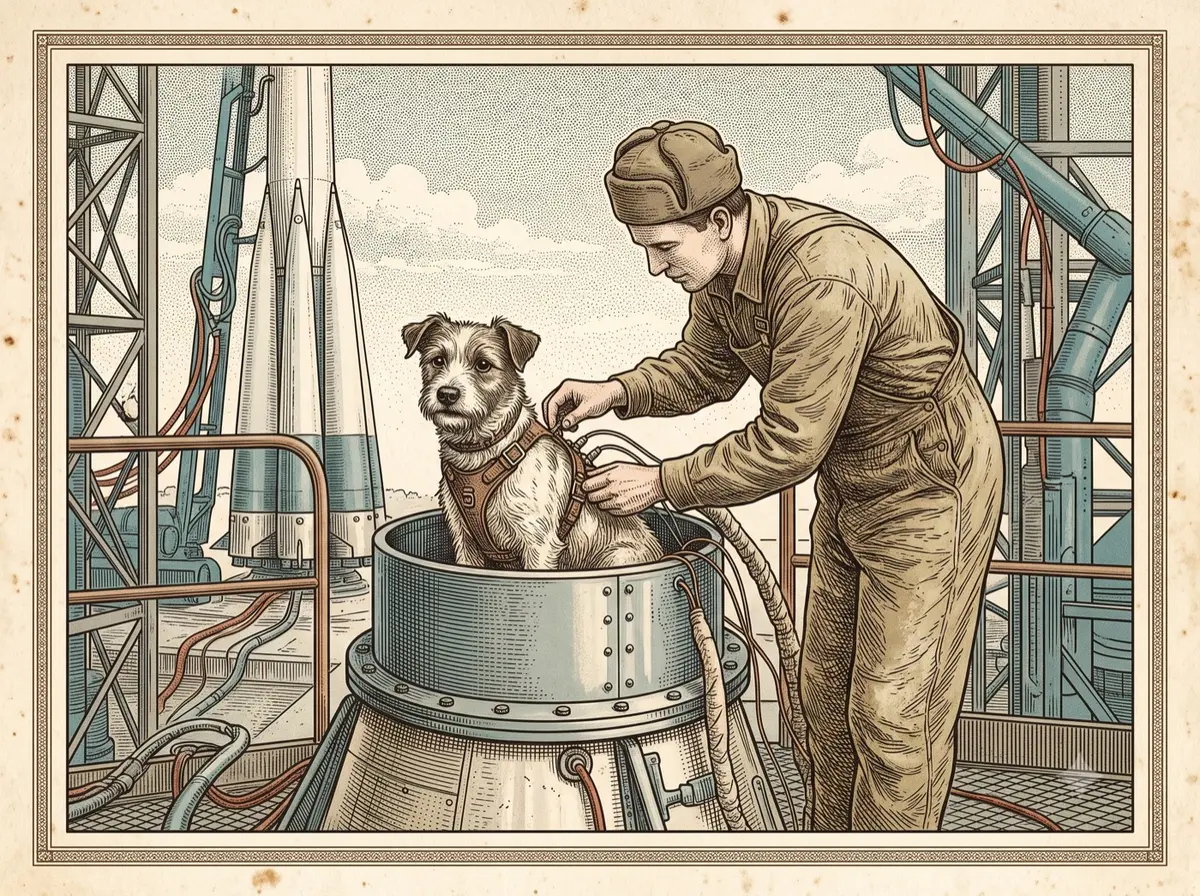
She was sealed into the capsule on October 31, with a heater hose keeping her warm against the launch-site cold. Just before liftoff from the Baikonur Cosmodrome, technicians sponged her fur, painted iodine where the sensors attached, and, as one recalled, “we kissed her nose and wished her bon voyage, knowing that she would not survive the flight.” Sputnik 2 had no way to come back. Laika’s death was part of the plan from the start.
Why it was strange: Laika the Dog
The strangest part isn’t that a dog went to space. It’s the story the world was told afterward, and how long it held. The Soviet Union gave shifting accounts of Laika’s fate: that she had been painlessly euthanized with poisoned food before her oxygen ran low, or that she had lived for days in orbit. For decades, the gentle version traveled the globe largely unchallenged.
The reality was much shorter and much harsher. During the rushed build, the capsule’s thermal control never quite worked. After Sputnik 2 reached orbit, its nose cone separated as planned, but the rocket’s core stage failed to detach. That disrupted the cooling system, and some thermal insulation tore loose. The cabin temperature climbed to around 40°C (104°F). Telemetry showed Laika’s heart racing from about 103 beats per minute before launch to 240 during ascent, then taking three times longer than in ground tests to settle, a clear sign of stress. Within roughly five to seven hours, the signals carrying her vital signs went quiet.
The same thread — Animals in Space — continues in The Two Tortoises That Flew Around the Moon Before Any Human Did.
What scientists learned: Laika the Dog
For all its tragedy, the flight delivered exactly the data engineers needed: proof that a living body could survive launch and function in weightlessness. Laika’s telemetry showed her heartbeat stabilizing once the violent acceleration ended and gravity fell away, evidence that orbit itself was survivable. That single fact cleared a major unknown standing between machines and human spaceflight. Less than four years later, Yuri Gagarin became the first person to orbit the Earth.
The truth about Laika’s end stayed buried until 2002. At the World Space Congress in Houston, the Russian scientist Dimitri Malashenkov, who had worked on the mission, finally laid it out: she had died of overheating by the fourth orbit, only hours into the flight. “It turned out that it was practically impossible to create a reliable temperature control system in such limited time constraints,” he explained. The myth of her peaceful, days-long voyage had outlived her by 45 years.
Another animal the lab could not ignore: The 2,478 Baby Jellyfish NASA Sent to Space — and the Ones That Came Home Dizzy.
How it reaches us today: Laika the Dog
Laika’s flight forced a conversation that still shapes science. The mission, never designed to bring her home, sparked protests from animal-welfare groups in Britain, the United States, and beyond, and it became an early flashpoint in the debate over animal testing. The Soviet program changed course: later canine flights were built to be recovered, and in 1960 the dogs Belka and Strelka returned alive from orbit, paving the way for Gagarin.
Even some of the people closest to the mission came to regret it. In 1998, the scientist Oleg Gazenko reflected: “The more time passes, the more I’m sorry about it… We did not learn enough from this mission to justify the death of the dog.” In 2008, a monument to Laika, standing atop a rocket, was unveiled near the Moscow facility that prepared her flight. She remains a symbol of both the reach of human ambition and its cost.
Another creature that ended up in the notes: The Dung Beetles Scientists Fitted With Tiny Hats to Prove They Steer by the Milky Way.
Fun fact: Laika the Dog
Sputnik 2 didn’t fall silent and vanish quickly. With Laika’s body aboard, it kept circling the planet for more than five months, completing about 2,570 orbits before burning up on re-entry on April 14, 1958.
Sources: Laika the Dog
- Laika — Wikipedia (cross-referenced against its cited primary sources)
- Sputnik 2 — NASA National Space Science Data Center
- First dog in space died within hours — BBC News (2002)
- Anatoly Zak, “The True Story of Laika the Dog” — Space.com
- D. C. Malashenkov, “Some Unknown Pages of the Living Organisms’ First Orbital Flight,” IAF Abstracts, World Space Congress (2002)
A note on the story: Laika’s flight is, fundamentally, the story of an animal who didn’t survive an experiment. It’s told here with care for that reality, and the science she made possible is shared in honor of what was asked of her.
Related stories: Laika the Dog
- The Two Tortoises That Flew Around the Moon Before Any Human Did — Two tortoises rounded the Moon before any human did
- The Teenager Who Sent Two Spiders to Spin Webs in Space — A student’s experiment sent two spiders to spin webs in orbit
- Acoustic Kitty: The CIA Wired a Live Cat for Sound to Spy on the Soviets — The CIA surgically wired a live cat to eavesdrop on the Soviets