Acoustic Kitty: The CIA Wired a Live Cat for Sound to Spy on the Soviets
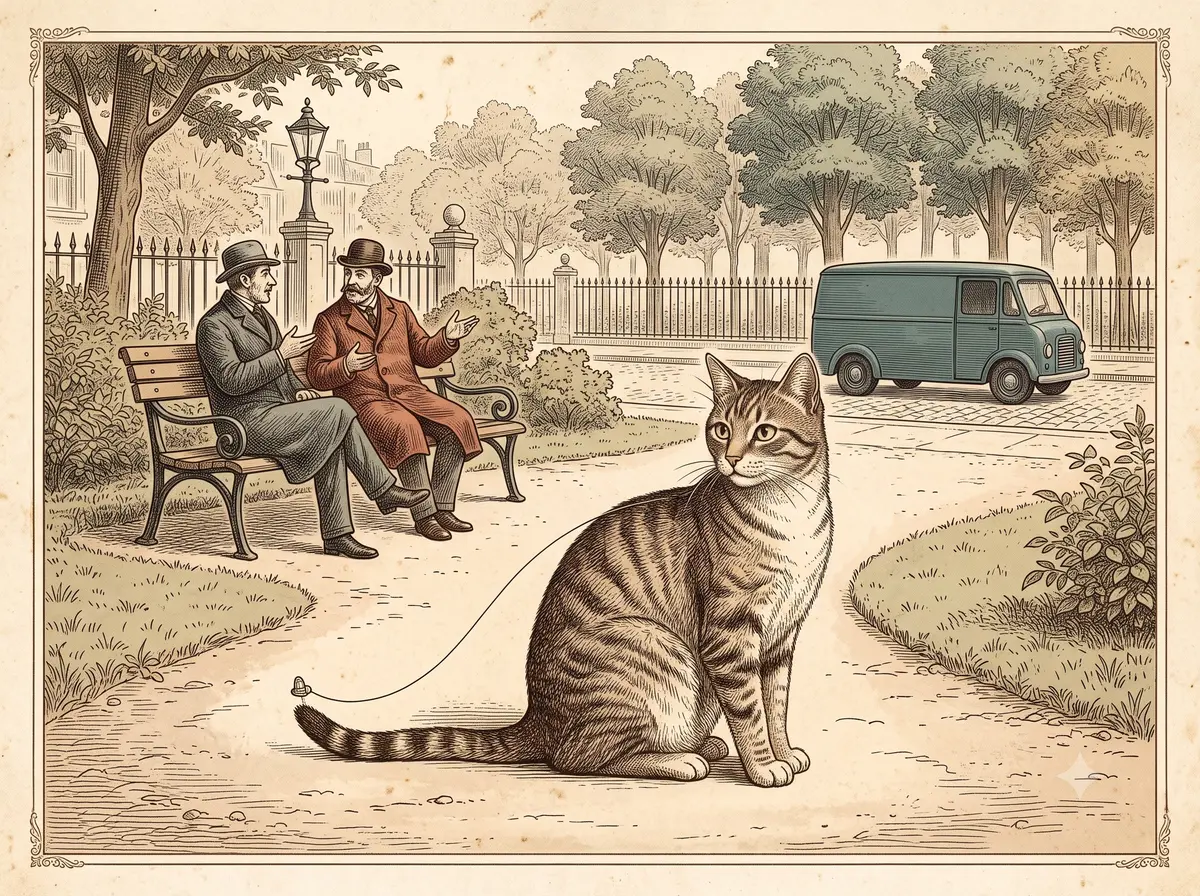
Somewhere in a 1960s CIA laboratory, a surgeon spent an hour turning an ordinary house cat into a piece of listening equipment: a microphone tucked in its ear canal, a tiny radio transmitter nestled at the base of its skull, and a hair-thin antenna woven through its fur all the way to the tail. The plan was to let the cat wander past a park bench where two men were talking, and simply listen. The plan did not survive contact with the cat.
By the Curiosities Desk · · 5 min read · Filed under Biology · Today’s round
Part of Creatures That Changed Science
What happened: Acoustic Kitty
In the 1960s, the CIA’s Directorate of Science and Technology — the in-house engineers nicknamed the “Wizards of Langley” — went looking for a bug that could walk into places a human agent could not. Microphones planted in walls could be swept for; a person loitering near a target would be noticed. But a cat? Cats go where they please, and nobody looks twice.
The project became known as Acoustic Kitty. According to accounts from inside the agency, the technical challenge was enormous for the era of reel-to-reel tape and room-sized computers. Working with outside audio contractors, technicians built a transmitter about three-quarters of an inch long to sit at the base of the skull. The microphone problem was solved by an almost obvious piece of anatomy: the ear canal. The antenna was made of fine wire threaded through the cat’s long fur down to the tail, so nothing showed. The batteries were a headache too — only the smallest ones would fit, which sharply limited how long the cat could record.
The work reportedly took about five years. And it uncovered a flaw no amount of engineering could fix: the cat behaved like a cat. Outside the lab, it wandered off when it got bored, distracted, or hungry. One retelling holds that the hunger problem prompted yet another surgery to try to override the animal’s appetite. By the time it was ready, the effort had, by one estimate, run to roughly $20 million.
Then the project ended. Exactly how is where the story splits in two, and it’s worth being careful about which parts are documented and which are legend.
The famous version comes from Victor Marchetti, once a special assistant to the Director of Central Intelligence. In his telling, the finished cat was taken to a park for a field test, released from a surveillance van aimed at two men on a bench — and almost immediately run over by a taxi. “There they were, sitting in the van with all those dials, and the cat was dead,” he said. It’s a perfect, grim punchline, and it has been repeated for decades.
But a competing account exists. Robert Wallace, a former director of the CIA’s Office of Technical Service, wrote in the book Spycraft (co-authored with Keith Melton) that the project was simply abandoned because the cat couldn’t be reliably trained — and that the equipment was removed, the animal was stitched back up, and it “lived a long and happy life.” In Wallace’s version the intended target wasn’t the Kremlin at all, but an Asian head of state. Whether the cat died under a taxi or retired to a quiet life is, honestly, not settled. Treat the taxi ending as the story’s enduring legend rather than a confirmed fact.
What is confirmed sits in a heavily redacted March 1967 memo titled “Views on Trained Cats [Redacted] for [Redacted] Use,” released decades later and held at the National Security Archive. It records the program’s quiet cancellation, concluding that using trained cats this way “would not lend itself in a practical way to our highly specialized needs.”
Why it was strange: Acoustic Kitty
The strangeness isn’t that the CIA bugged a cat. It’s that some of the finest engineers in the country solved every hard problem — miniaturizing a transmitter, hiding an antenna in fur, fitting a microphone into an ear — and were defeated by the one variable they couldn’t design around: a cat’s opinion of the assignment. The machine worked. The animal quit.
That same 1967 memo is a small masterpiece of institutional face-saving. Even as it shut the program down, it praised the team for proving that “cats can indeed be trained to move short distances,” which it called “an important cornerstone” and, in itself, “a remarkable scientific achievement.” Millions of dollars, five years, and the triumphant finding was: the cat can be nudged to walk a little way, sometimes.
It shares a shelf with Nikola Tesla and the Pigeon He Loved, in Creatures That Changed Science.
What scientists learned: Acoustic Kitty
The real lesson was about the limits of behavioral control, not electronics. A pigeon or a raven can be trained with food rewards to perform fairly reliable tasks; cats are famously indifferent to that kind of conditioning. Hunger, boredom, and curiosity — the very independence that made a cat seem like the perfect unnoticed spy — also made it impossible to steer toward a target on command. You can hide a radio in an animal, but you cannot install a sense of duty.
It’s also a case study in the sunk-cost trap that haunts research programs. Each new obstacle got its own expensive fix — a smaller battery here, an extra surgery there — until the total bill dwarfed any plausible payoff, and the project had to be talked into a dignified retirement rather than admitted as a straightforward miss.
The same thread — Cats — continues in The 23 Cats the RAF Parachuted Into Borneo to Fight a Rat Plague.
How it reaches us today: Acoustic Kitty
Acoustic Kitty has become shorthand for over-engineered intelligence schemes, wheeled out whenever a spy agency’s ambition outruns its common sense. But the underlying idea — a living creature carrying miniature sensors into places machines can’t reach — never really died. Modern researchers fit birds, sharks, and insects with tiny GPS trackers and biologgers to study migration and behavior, and defense agencies have openly funded work on insect-scale “cyborg” sensors. What the 1960s couldn’t manage with a house cat and vacuum-tube-era electronics is now, in gentler forms, ordinary wildlife science. The cat was ahead of its time; it just refused to cooperate with it.
Also in Creatures That Changed Science: The Baby-Blue Blood of the Horseshoe Crab That Keeps Every Vaccine Safe.
Fun fact: Acoustic Kitty
The declassified memo that ended the program is so redacted that we still don’t officially know from the document alone who the cat was supposed to spy on — the target’s identity is blacked out. The CIA was willing to admit it had wired a cat for sound before it was willing to say whom the cat was meant to overhear.
Sources: Acoustic Kitty
- CIA memo, “Views on Trained Cats [Redacted] for [Redacted] Use” (March 1967), National Security Archive / George Washington University — the primary declassified document.
- “Document Friday: Acoustic Kitty,” UNREDACTED: The National Security Archive Blog — analysis of the memo, plus the Victor Marchetti quotation.
- Kat Eschner, “The CIA Experimented On Animals in the 1960s Too. Just Ask ‘Acoustic Kitty,’” Smithsonian Magazine (2017) — technical details and cost estimates.
- Acoustic Kitty, Wikipedia — overview and the competing Marchetti/Wallace accounts of the cat’s fate; useful as a starting point for the cited sources.
Related stories: Acoustic Kitty
- Part of Creatures That Changed Science
- The Bomb Three Pigeons Were Trained to Steer — B. F. Skinner trained pigeons to fly missiles to their targets
- The 23 Cats the RAF Parachuted Into Borneo to Fight a Rat Plague — The RAF airdropped cats into Borneo after a pesticide backfired
- The Cat Who Co-Authored a Physics Paper Because His Owner Used the Word ‘We’ — A physicist listed his cat as co-author to fix a pronoun