Strange Animals Scientists Studied · Biology
The Wombat That Proved You Can Fit a Square Peg Through a Round Hole
On November 18, 2018, at the annual meeting of the American Physical Society's Division of Fluid Dynamics in Atlanta, an engineer named Patricia Yang stood before a room of physicists to present a talk titled, in full, "How do wombats make cubed poo?" Her slides included measurements from a wombat intestine that her team had emptied, threaded with a long balloon, and inflated, just to see which parts of the gut stretched. The answer would win a physics prize, solve a puzzle that had baffled Australian bushwalkers for generations, and prove, in the words of one of her co-authors, that "you really can fit a square peg through a round hole."
By the Curiosities Desk · · 5 min read · Filed under Biology · Today’s round
What happened?
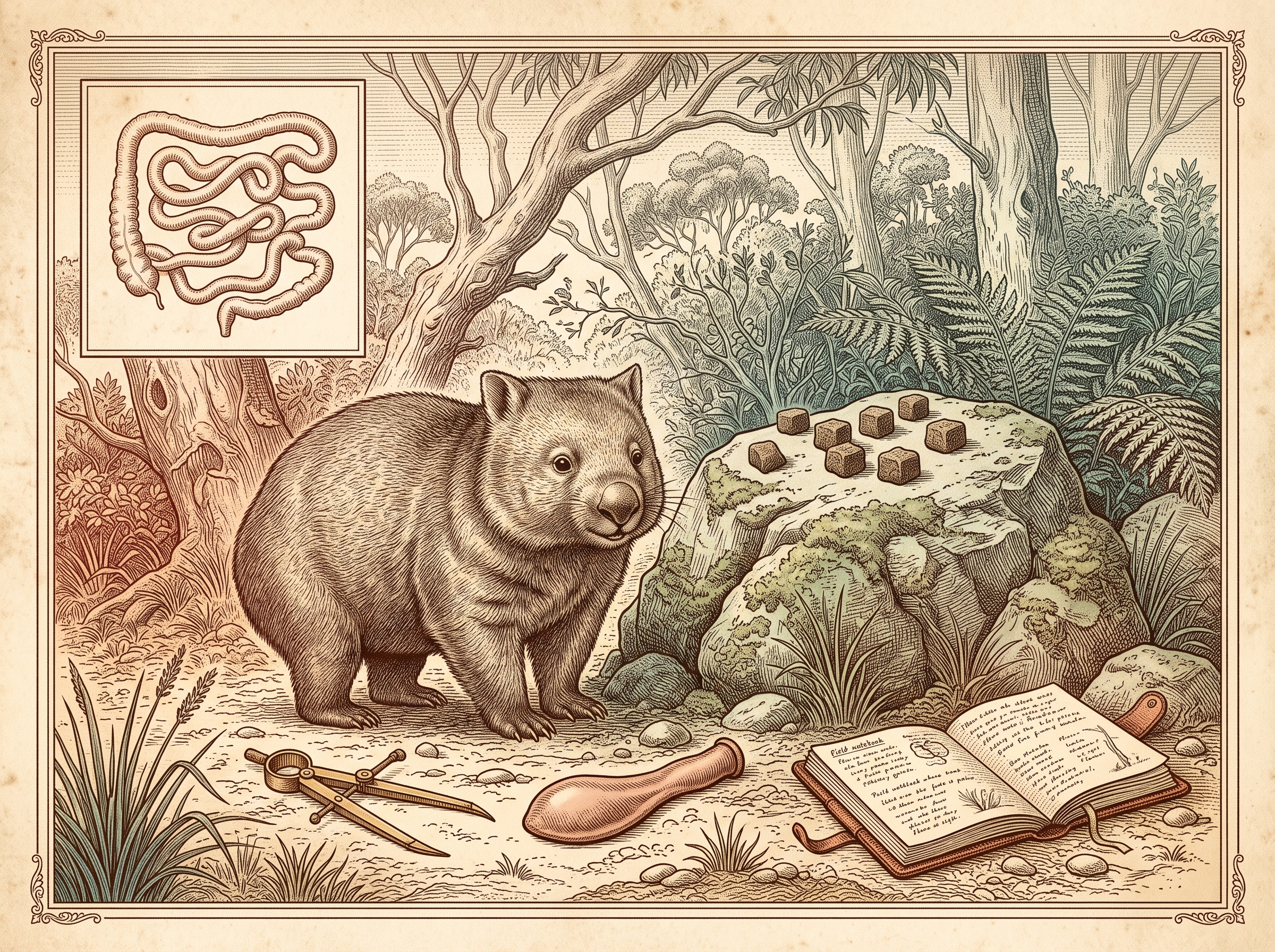
The bare-nosed wombat (Vombatus ursinus) is a stocky, burrowing marsupial from south-eastern Australia, roughly the size of a medium dog. It is famous in its home country for one thing above almost all others: its droppings are cubes. Not roughly blocky lumps, but flat-sided pellets about 2 centimeters (under an inch) across, with surprisingly clean corners. By one estimate quoted by the researchers, a single wombat can produce 80 to 100 of them in a night, and it tends to leave them on conspicuous spots, such as the top of a rock or a log.
For a long time, nobody knew how. Popular theories filled the gap. Scott Carver, a wildlife ecologist at the University of Tasmania, later listed some he had heard: that the wombat’s pelvic bones squeezed the droppings into shape, that the animal had a square anus, and his personal favorite, that wombats patted each dropping into a cube after the fact.
Carver wasn’t studying poop at all. His research focused on sarcoptic mange, a mite-borne skin disease that devastates wombat populations. That work meant dissecting wombats, and the ones that reached his lab had been euthanized by veterinarians after being struck by cars. When he opened the digestive tract of one, he found something nobody seemed to have documented: the cubes were already cubes well inside the body. Their shape began, he said, about a meter up from the exit.
Carver brought the puzzle to David Hu, a mechanical engineer at the Georgia Institute of Technology who studies the physics of animals, and to Hu’s postdoctoral researcher Patricia Yang. Hu and Yang had form here. In 2015 they had already won an Ig Nobel Prize, a parody award from the magazine Annals of Improbable Research for work that “makes people laugh, then think,” for showing that nearly all mammals empty their bladders in about 21 seconds.
The team worked with the intestinal tracts of two wombats. The guts were long, around 9 to 10 meters (about 30 feet), several times the animal’s body length. Food takes much longer to pass through a wombat than through a person, and the wombat squeezes out so much water along the way that its droppings are roughly a third drier than ours. Following the contents down the tube, the researchers saw them change from a soupy slurry into a solid near the end and then separate into distinct cubes.
To find out why, they emptied a section of intestine, slipped in a long balloon, and inflated it. The intestinal wall did not stretch evenly. In some places it stretched about 20 percent; in others, about 75 percent. Yang presented those first results in Atlanta in November 2018.
In September 2019, the team (Yang, Alexander Lee, Miles Chan, Alynn Martin, Ashley Edwards, Carver, and Hu) received the Ig Nobel Prize in Physics “for studying how, and why, wombats make cube-shaped poo.” Carver accepted it at Harvard and called it “a comical and tremendous honour.” The full study, examining the gut wall’s tissue under a microscope and testing its stiffness, appeared in the journal Soft Matter in early 2021.
Why was it strange?
Nature is full of round things and sharp things, but natural objects with flat faces and right-angle corners are rare. Humans make cubes with hard tools: molds, dies, saws, extruders. The wombat does it with a soft, round, flexible tube and no hard edges anywhere, then passes the result through a round opening without losing the shape.
And the mystery sat in plain sight on rocks across Australia, waiting for someone curious enough to look inside.
Another creature that ended up in the notes: The Water Bears That Survived Naked in Open Space.
What did scientists learn?
The Soft Matter paper found that the cubes take shape in roughly the last 17 percent of the intestine (the first conference abstract had put it at the final 8 percent). In that stretch, the wall is not uniform. Around its circumference are regions that are about twice as thick and about four times stiffer than their neighbors.
Intestines move food along by peristalsis, waves of muscle contraction that squeeze the contents forward. In the wombat’s final stretch, the stiff regions contract faster, while the softer regions in between move more slowly. As the drying, compacting material is pushed along, the uneven squeezing presses flat faces into it and pinches corners at the boundaries between stiff and soft zones. The team built a mathematical model of this process that reproduced cube-like shapes, showing that corners can form without anything sharp.
Why wombats evolved this is less certain. A popular idea is that cubes stay put on a rock instead of rolling away, which would suit an animal that uses droppings to communicate with other wombats. That is plausible, but it is a hypothesis, not a proven explanation. Carver himself said there is “still much to be learned” about why cubes evolved in the first place.
The same thread — Ig Nobel Prize — continues in The Dung Beetles Scientists Fitted With Tiny Hats to Prove They Steer by the Milky Way.
How does it affect us today?
The researchers pointed to two payoffs. The first is manufacturing, where shaping soft materials usually means molding or cutting them. The wombat suggests another route: a flexible tube with walls of varying stiffness that sculpts material as it moves. Hu’s team described it as a new mechanism for forming corners in soft matter, with possible uses in shaping plastics or controlling soft robots.
The second is medicine. Stiffening of parts of the colon wall can be a feature of disease, and Yang noted that such changes might alter the shape of feces in ways that could someday serve as an early warning sign. For wombats themselves, Carver suggested that how well their droppings hold a cube shape could help keepers judge whether captive animals are properly hydrated, since cubes look less crisp in wetter conditions.
Another animal the lab could not ignore: The 8,510 Cows Scientists Counted on Google Earth to See If They Point North.
Fun fact
The wombat prize was the second Ig Nobel for Patricia Yang and David Hu. Their first, in 2015, was for the urination study, which means the same two engineers have been honored for explaining both how mammals pee and how wombats poop.
Sources
- Patricia J. Yang et al., “Intestines of non-uniform stiffness mold the corners of wombat feces,” Soft Matter, 2021 (DOI: 10.1039/D0SM01230K).
- Patricia J. Yang, Miles Chan, Scott Carver, and David L. Hu, “How do wombats make cubed poo?” abstract, 71st Annual Meeting of the APS Division of Fluid Dynamics, November 18, 2018.
- University of Tasmania / Phys.org, “Researchers discover how wombats excrete poop cubes,” February 1, 2021.
- Phoebe Hosier, “Wombat cubic faeces mystery solved and recognised by Ig Nobel prize,” ABC News (Australia), September 14, 2019.
- Improbable Research, “Past Ig Winners” — 2019 Physics and 2015 Physics citations.