Strange Animals Scientists Studied · Biology
The Rats That Learned to Drive Tiny Cars — and Revved the Engine Before the Ride
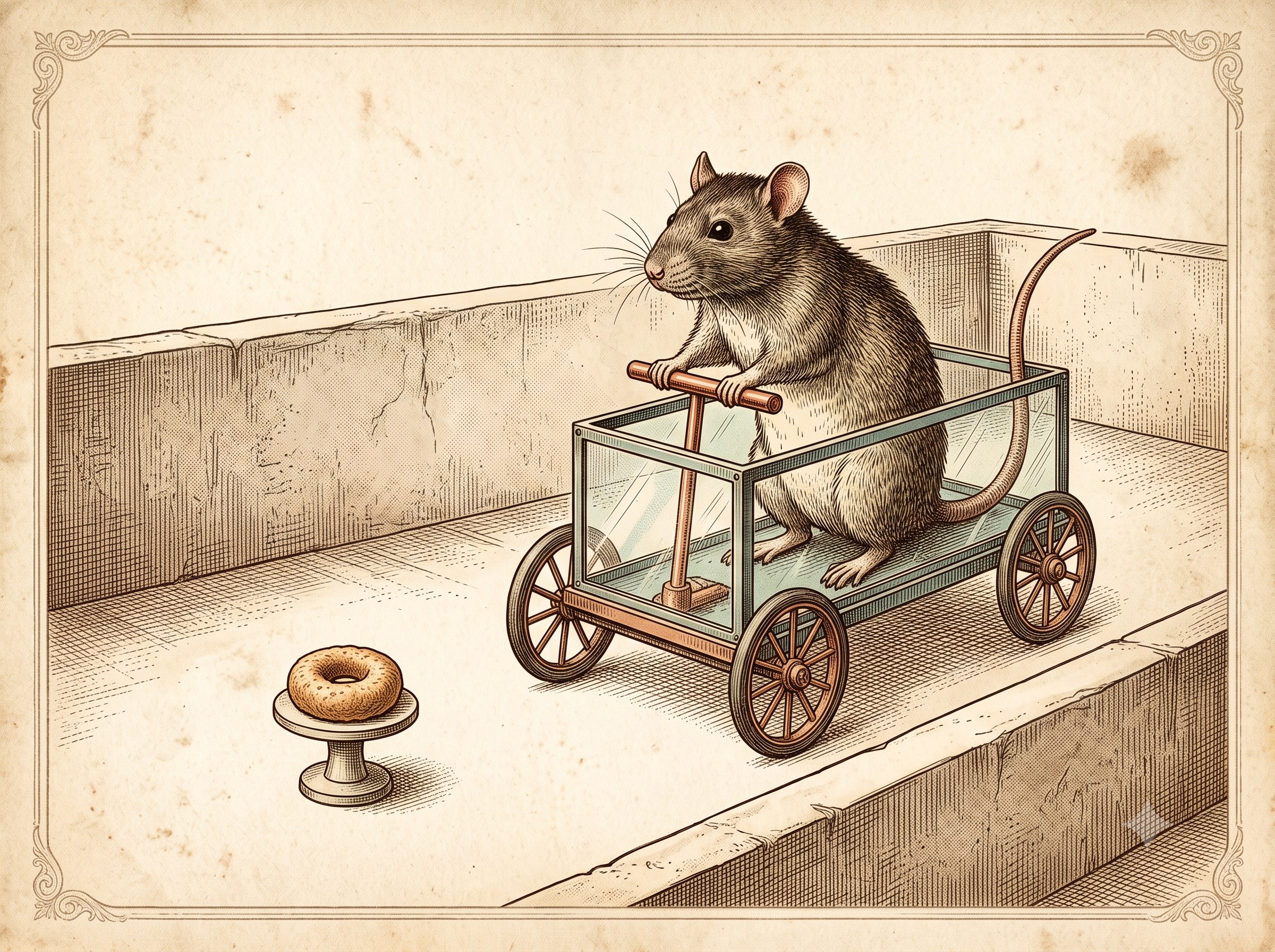
A rat climbs into a car built from a clear plastic cereal container, plants its front paws on a copper bar, and drives across a rectangular arena toward a Froot Loop. It is not being carried. It is not being nudged. Somewhere in a psychology lab in Virginia, a rodent is steering.
By the Curiosities Desk · · 5 read · Filed under Biology · Today’s round
What happened?
In 2019, a team at the University of Richmond published a paper in Behavioural Brain Research with a title that reads like a prank and isn’t: “Enriched environment exposure accelerates rodent driving skills.”
The vehicle came first. Kelly Lambert, a professor of behavioral neuroscience, and her colleagues built what they called a rodent operated vehicle, or ROV, out of a clear plastic food container mounted on wheels. The floor was aluminum. Across the front were three copper bars. When a rat stood on the aluminum floor and touched a copper bar, it closed an electrical circuit and the motor ran — left bar, center bar, and right bar sending the car in different directions. The rat was, functionally, both the ignition and the steering wheel.
Seventeen male Long-Evans rats went through what the lab cheerfully called driver’s education. They were trained in stages, using operant conditioning — the standard technique of rewarding a behavior in small approximations until the full behavior appears. First, climb into the car. Then press a bar. Then hold it long enough to move. Then aim. The reward at the end of a successful trip was a Froot Loop.
The rats learned. Not perfectly, and not all of them — but well enough that Lambert reported they “engaged in steering patterns they had never used” to reach the treat.
The finding the paper was actually built around was a comparison. Half the rats lived in enriched housing: a larger space with objects to climb on, things to manipulate, and companions. The others lived in standard laboratory cages. The enriched-housed rats learned to drive noticeably better, and kept trying the car even during extinction trials — the phase where the Froot Loop stops coming and researchers watch to see who gives up. The standard-cage rats, in the team’s blunt phrasing, largely failed their driving test.
The researchers also tracked hormones, using fecal samples so they didn’t have to stress the animals to measure their stress. They looked at the ratio between corticosterone, a rodent stress hormone, and DHEA, a hormone that buffers against it. Across the board — enriched and standard housing alike — that DHEA-to-corticosterone ratio climbed as training went on. Learning to drive appeared to leave the rats in better hormonal shape than it found them.
Then the project got stranger. The rats began jumping into the car and pressing the lever before the car was even placed on the track, as though revving an engine in a driveway. One morning in the summer of 2020, Lambert walked into the lab and found her three driving-trained rats rushing to the side of the cage to meet her — behavior she compared to a dog that has heard the word “walk.”
Why was it strange?
Rats are among the most studied animals on Earth. They press bars, run mazes, recognize objects. None of that is surprising anymore.
Driving is different in kind. It stacks several demands at once: hold a grip, keep holding it, correct your heading while the world moves past you, and stay pointed at a goal you can see but not yet reach. That is a longer, more integrated chain of behavior than a lab rat is usually asked for, and it isn’t remotely close to anything a rat’s ancestors did in a burrow.
The stranger result was the enrichment gap. Same species, same task, same treats — and the deciding variable was what the animals’ bedroom looked like. A cage with toys and company didn’t just make happier rats. It made rats that could learn a harder skill.
Another animal the lab could not ignore: The Water Bears That Survived Naked in Open Space.
What did scientists learn?
The headline lesson is about neuroplasticity — the brain’s capacity to reorganize itself in response to what the environment demands. The rats raised in a complex world arrived at the task with more capacity to take it on.
The hormone data points somewhere subtler. In an earlier comparison presented at a conference — worth flagging as a conference report rather than a peer-reviewed result — Lambert’s team drove some rats around by remote control over the same distances the trained rats drove themselves. They called these the “Uber rats.” The rats that did their own driving showed the healthier hormone shift. Same ride, same destination, same snack; the difference was who held the wheel. Lambert’s reading is that control over your own environment is itself a physiological event, something like the rodent version of what psychologists call self-efficacy.
The lab has since pivoted from studying stress to studying anticipation, running a program they named “Wait For It,” in which rats are made to wait before rewards arrive. Early results suggest the waiting rats become bolder problem-solvers. These are preliminary findings and haven’t yet cleared peer review, so treat them as a promising direction rather than a settled fact — and note that no one can ask a rat whether it is enjoying itself. What researchers can measure is behavior and chemistry, not feelings.
Another creature that ended up in the notes: The Wombat That Proved You Can Fit a Square Peg Through a Round Hole.
How does it affect us today?
The practical payoff is in how laboratory animals are housed. If a barren cage measurably limits what an animal can learn, then housing conditions aren’t a footnote in a study’s methods section — they’re a variable that can quietly shape the result. That matters for every rodent experiment used to model human disease.
The mental-health angle is the one Lambert emphasizes. Depression and anxiety are both worsened by chronic stress, and if mastering a difficult skill reliably shifts stress chemistry in a healthier direction, that’s an inexpensive intervention worth understanding. Lambert coined the word “behaviorceuticals” for the idea: experiences that alter brain chemistry the way drugs do.
The team also published free build instructions for the rat car online, so any lab that wants to replicate it can — which is exactly what should happen to a result this odd.
A close cousin: The 8,510 Cows Scientists Counted on Google Earth to See If They Point North.
Fun fact
When the team gave trained rats a choice between walking straight to the Froot Loop or turning away from it to go get the car, two of the three rats went and got the car. It’s a very small sample and shouldn’t be oversold — but on that day, at least, the rats appeared to prefer the drive to the shortcut.
This story touches on stress and mental health research. If any of it lands close to home, talking with a doctor or a mental health professional is a good place to start.
Sources
- Crawford, L. E., Knouse, L. E., Kent, M., et al. (2020). “Enriched environment exposure accelerates rodent driving skills.” Behavioural Brain Research, 378, 112309. (The primary peer-reviewed paper; PMID 31629004.)
- University of Richmond Newsroom (October 25, 2019). “Research Scientists at University of Richmond Teach Rats to Drive.”
- Lambert, K. (November 2024). “I’m a neuroscientist who taught rats to drive — their joy suggests how anticipating fun can enrich human life.” The Conversation. (First-person account by the lead researcher.)
- Lambert Behavioral Neuroscience Laboratory, University of Richmond. Lab site and publications.
- “Rat Operated Vehicle” — the team’s published build instructions for the ROV.