Strange Animals Scientists Studied · Biology
The Water Bears That Survived Naked in Open Space
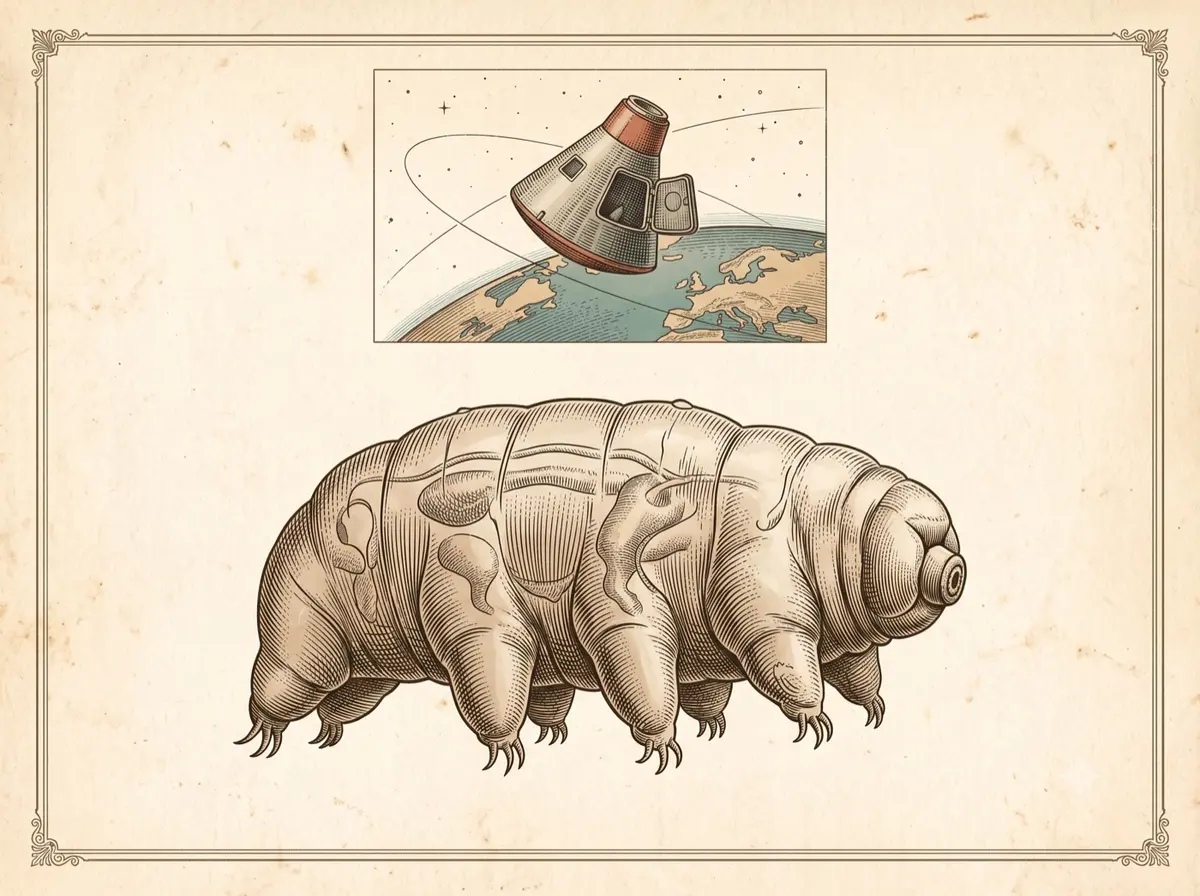
In September 2007, a small capsule was circling Earth at the edge of the atmosphere when a hatch slid open and exposed a tray of tiny animals to the raw vacuum of space — no air, no pressure, and the full, unfiltered glare of the sun. Ten days later the capsule came home, the animals were rehydrated with a drop of water, and many of them simply stretched, started walking, and got on with their lives. They had become the first animals known to survive open space.
By the Curiosities Desk · · 5 min read · Filed under Biology · Today’s round
Part of Creatures That Changed Science
What happened: The Water Bears That Survived Naked in Open Space
The animals were tardigrades — eight-legged micro-creatures less than a millimeter long, better known by their nicknames “water bears” and “moss piglets” for their lumbering, bear-like crawl. They live almost everywhere there is a film of water: in moss, lichen, soil, deep-sea sediment, and mountaintop streams.
The flight was the European Space Agency’s FOTON-M3 mission, and the experiment riding aboard was nicknamed TARDIS — Tardigrades in Space — led by Ingemar Jönsson of Kristianstad University in Sweden. His team dried out two species, Richtersius coronifer and Milnesium tardigradum, until the animals shriveled into a dormant, barrel-shaped state, then mounted them in low Earth orbit and opened them to the void for about ten days.
The results, published in the journal Current Biology in 2008, were startling. Tardigrades exposed to the vacuum of space alone came back in good shape, with most surviving and reproducing normally afterward. Vacuum, it turned out, barely bothered them. The real enemy was the sun: animals hit with the full force of unfiltered solar ultraviolet radiation died in far greater numbers. But even there, a handful of Milnesium tardigradum survived both the vacuum and the most intense UV — and went on to lay eggs that hatched into healthy young. Life, it seemed, could take a ten-day walk in space and come back to make more life.
Why it was strange: The Water Bears That Survived Naked in Open Space
Every textbook rule of biology says this should be impossible. Animals need water to run the chemistry of life. They need atmospheric pressure to keep their tissues from boiling and rupturing in a vacuum. And they need protection from ultraviolet and cosmic radiation, which shreds DNA. Strip all three away at once and you have a near-perfect recipe for killing anything.
Tardigrades ignore the recipe. They don’t merely tolerate space the way a hardy plant tolerates a cold night; they switch their biology almost entirely off and then switch it back on. The water bears that came home weren’t survivors clinging to life by a thread — some were healthy enough to reproduce. The leap from “fascinating microscopic animal” to “creature that can be flung into the cosmos and rehydrated like a sponge” is the kind of thing that makes biologists rewrite the boundaries of what counts as survivable.
Another animal the lab could not ignore: The Platypus Pelt a Museum Keeper Cut Open With Scissors, Hunting for the Stitches.
What scientists learned: The Water Bears That Survived Naked in Open Space
The secret is a trick called cryptobiosis — literally “hidden life.” When their environment dries out, tardigrades expel most of the water from their bodies and curl into a compact, dehydrated ball called a tun. In this state their metabolism drops so low it can barely be measured; by some estimates it runs at a tiny fraction of a percent of normal. A tun is not quite alive and not quite dead. It is life on pause.
To pull this off without their cells collapsing, tardigrades replace lost water with protective molecules. They make sugars and a set of tardigrade-specific proteins that, as the animal dries, turn the inside of each cell into a glass-like solid, locking delicate structures in place so they don’t tear. In 2016, researchers at the University of Tokyo led by Takekazu Kunieda found another piece of the puzzle: a protein they named Dsup, short for “Damage suppressor,” that physically shields the animal’s DNA from radiation. When they inserted the Dsup gene into human cells in the lab, those cells suffered markedly less X-ray damage — a hint that the tardigrade’s armor might one day be borrowed.
Crucially, none of this means tardigrades are visitors from space. Their toughness evolved to survive something much more mundane and much more common here on Earth: ponds and patches of moss that dry up and then, days or years later, get wet again.
Another creature that ended up in the notes: The Rats That Learned to Drive Tiny Cars — and Revved the Engine Before the Ride.
How it reaches us today: The Water Bears That Survived Naked in Open Space
The space-survival experiments turned tardigrades into stars of astrobiology, the study of life’s limits and whether it could exist beyond Earth. If a complex animal can endure vacuum and radiation, it sharpens old questions about whether hardy organisms could ride debris between worlds, and it gives space agencies a concrete reason to worry about contaminating other planets with stowaway Earth life.
The payoff may be closer to home, too. Understanding how tardigrade proteins vitrify cells is feeding research into “dry” preservation — the dream of storing vaccines, blood, and living cells at room temperature without refrigeration, simply by drying them out and rehydrating them later. And Dsup’s ability to guard DNA has obvious appeal for protecting astronauts on long missions and for shielding healthy tissue during cancer radiotherapy. We are, in a real sense, studying a moss-dwelling micro-animal for clues on how to keep humans alive in places humans were never built to go.
A close cousin: The Wombat That Proved You Can Fit a Square Peg Through a Round Hole.
Fun fact: The Water Bears That Survived Naked in Open Space
In 2019, an Israeli spacecraft called Beresheet crash-landed on the Moon carrying a cargo of dehydrated tardigrades, tucked inside an archive of human knowledge. That means there are very likely tardigrade tuns scattered across the lunar surface right now. Whether any could ever be revived is doubtful — the Moon has no liquid water for them to drink — but it does mean Earth has, accidentally, seeded the Moon with one of its toughest animals.
Sources: The Water Bears That Survived Naked in Open Space
- K. Ingemar Jönsson et al., “Tardigrades survive exposure to space in low Earth orbit,” Current Biology, vol. 18, no. 17 (2008) — https://www.cell.com/current-biology/fulltext/S0960-9822(08)00805-1
- European Space Agency, “Tiny animals survive exposure to space” (FOTON-M3 / TARDIS mission report), 2008 — https://www.esa.int/Science_Exploration/Space_Science/Tiny_animals_survive_exposure_to_space
- Takuma Hashimoto, Takekazu Kunieda et al., “Extremotolerant tardigrade genome and improved radiotolerance of human cultured cells by tardigrade-unique protein,” Nature Communications, vol. 7 (2016) — https://www.nature.com/articles/ncomms12808
- “Tardigrade,” Encyclopædia Britannica — https://www.britannica.com/animal/tardigrade
- “Tardigrade,” Wikipedia — https://en.wikipedia.org/wiki/Tardigrade
Related stories: The Water Bears That Survived Naked in Open Space
- The Jellyfish That Can Reverse Its Own Aging — A jellyfish that can rewind itself back to childhood
- The Naked Mole-Rat: The Cold-Blooded Mammal That Lives Like an Ant and Won’t Age on Schedule — A wrinkled rodent that resists cancer and ignores aging
- The Teenager Who Sent Two Spiders to Spin Webs in Space — A student’s experiment sent two spiders to spin webs in orbit