Strange Animals Scientists Studied · Biology
The Naked Mole-Rat: The Cold-Blooded Mammal That Lives Like an Ant and Won't Age on Schedule
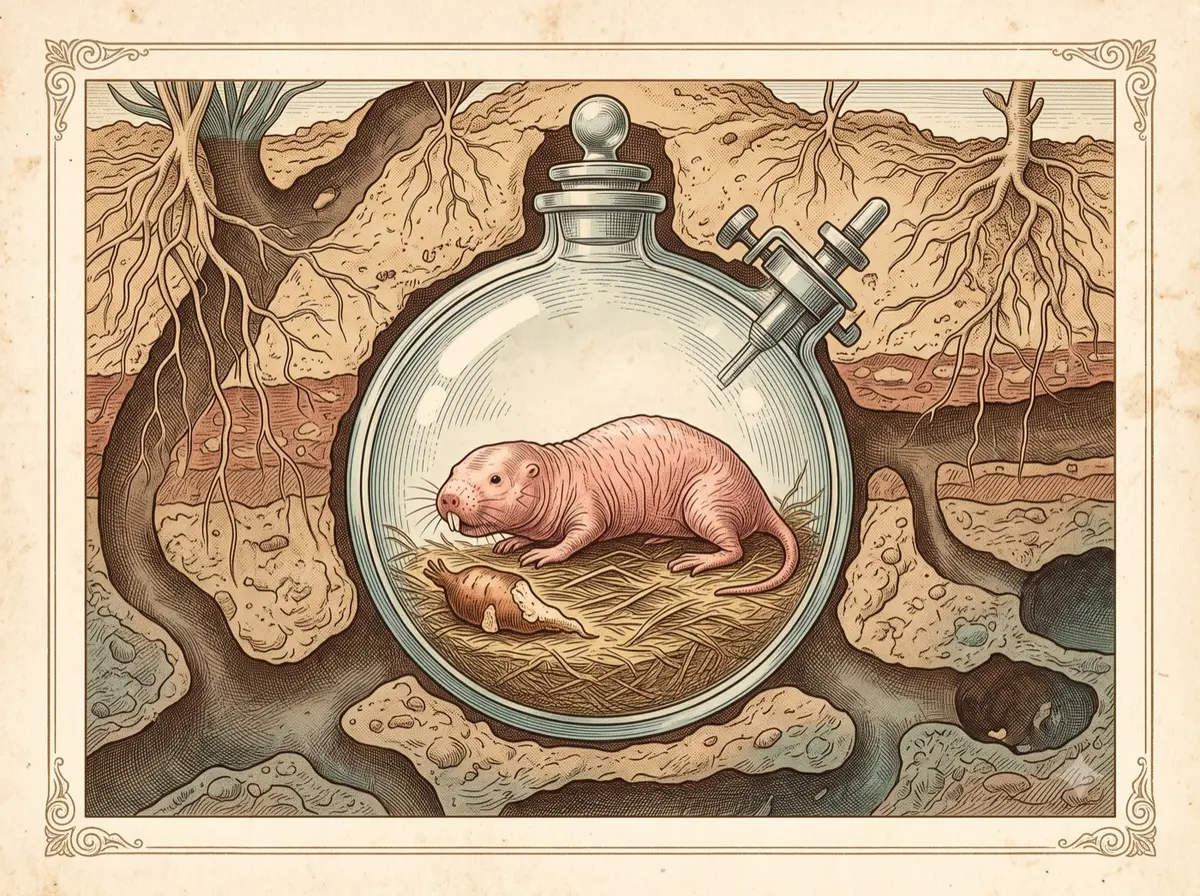
Seal one in a chamber with no oxygen at all, and a naked mole-rat does something no other mammal can: it simply waits. Its heart slows from about 200 beats a minute to 50, its breathing stops, it loses consciousness — and after eighteen minutes of air a human couldn't survive, it wakes up and goes back to nibbling a tuber as if nothing happened.
By the Curiosities Desk · · 6 min read · Filed under Biology · Today’s round
Part of Creatures That Changed Science
What happened: The Naked Mole-Rat: The Cold-Blooded Mammal That Lives Like an Ant and
The naked mole-rat (Heterocephalus glaber) is a wrinkled, pink, nearly hairless rodent about the length of a thumb — roughly 8 to 10 centimeters long and weighing 30 to 35 grams. It lives in sprawling underground colonies in the dry grasslands of the Horn of Africa, mostly southern Ethiopia, Kenya, and Somalia, digging with buck teeth that sit outside its sealed lips so it never gets a mouthful of dirt.
For most of the twentieth century it was a zoological curiosity. Then, beginning with South African zoologist Jennifer Jarvis, scientists started actually studying colonies — and the curiosity turned into one of the most-studied animals in biology. In 1981, Jarvis published a paper in Science announcing something that sounded impossible: this rodent is eusocial. That means it organizes itself like an ant or termite colony. A single breeding female, the “queen,” does essentially all the reproducing, supported by one to three breeding males. Everyone else — dozens of brothers and sisters — works. Smaller members forage and tend pups; larger ones dig tunnels and fight off snakes. When the queen dies, females battle, sometimes lethally, for the throne, and the winner’s spine physically lengthens to make room for litters that can top two dozen pups.
The deeper scientists dug, the stranger the animal got. By 2011 an international team had sequenced its genome specifically to understand why it lives so long. In 2013, a University of Rochester lab published a cover story in Nature on its near-immunity to cancer. In 2017, a German-led team reported in Science the oxygen-free survival trick. The homely rodent had become a research celebrity.
Why it was strange: The Naked Mole-Rat: The Cold-Blooded Mammal That Lives Like an Ant and
Almost everything about the naked mole-rat violates the rules for being a mammal.
It is, for one, effectively cold-blooded. It’s the only known mammalian “thermoconformer” — instead of burning energy to hold a steady internal temperature, its body simply tracks the temperature of its burrow, the way a lizard’s does. It also feels no pain from acid or from capsaicin, the fiery compound in chili peppers, because its skin nerves lack a key signaling molecule. And it can switch its metabolism, when starved of oxygen, to run on fructose — the same fuel strategy plants use — a pathway never before seen powering a mammal.
But the strangest violation is about death itself. For nearly every animal, including us, the risk of dying climbs steadily with age — a pattern so reliable it was written down as a mathematical law in 1825. The naked mole-rat ignores it. A 2018 analysis of thousands of them found that a mole-rat’s chance of dying on any given day does not rise as it gets older. A 25-year-old is, statistically, no closer to death than a 2-year-old.
It shares a shelf with Nikola Tesla and the Pigeon He Loved, in Creatures That Changed Science.
What scientists learned: The Naked Mole-Rat: The Cold-Blooded Mammal That Lives Like an Ant and
The longevity is the headline. Naked mole-rats can live past 37 years — by far the longest of any rodent. The next-longest-lived, the African porcupine, tops out around 28. For an animal the size of a mouse (which lives about three years), that’s extraordinary.
Several mechanisms seem to stack up. Their cells make unusually error-free proteins, thanks to high-fidelity ribosomes, and they keep their DNA-repair systems running hard. They also resist oxidative damage and can throttle their metabolism down when conditions turn harsh — a strategy one researcher described as living “in pulses.”
The cancer resistance turned out to have an elegant cause. In 2013, Vera Gorbunova and Andrei Seluanov’s team found that mole-rat cells are packed with an unusually large form of hyaluronan — a gooey sugar molecule your own joints use as lubricant. Theirs is more than five times bigger than the human version, and it makes cells so sensitive to crowding that they stop dividing before a tumor can form. Tellingly, when scientists later inserted the gene for that super-sized molecule into mice, the mice got cancer less often and lived modestly longer.
A note on precision, since it’s the brand here: naked mole-rats are not literally immortal or cancer-proof. In 2016, two captive zoo animals were found with the first documented mole-rat tumors — though both had lived their whole lives in 21% oxygen, far richer than the 2–9% of their natural burrows, which may have mattered. The animals still die; they just don’t seem to age the way the rest of us do.
Also in Creatures That Changed Science: The Baby-Blue Blood of the Horseshoe Crab That Keeps Every Vaccine Safe.
How it reaches us today: The Naked Mole-Rat: The Cold-Blooded Mammal That Lives Like an Ant and
This is why the naked mole-rat sits at the center of modern aging research. It is, in effect, a mammal that has already solved problems biotech companies spend billions chasing: avoiding cancer, resisting the cellular damage of getting old, and surviving the kind of oxygen loss that, in a human, causes a stroke or heart attack within minutes.
Each trait points somewhere useful. The hyaluronan work hints at new cancer-prevention strategies. The fructose-powered, oxygen-free survival could inform treatments for heart attacks and strokes, where the damage comes from tissue starved of oxygen. And the painless skin has helped researchers map exactly which molecules carry inflammatory pain — knowledge that feeds the long search for better painkillers. A wrinkled rodent that looks, as one biologist put it, like a “saber-toothed sausage” may end up teaching us how to age more slowly.
Another from Creatures That Changed Science: The Teenager Who Sent Two Spiders to Spin Webs in Space.
Fun fact: The Naked Mole-Rat: The Cold-Blooded Mammal That Lives Like an Ant and
When a naked mole-rat finds a new tuber deep underground, it doesn’t keep the discovery to itself. It hurries back to the nest giving a special call, waving the food around, and leaves a scent trail so colony-mates can follow it to the source — a recruitment system strikingly similar to how ants and termites lead each other to food.
Sources: The Naked Mole-Rat: The Cold-Blooded Mammal That Lives Like an Ant and
- Park, T. J. et al. (2017). “Fructose-driven glycolysis supports anoxia resistance in the naked mole-rat.” Science, 356(6335): 307–311.
- Tian, X. et al. (2013). “High-molecular-mass hyaluronan mediates the cancer resistance of the naked mole rat.” Nature, 499: 346–349.
- Ruby, J. G., Smith, M., & Buffenstein, R. (2018). “Naked mole-rat mortality rates defy Gompertzian laws by not increasing with age.” eLife, 7: e31157.
- Jarvis, J. U. M. (1981). “Eusociality in a Mammal: Cooperative Breeding in Naked Mole-Rat Colonies.” Science, 212(4494): 571–573.
- Smithsonian’s National Zoo & Conservation Biology Institute. “Naked mole-rat.”
Related stories: The Naked Mole-Rat: The Cold-Blooded Mammal That Lives Like an Ant and
- Part of Creatures That Changed Science
- The Jellyfish That Can Reverse Its Own Aging — A jellyfish that can rewind itself back to childhood
- The Water Bears That Survived Naked in Open Space — Tardigrades survived unprotected exposure to open space
- The Mouse Utopia With Endless Food That Went Extinct Anyway — Mice given endless food built a utopia and went extinct anyway