Strange Animals Scientists Studied · Biology
The Jellyfish That Can Reverse Its Own Aging
Somewhere off the coast of Italy in the 1980s, biology students kept making the same "mistake." They'd watch a jellyfish reach adulthood, then seem to die — only to find a fresh colony of juveniles in the same dish. The students hadn't messed up the experiment. They had stumbled onto an animal that refuses to stay dead.
By the Curiosities Desk · · 4 min read · Filed under Biology · Today’s round
Part of Creatures That Changed Science
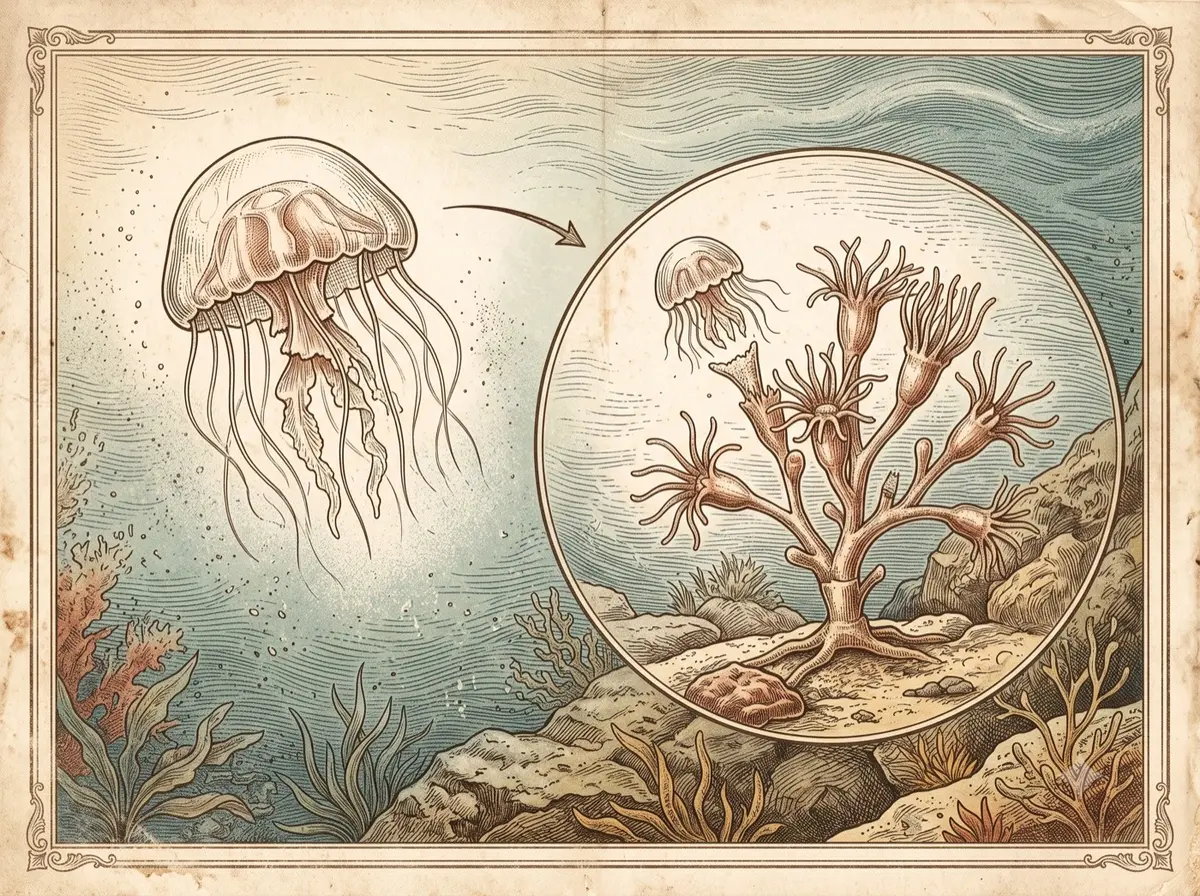
What happened: The Jellyfish That Can Reverse Its Own Aging
The creature is Turritopsis dohrnii, a jellyfish no bigger than a pinky fingernail — about 4.5 millimeters across — that lives in temperate and tropical seas worldwide. Like most jellyfish, it starts life as a larva, settles into a colony of polyps anchored to the seafloor, and then buds off into the free-swimming, sexually mature medusa form we recognize as a “jellyfish.”
Here’s where it breaks the rules. When a typical jellyfish reaches the end of its adult life, it dies. But when Turritopsis dohrnii is starved, injured, or otherwise stressed, it can do something almost no other animal can: it reverses course. The adult medusa transforms its cells and reverts all the way back to the polyp stage — effectively returning to childhood — and then grows up all over again. This earned it the nickname “the immortal jellyfish.” Researchers documented the full life-cycle reversal in a landmark 1996 study, and the species was formally distinguished from its look-alike relatives in 2006.
Why it was strange: The Jellyfish That Can Reverse Its Own Aging
Animals are supposed to develop in one direction. A tadpole becomes a frog; a frog does not become a tadpole. The cells in your body specialize early — a skin cell stays a skin cell — and that one-way street is what we usually mean by “growing up.” Turritopsis dohrnii drives the wrong way down that street through a process called transdifferentiation, in which already-specialized cells transform directly into entirely different cell types. It’s as if a butterfly could melt back into a caterpillar whenever life got hard.
“Biologically immortal” doesn’t mean invincible, though, and this is the part that often gets garbled. In the wild, the vast majority of these jellyfish still get eaten by predators or killed by disease long before they ever pull off the trick. Immortality here means no fixed expiration date — not an inability to die.
The same thread — Aging — continues in The Naked Mole-Rat: The Cold-Blooded Mammal That Lives Like an Ant and Won’t Age on Schedule.
What scientists learned: The Jellyfish That Can Reverse Its Own Aging
The jellyfish has become a serious target for aging and regenerative-medicine research. In 2022, scientists sequenced its genome and compared it to a non-rejuvenating relative, identifying genes linked to DNA repair, stem-cell renewal, and the maintenance of telomeres — the protective caps on chromosomes that normally shorten as we age. Studying how this animal resets its own cellular clock could eventually inform research into human tissue repair, though scientists are careful to note that human “immortality” is not on the menu.
Another animal the lab could not ignore: The 8,510 Cows Scientists Counted on Google Earth to See If They Point North.
How it reaches us today: The Jellyfish That Can Reverse Its Own Aging
Beyond the lab, Turritopsis dohrnii is quietly spreading across the world’s oceans, hitching rides in the ballast water of cargo ships — a “silent invasion,” as one Smithsonian researcher called it, that goes unnoticed because the animals are so tiny and harmless. For the rest of us, it’s a humbling reminder that some of biology’s most radical capabilities are hiding in animals we’d never look at twice.
Another creature that ended up in the notes: The Blind Bats That Flew Perfectly in the Dark.
Fun fact: The Jellyfish That Can Reverse Its Own Aging
Keeping these jellyfish alive in a lab is so difficult that for years essentially one scientist — Shin Kubota of Kyoto University — reliably managed it. Over a two-year span, his colony rebirthed itself 11 times. Kubota is also known for writing and singing songs about the immortal jellyfish on Japanese television.
Sources: The Jellyfish That Can Reverse Its Own Aging
- “Turritopsis dohrnii,” Wikipedia — https://en.wikipedia.org/wiki/Turritopsis_dohrnii
- S. Piraino et al., “Reversing the Life Cycle: Medusae Transforming into Polyps and Cell Transdifferentiation in Turritopsis nutricula,” The Biological Bulletin, 1996
- Pascual-Torner et al., “Comparative genomics of mortal and immortal cnidarians unveils novel keys behind rejuvenation,” PNAS, 2022 — https://www.ncbi.nlm.nih.gov/pmc/articles/PMC9459311
- Nathaniel Rich, “Can a Jellyfish Unlock the Secret of Immortality?” The New York Times Magazine, Nov. 28, 2012
Related stories: The Jellyfish That Can Reverse Its Own Aging
- The Naked Mole-Rat: The Cold-Blooded Mammal That Lives Like an Ant and Won’t Age on Schedule — A wrinkled rodent that resists cancer and ignores aging
- The Water Bears That Survived Naked in Open Space — Tardigrades survived unprotected exposure to open space
- The Fish Extinct for 66 Million Years That Rode to the Museum in a Taxi — A fish extinct for 66 million years turned up on a trawler