Strange Animals Scientists Studied · Biology
The 8,510 Cows Scientists Counted on Google Earth to See If They Point North
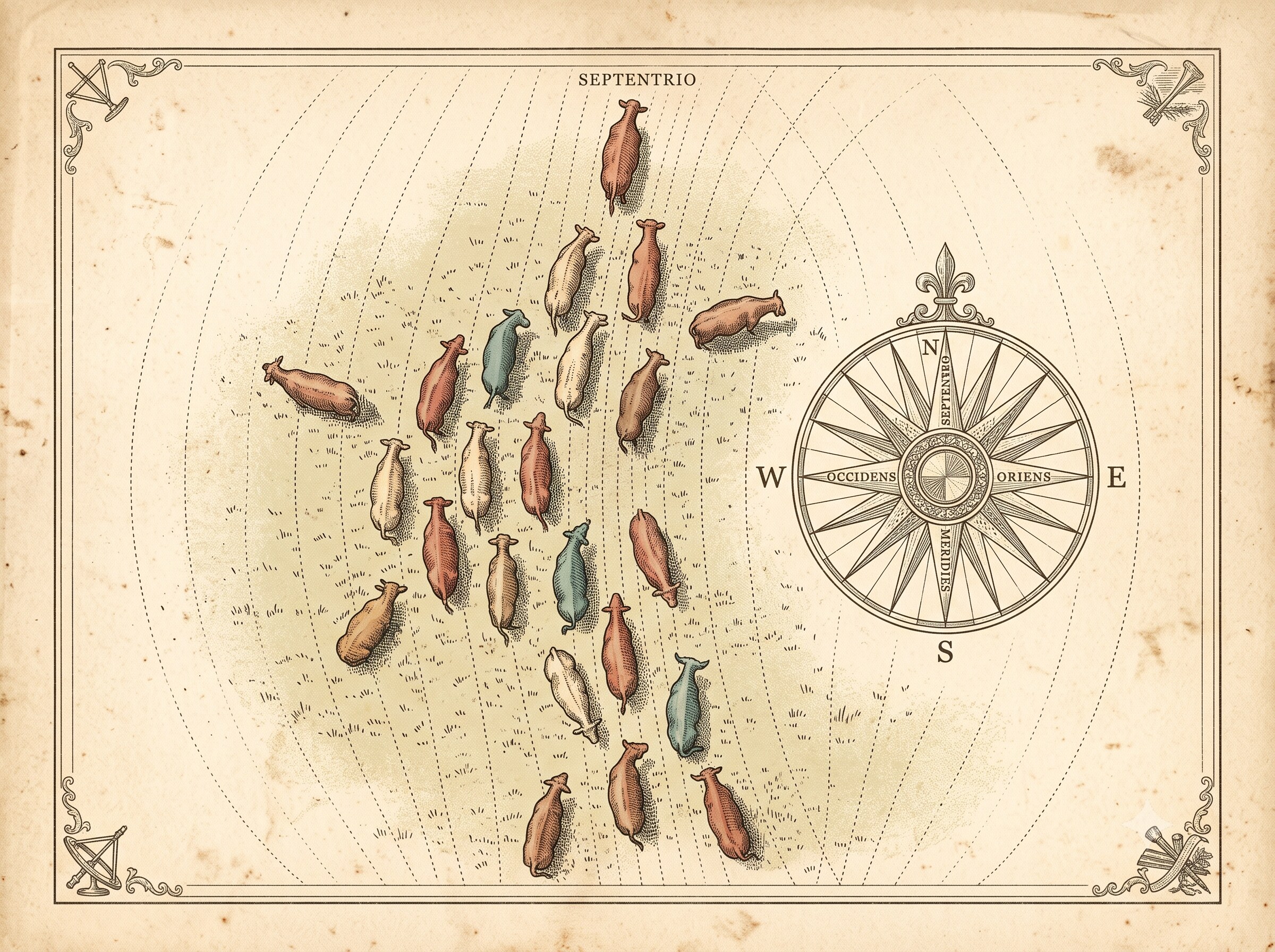
In 2008, a team of zoologists sat down at their computers, opened Google Earth, and started counting cows. Not a few cows. Eight thousand five hundred and ten of them, standing in 308 pastures scattered across six continents, each one a small pale smudge in a satellite photograph. The researchers measured which way every single smudge was pointing. And when they added it all up, the cows appeared to be lining up like compass needles.
By the Curiosities Desk · · 5 min read · Filed under Biology · Today’s round
What happened?
The team was led by Sabine Begall of the University of Duisburg-Essen, with colleagues in Germany and the Czech Republic. Their lab already studied magnetoreception — the ability to sense Earth’s magnetic field — mostly in African mole-rats, burrowing rodents that navigate in total darkness. What nagged at them was whether much larger, much more ordinary mammals had the same sense and had simply never been checked.
Checking would normally mean an enormous field campaign. Instead they realized one had already been run, for free, by satellites. Google Earth had photographed pastures all over the planet, in daylight, from directly overhead. A cow seen from above is essentially an oriented rectangle. If you can see the rectangle, you can measure its axis.
So they did, across a deliberately messy sample: different breeds, countries, and altitudes, from South Africa to India to the United Kingdom. Because heads and tails are hard to tell apart from orbit, they recorded the body axis rather than the facing direction — north-south versus east-west, not “north” versus “south.” Their published result was that the herds clustered along a roughly north-south axis far more often than chance would predict, with the odds of the pattern arising randomly reported as less than one in a hundred thousand.
Then came the detail that made the finding feel less like an artifact. The animals did not line up on geographic north but closer to magnetic north — which sits at a different angle depending on where you stand, a gap called magnetic declination. As the sample moved across the globe, the herds’ preferred axis appeared to swing with the local magnetic field, not the map grid.
To check the satellite work on the ground, the team counted deer across more than 200 sites in the Czech Republic — nearly 3,000 red and roe deer, plus the body-shaped depressions the resting ones had pressed into the snow. The deer aligned even more strongly than the cattle, including at night, when the sun could not have been the cue.
A follow-up in 2009 sharpened the case. Under and beside high-voltage power lines, which generate their own low-frequency magnetic fields, cattle and roe deer stopped lining up at all. Their orientation went essentially random near the wires, and drifted back toward north-south the farther away the animals stood.
And then the story got complicated, which is the honest and more interesting half of it. In 2011 a separate Czech team led by Jiří Hert repeated the satellite survey with 3,412 cattle in 232 herds and found no alignment at all. They argued the effect was fragile enough to be produced by image quality, herd selection, and unblinded scoring. Begall’s group rebutted that the replication had excluded most of the animals actually visible in its own pastures. A 2013 study from a third lab, using a blinded protocol on 2,235 cattle, came down on the original side — and added that the alignment showed up mainly in loosely spaced herds.
The most direct test came in 2018, and it did not favor the cows-as-compasses story. Researchers in Portugal strapped strong neodymium magnets to the collars of 34 cows to scramble any magnetic sense. The cows showed no directional preference with the magnets — and none without them either. Across 2,428 observations of 659 resting animals, the average orientation was about 130 degrees from magnetic north, and it tracked the sun.
Why was it strange?
Set aside whether the effect is real. The claim itself was startling for a reason that has nothing to do with magnetism: if cows really do point north, then humans have stood in fields with cows for roughly ten thousand years and nobody noticed. Herdsmen, ranchers, hunters, dairy farmers — an unbroken chain of people who spent their working lives looking at cattle — and it took a satellite archive and a laptop to spot it.
That is either a remarkable indictment of how badly we see familiar things, or a clue that the pattern was never there. Both possibilities are uncomfortable, and the field has not settled which one applies.
Another animal the lab could not ignore: The Blind Bats That Flew Perfectly in the Dark.
What did scientists learn?
Magnetic alignment is the humblest thing an animal can do with a magnetic sense. It is not navigation. A migrating bird works out where it is and where it needs to go; an aligned animal merely parks itself at a consistent angle to the field, the way you might always sleep facing the same wall. It has been reported in flies, carp, and foxes.
Nobody has found the receptor that would make it work in a cow. Two candidates compete: crystals of the iron mineral magnetite acting as microscopic compass needles, and light-sensitive proteins called cryptochromes in the eye, in which a magnetic field nudges a chemical reaction. Neither has been pinned down in cattle.
The deeper lesson is methodological. This is a textbook case of a beautiful, cheap, wildly shareable result colliding with the hard part of science — replication — and not cleanly surviving it. Satellite images are not neutral either: a 2022 analysis argued that the way orbital cameras stitch and shutter their frames can smear elongated objects in a consistent direction, manufacturing an alignment no animal ever performed.
Another creature that ended up in the notes: The Chicken That Lived 18 Months After Losing His Head.
How does it affect us today?
The cow study helped normalize something now routine: using free satellite archives as a global observatory for wildlife. Researchers today count penguin colonies, whales, and wildebeest from orbit, and the technique owes part of its popular breakthrough to this paper.
It also sits, unresolved, inside an active argument about whether artificial electromagnetic fields affect animal behavior — a question with real stakes for where we route power lines and wind farms. The 2009 power-line result would matter a great deal if it holds up, which is exactly why the replication fight is worth having in public.
A close cousin: The Jellyfish That Can Reverse Its Own Aging.
Fun fact
The same research group later turned to dogs. Over two years they watched 70 dogs relieve themselves 7,475 times — 1,893 defecations and 5,582 urinations — and reported that the dogs preferred to align north-south, but only when Earth’s magnetic field was calm. The work won the 2014 Ig Nobel Prize in Biology, an award for research that makes people laugh and then makes them think.
Sources
- Begall, S., Červený, J., Neef, J., Vojtěch, O., & Burda, H. (2008). “Magnetic alignment in grazing and resting cattle and deer.” PNAS 105(36), 13451–13455. — the original study.
- Burda, H., Begall, S., Červený, J., Neef, J., & Němec, P. (2009). “Extremely low-frequency electromagnetic fields disrupt magnetic alignment of ruminants.” PNAS 106(14), 5708–5713.
- Hert, J., Jelínek, L., Pekárek, L., & Pavlíček, A. (2011). “No alignment of cattle along geomagnetic field lines found.” Journal of Comparative Physiology A 197, 677–682.
- Weijers, D., Hemerik, L., & Heitkönig, I. M. A. (2018). “An experimental approach in revisiting the magnetic orientation of cattle.” PLOS ONE 13(4), e0187848.
- Hart, V., et al. (2013). “Dogs are sensitive to small variations of the Earth’s magnetic field.” Frontiers in Zoology 10, 80. — the Ig Nobel–winning dog study.