Strange Animals Scientists Studied · Biology
The Platypus Pelt a Museum Keeper Cut Open With Scissors, Hunting for the Stitches
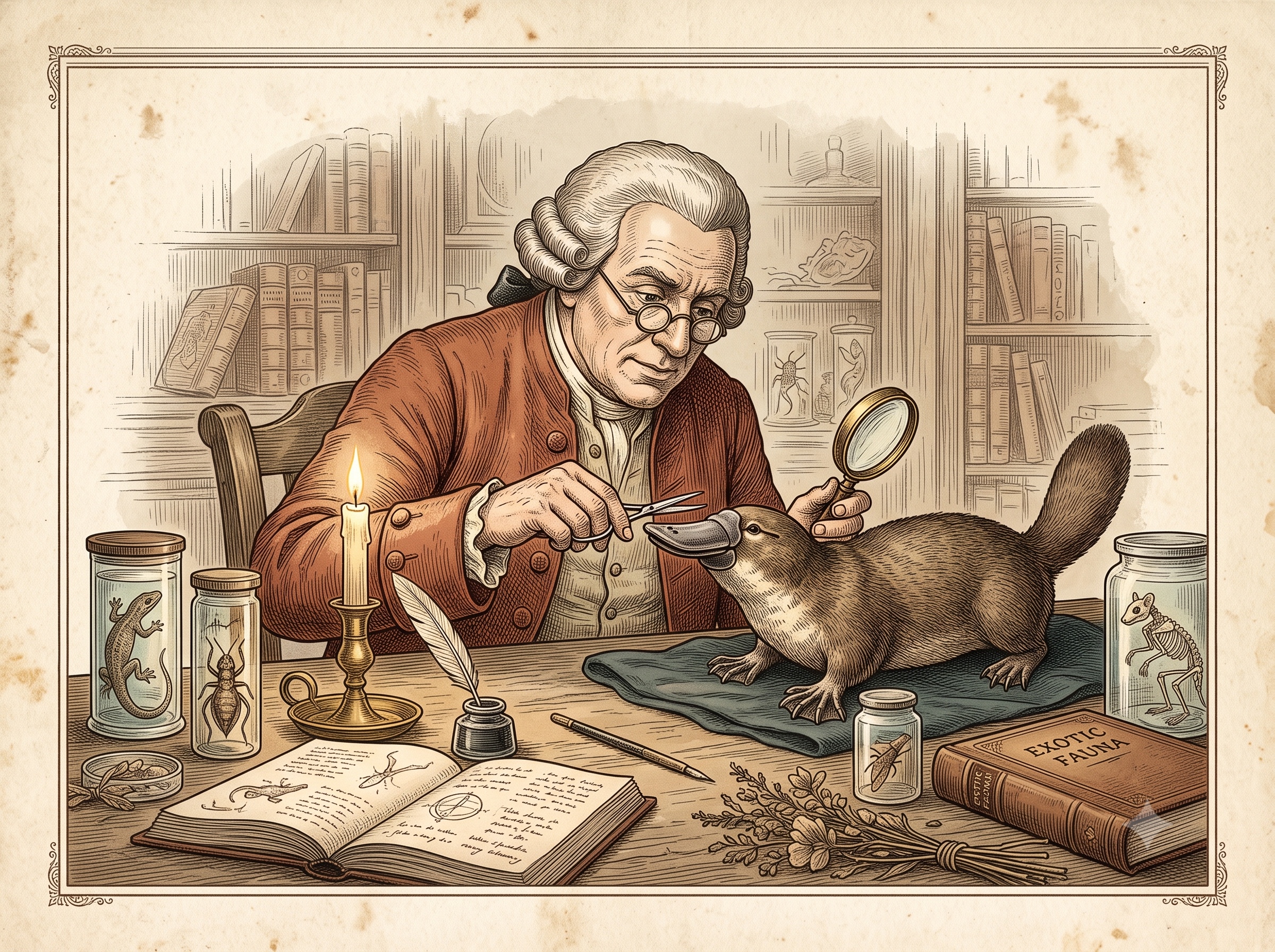
In 1799, in a back room of the British Museum, a respected naturalist sat with a damp brown pelt in one hand and a pair of scissors in the other. The animal had a beaver's tail, a mole's fur, webbed feet with claws, and — impossibly — the flat rubbery bill of a duck. George Shaw was not admiring it. He was cutting into it, looking for the seam where some very talented forger had sewn a duck's face onto a mammal.
By the Curiosities Desk · · 5 read · Filed under Biology · Today’s round
What happened?
The skin had come from the young British colony in New South Wales, sent home to England along with the usual crates of Australian oddities. What arrived in London was, by any reasonable standard, a prank waiting to be exposed.
Shaw was Keeper of the natural history collections at the British Museum — the institution whose collections would later become the Natural History Museum — and it fell to him to describe the thing formally. In June 1799 he published the first scientific account of the platypus in his illustrated series The Naturalist’s Miscellany, with plates engraved by Frederick Polydore Nodder. He gave it the name Platypus anatinus: “flat-footed duck.”
He also, to his enormous credit, published his own suspicion. “Of all the Mammalia yet known it seems the most extraordinary in its conformation,” he wrote, “exhibiting the perfect resemblance of the beak of a Duck engrafted on the head of a quadruped.” So accurate was the resemblance that “at first view, it naturally excites the idea of some deceptive preparation by artificial means.”
That suspicion was not paranoia. European naturalists in the 1790s were being fooled regularly. A workshop trade in composite taxidermy — monkey torsos stitched to fish tails, sold as mermaids — was doing brisk business, and one such creation would later tour America as P. T. Barnum’s “Feejee Mermaid.” A butterfly accepted into Linnaeus’s Systema Naturae had been unmasked in 1793 as an ordinary specimen with spots inked onto its wings. A man handed a strange skin in 1799 had every reason to check the stitching.
So Shaw checked. He snipped into the pelt where the bill met the fur, and found no seam, no thread, no glue. The type specimen still sits in the Natural History Museum’s collection, and according to the museum’s own account, the cut marks left by that skeptical examination are still visible on it — a set of scissor snips preserved for two centuries as evidence of a hoax that wasn’t.
Shaw’s name for the animal did not survive either. Platypus was already taken: a Danish entomologist had used it years earlier for a genus of wood-boring ambrosia beetles. In 1803 Johann Friedrich Blumenbach described the animal again as Ornithorhynchus paradoxus — “paradoxical bird-snout.” The rules of naming eventually produced a hybrid, Ornithorhynchus anatinus, which is what the platypus is called today.
Doubt about the animal’s authenticity faded as more specimens arrived. Doubt about what it was lasted much longer. Through the 1820s, anatomists in Edinburgh and London dissected shipment after shipment of platypus organs, arguing over whether the creature was a mammal, a reptile, a bird, or something requiring a category of its own.
The stickiest question was the simplest: did it lay eggs? Aboriginal Australians said it did, and had said so from the beginning. European science declined to accept it without a specimen. The argument ran for 85 years.
It ended in Queensland in 1884. William Hay Caldwell, a 25-year-old Scottish zoologist funded by Cambridge, the Royal Society and the British government, camped on the Burnett River and — with the help of a large group of Aboriginal Australians whose skill he later admitted was the only reason he succeeded — collected roughly 1,400 specimens. His team found an echidna with an egg in her pouch, and a platypus with one egg in her nest and a second inside her, about to be laid. Caldwell wired the news to the British Association meeting in Montreal in six words: “Monotremes oviparous, ovum meroblastic.”
Why was it strange?
Almost every animal ever described has been slotted into a category that already existed. The platypus arrived with a body that read like a forgery — and then, once accepted as real, refused to fit anywhere. It nursed its young without nipples, sensed prey with its bill, carried venom in the males’ hind spurs, and laid eggs. It was not a missing link between reptiles and mammals; it was a mammal that had simply never given up a very old habit.
The stranger detail is human, not zoological. The correct answer was available in 1799 from the people who lived alongside the animal. It took nearly nine decades and a telegram from a Cambridge man before European science was willing to write it down.
The same thread — Evolution — continues in The Fish Extinct for 66 Million Years That Rode to the Museum in a Taxi.
What did scientists learn?
Caldwell’s six words carried two facts. Oviparous meant egg-laying — settling the argument. Meroblastic was the more technical prize: it means the fertilized egg does not divide all the way through, but splits only in a small disc sitting on top of a large yolk, exactly as a reptile or bird egg does.
That gave the platypus and the echidnas their own mammalian order, Monotremata. Modern genetics puts the split between monotremes and the lineage leading to us at roughly 166 million years ago. The 2008 sequencing of the platypus genome found precisely the mosaic the anatomists had been fighting over: gene families shared with reptiles and birds sitting alongside unmistakably mammalian ones.
Another creature that ended up in the notes: The Parrot That Asked What Color Am I.
How does it affect us today?
The platypus stayed useful. Its genome remains a reference point for reconstructing what the earliest mammals were like. In 2016, researchers at the University of Adelaide and Flinders University found that platypuses and echidnas produce an unusually durable form of GLP-1 — the hormone that triggers insulin release — which in humans breaks down within minutes. That resistance to degradation is exactly the property that type 2 diabetes drugs are built to imitate, and monotreme GLP-1 is being studied as a model for it.
Shaw’s scissors left a different legacy. His paper is a small monument to a habit science still depends on: publish the specimen, publish the description, and publish the fact that you don’t quite believe it yet.
Another animal the lab could not ignore: The Stork That Came Home With an African Spear Through Its Neck.
Fun fact
The platypus is not, technically, a platypus. Shaw’s genus name Platypus had already been assigned to a group of wood-boring beetles, so the animal was renamed Ornithorhynchus. The beetles kept the name. The platypus kept the nickname.
Sources
- George Shaw, “The Duck-Billed Platypus, Platypus anatinus,” The Naturalist’s Miscellany, vol. 10 (1799) — the original description, digitized by the Biodiversity Heritage Library
- Natural History Museum, “The platypus puzzle”
- University of Cambridge, “Discovered: 150-year-old platypus and echidna specimens that proved some mammals lay eggs”
- Bill Jenkins, “The platypus in Edinburgh: Robert Jameson, Robert Knox and the place of the Ornithorhynchus in nature, 1821–24,” Notes and Records of the Royal Society
- Warren et al., “Genome analysis of the platypus reveals unique signatures of evolution,” Nature 453 (2008)