Strange Animals Scientists Studied · Biology
The Parrot That Asked What Color Am I
One afternoon in a university lab, a one-year-old parrot caught sight of himself in a mirror and did something no non-human animal had ever been recorded doing before. He asked a question. "What color?" he said, peering at his own reflection. A researcher told him: gray. He said it back a few times, and from then on, he knew the word for what he was.
By the Curiosities Desk · · 6 min read · Filed under Biology · Today’s round
Part of Creatures That Changed Science
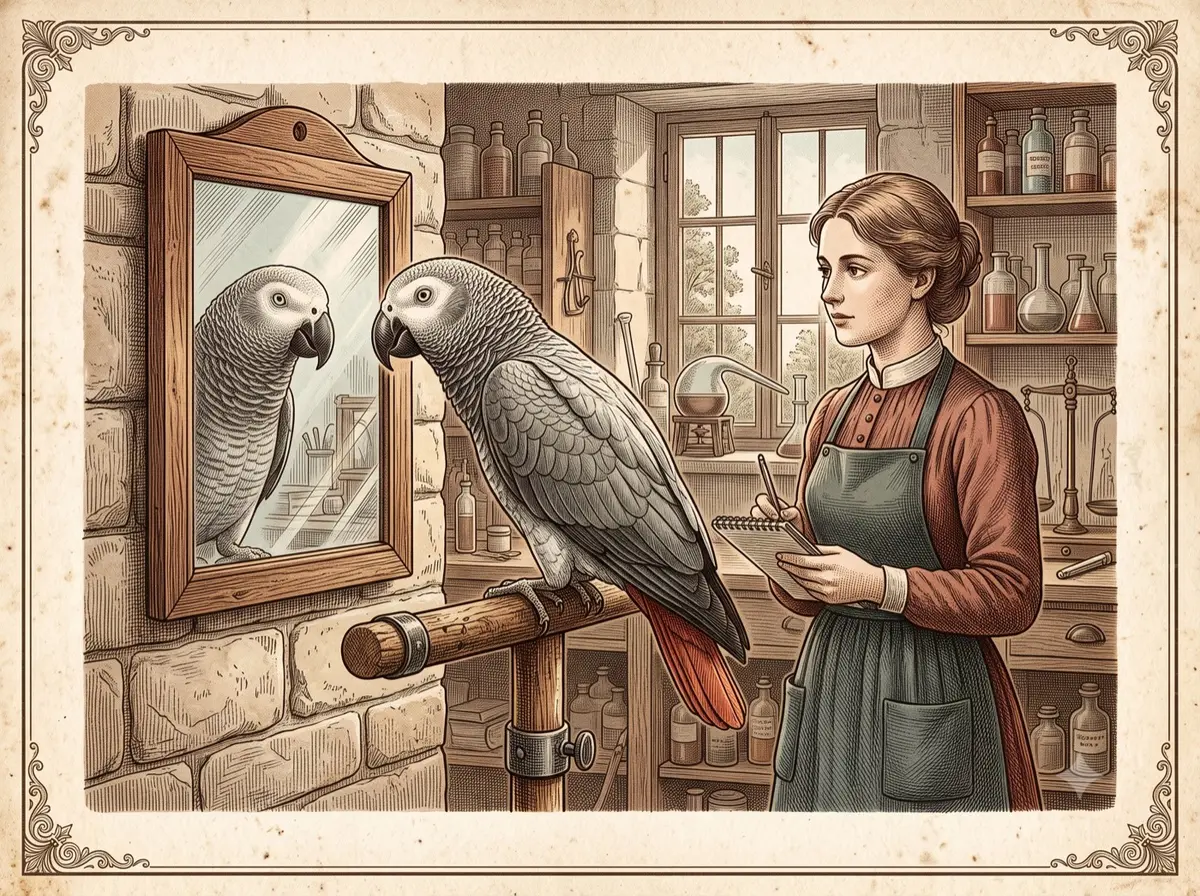
What happened: The Parrot That Asked What Color Am I
In June 1977, a comparative psychologist named Irene Pepperberg walked into a Chicago pet store and asked an employee to pick out a grey parrot for her — any one, at random. She didn’t want to choose the bird herself, because she wanted to prove that whatever he learned would be evidence about the species, not about her having cherry-picked an unusually gifted animal. The bird she brought home was named Alex, an acronym for the “Avian Language EXperiment” she was about to run, first at Purdue University and later at the University of Arizona, Harvard, and Brandeis.
At the time, this was a fairly radical thing to attempt. The scientific consensus held that real cognition, and certainly anything resembling language, required a large primate-style brain. Birds mimicked sounds; they didn’t understand them. Pepperberg spent the next three decades quietly overturning that assumption, one labeled block and one wrong answer at a time.
She trained Alex using something called the model/rival technique, adapted from a method used to teach language to children. Two human trainers worked in front of Alex: one asked questions, the other answered them (correctly or, sometimes, deliberately incorrectly) and was praised or gently scolded in turn. Alex watched a person compete for a trainer’s attention by using the words Pepperberg wanted him to learn — so he had both a model of the behavior and a rival for the attention he wanted for himself. Critically, when Alex got an answer right, his reward wasn’t a food pellet; it was the object itself. If he said “wanna nut,” he got a nut. If he asked for a cork, wanting to chew it, he got the cork. That direct link between word and object, Pepperberg argued, was what made the difference.
Over thirty years, Alex learned to label more than 50 objects, seven colors, five shapes, and quantities up to six. He could tell you what an object was made of — wood, wool, cork, hide — and how many of them were on a tray. He understood “same,” “different,” “bigger,” “smaller,” and was working on “over” and “under” when he died. He combined words in his own way: he called an apple a “banerry,” which Pepperberg’s linguist colleagues guessed was his own blend of “banana” and “cherry,” the two fruits he already had names for. When he got bored being asked to identify the same colored blocks over and over, he once answered a question about “three” blocks by saying “five” — there were no five blocks on the tray. Told to try again, he said “none.”
That word, “none,” turned out to matter more than it seemed. In a 2005 paper published in the Journal of Comparative Psychology, Pepperberg and her co-author reported that Alex had spontaneously used “none” to describe an absence of a quantity during a counting test — not something he’d been drilled to say in that context. It was evidence, they argued, of a zero-like concept: the idea of “nothing” treated as an answerable quantity, a concept human children don’t typically grasp until around age four.
Then there was the mirror moment. Sometime around 1980, a lab assistant named Kathy Davidson was in a washroom with Alex when he looked at his reflection and asked “What’s that?” Told it was Alex, he looked again and asked “What color?” Davidson told him: gray. After being told six times, he had the word. By at least one account cited in later commentary on the case, this made Alex the first non-human animal on record to ask a question about himself — something that trained sign-language-using apes, for all their vocabulary, had never been documented doing.
Why it was strange: The Parrot That Asked What Color Am I
The strangeness here isn’t just “a bird talked.” Parrots mimicking phrases is old news to anyone who has owned one. What unsettled expectations was the suggestion that Alex wasn’t just repeating sounds for a reward, but using them referentially and, in at least this one recorded instance, generating a question no one had trained him to ask. A brain the size of a walnut, belonging to an animal whose lineage split from ours roughly 300 million years ago, appeared to be doing something that looked a great deal like curiosity about itself. Not every scientist was convinced this rose to the level of “language” — more on that below — but even skeptics had to reckon with just how much structure was in there.
Another creature that ended up in the notes: The Chicken That Lived 18 Months After Losing His Head.
What scientists learned: The Parrot That Asked What Color Am I
Alex’s case, backed by Pepperberg’s peer-reviewed papers over the decades, helped dismantle the assumption that sophisticated cognition requires a mammalian, primate-style cortex. Birds lack the layered neocortex mammals use for higher reasoning, yet Alex demonstrated categorical concepts (color, shape, material), relational concepts (same/different, bigger/smaller), small-number arithmetic, and a rudimentary zero concept. Pepperberg was careful not to claim Alex had “language” in the full linguistic sense; she described his abilities as a “two-way communications code.” Other researchers pushed back harder. Herbert Terrace, who ran a well-known chimpanzee language study, argued Alex’s responses could be an elaborate form of learned discrimination rather than true understanding — a reminder this remains debated, not settled. What’s less disputed is the broader finding this research fed into: flexible problem-solving evolved more than once, along more than one kind of brain, and birds are now studied seriously as a result.
Another animal the lab could not ignore: The Jellyfish That Can Reverse Its Own Aging.
How it reaches us today: The Parrot That Asked What Color Am I
Alex’s research helped launch the modern field of avian cognition, which now includes well-documented work on tool use and planning in crows and other corvids. The model/rival training technique Pepperberg developed has been adapted in animal behavior labs and in some speech and language therapy contexts for children. And the questions Alex’s case raised — about animal minds, welfare, and how much credit we owe other species for the reasoning they show us — continue to shape how zoos, sanctuaries, and researchers think about captive animal enrichment today.
A close cousin: The Rats That Learned to Drive Tiny Cars — and Revved the Engine Before the Ride.
Fun fact: The Parrot That Asked What Color Am I
Alex’s last words to Pepperberg, on the evening before he was found dead in his cage on September 6, 2007, at age 31, were the same phrase he said to her most nights when she left the lab: “You be good. I love you. See you tomorrow.” A necropsy found no clear cause of death; the Alex Foundation later reported that a fatal arrhythmia, heart attack, or stroke linked to arteriosclerosis was the likely cause. He was expected to live into his 40s or longer.
Sources: The Parrot That Asked What Color Am I
- Pepperberg, I. M., & Gordon, J. D. (2005). Numerical comprehension by a Grey parrot (Psittacus erithacus), including a zero-like concept. Journal of Comparative Psychology, 119(2), 197–209.
- The Alex Foundation. Pathology Report. October 4, 2007.
- Carey, B. (2007, September 10). Alex, a Parrot Who Had a Way With Words, Dies. The New York Times.
- Chandler, D. (2007). Farewell to a famous parrot. Nature News.
- Alex (parrot). Wikipedia (cross-referenced against the sources above).
Related stories: The Parrot That Asked What Color Am I
- Clever Hans: The Horse That Could ‘Do Math’ — A horse that seemed to do arithmetic, and the bias it exposed
- The Blind Bats That Flew Perfectly in the Dark — Blindfolded bats flew fine; deafened ones crashed
- The Naked Mole-Rat: The Cold-Blooded Mammal That Lives Like an Ant and Won’t Age on Schedule — A wrinkled rodent that resists cancer and ignores aging