Accidental Discoveries · Biology
The Fish Extinct for 66 Million Years That Rode to the Museum in a Taxi
On a hot December morning in 1938, a young museum curator in the South African port of East London stood on a trawler's deck picking through a heap of unsellable fish. Under the pile she saw a flash of blue. She pulled out a five-foot animal with armour-plated scales, a stubby extra lobe on its tail, and four thick fleshy fins that looked disconcertingly like the beginnings of legs. She had no idea what it was. She hailed a taxi, wrestled the fish into it, and rode back to the museum with an animal that science had confidently listed as extinct for the previous 66 million years.
By the Curiosities Desk · · 5 min read · Filed under Biology · Today’s round
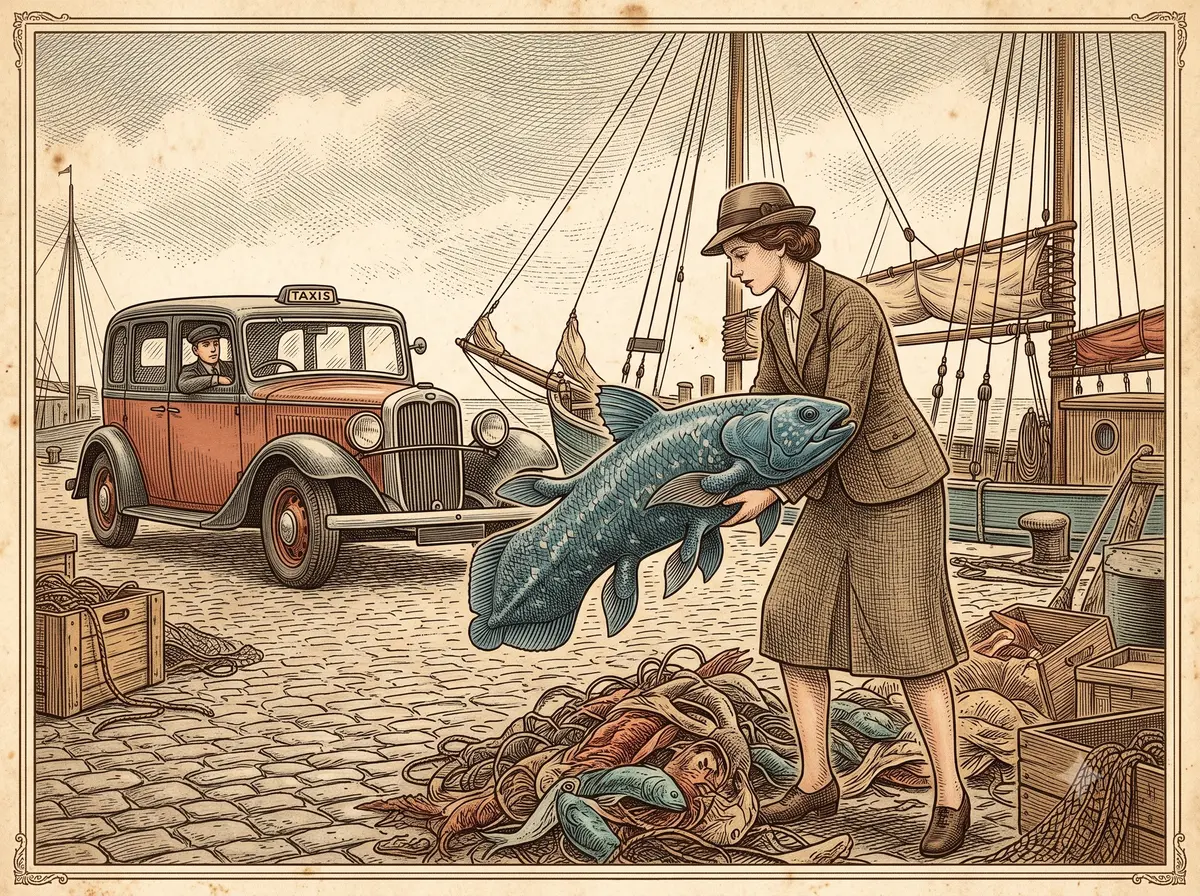
What happened: A Coelacanth
Marjorie Courtenay-Latimer was 31 and had been curator of the East London Museum since 1931 — a job she got with no formal training in zoology, on the strength of a lifelong obsession with South African plants and animals. Her collection was thin, so she had made a standing arrangement with local trawler crews: if anything odd turned up in the nets, call her.
On 22 December 1938 the call came from Captain Hendrik Goosen of the trawler Nerine, who had been working the seabed at roughly 70 metres near the mouth of the Chalumna River. She went down to the dock to look at the by-catch. In among the ordinary fish was the blue one.
Back at the museum, nobody could identify it. Nothing in her reference books came close. Convinced it mattered, Courtenay-Latimer wrote to J. L. B. Smith, a chemistry lecturer at Rhodes University in Grahamstown who was also the region’s best-known amateur ichthyologist — a scientist who studies fish. She enclosed a careful pencil sketch of the animal, fins and all.
Then everything went wrong at once. It was Christmas week, and Smith was away. The fish sat in the summer heat. Courtenay-Latimer wrapped it in formalin-soaked cloths, but preservation was losing the race. On 26 December she gave up and handed it to a local taxidermist, Mr. Center, who skinned and mounted it — and threw away the internal organs, which for a completely unknown animal was the single most scientifically valuable part of it.
Smith got back on 3 January 1939, read the letter, looked at the sketch, and understood immediately what he might be holding a drawing of. He fired off a telegram that has been quoted ever since: “MOST IMPORTANT PRESERVE SKELETON AND GILLS = FISH DESCRIBED.” It arrived too late. The organs were already gone.
Smith reached East London in February and saw the mounted skin for himself. In his 1956 memoir Old Fourlegs he described the moment: “I stood as if stricken to stone. Yes, there was not a shadow of a doubt, scale by scale, bone by bone, fin by fin, it was a true Coelacanth.” He announced the find in Nature in 1939 under the title “A living fish of Mesozoic type,” and named it Latimeria chalumnae — the genus for Courtenay-Latimer, the species for the river.
Why it was strange: A Coelacanth
Coelacanths were a well-known fossil group, described since 1836 and turning up in rocks spanning hundreds of millions of years — and then they stopped. No coelacanth fossil younger than about 66 million years had ever been found, so the reasonable conclusion was that they had died out around the same time as the non-avian dinosaurs.
Extinction is normally a one-way verdict. A fossil group reappearing alive, in a fishing net, in the twentieth century, was not a thing that was supposed to happen. New Zealand’s Auckland Star ran a column in April 1939 headlined “Loch Ness Outdone” — the world had just been told there was no monster in the loch, and here was a real one, hauled up off South Africa.
There is also the smaller, more human strangeness: the fish was never lost, exactly. Comoran fishermen had a name for it, gombessa, and pulled a couple up most years while night fishing. It simply had no commercial value, so nobody with a scientific journal subscription had ever heard about it.
The same thread — Evolution — continues in The Platypus Pelt a Museum Keeper Cut Open With Scissors, Hunting for the Stitches.
What scientists learned: A Coelacanth
Coelacanths belong to the lobe-finned fishes, a lineage whose paired fins are built on a fleshy, bony stalk rather than a fan of rays. That group is the one land vertebrates came from, which is why Latimeria was immediately billed as a “missing link.” It isn’t. Genetic work — including the 2013 sequencing of the coelacanth genome — indicates that lungfishes, not coelacanths, are our closer aquatic relatives.
It is also worth being careful with the phrase “living fossil.” Latimeria is not a Cretaceous animal that pressed pause. It is a modern genus in an ancient group, with its own 66 million years of change behind it. What’s conserved is the body plan, not the individual species.
And the body plan is genuinely odd. Instead of a robust backbone, an adult coelacanth is supported largely by a notochord — a fluid-filled tube that most vertebrates have only as embryos. Its skull carries an intracranial joint, a hinge running across the braincase that lets it swing its mouth open unusually wide, and no other living vertebrate has one. Its snout houses a rostral organ that appears to detect the faint electrical fields of prey; divers have watched coelacanths tip vertically into slow “headstands,” apparently sweeping for signals. And in 1975, researchers found that females give birth to live young.
Another time the mistake was the invention: The Dogs That Drooled Too Soon — and the Bell Pavlov Didn’t Ring.
How it reaches us today: A Coelacanth
The coelacanth quietly rewrote how biologists treat the word “extinct.” A species absent from the fossil record for tens of millions of years and then found alive is now called a Lazarus taxon, and the coelacanth is the type specimen of the idea. It made “absence of evidence” a phrase field biologists say out loud, and it is part of why serious money still goes into surveys for species presumed gone.
It also became a cautionary tale about attention. Once a reward was attached to the fish, catches rose sharply, and Smith grew uneasy about what he had started. Both living coelacanth species are now protected from international trade, and L. chalumnae is listed as Critically Endangered.
Courtenay-Latimer’s fish is still on display at the East London Museum, and there is a plaque at the dock where she flagged down the taxi.
Another accident worth keeping: The Tin of Meat That Spoiled After a Dose of Radiation Meant to Kill Everything.
Fun fact: A Coelacanth
A 2021 study in Current Biology aged coelacanths by counting nearly invisible growth rings on their scales — and found the previous estimates were off by a factor of five. African coelacanths appear to live close to a century, and don’t reach sexual maturity until roughly age 55. A coelacanth that isn’t old enough to reproduce can still be older than the scientist studying it.
Sources: A Coelacanth
- J. L. B. Smith, “A Living Fish of Mesozoic Type,” Nature 143, 455–456 (1939) — the original announcement and naming of Latimeria chalumnae: nature.com
- Natural History Museum, London, “Coelacanths: The fish that ‘outdid’ the Loch Ness Monster”: nhm.ac.uk
- Linda Hall Library, “Scientist of the Day — Marjorie Courtenay-Latimer,” with images of Smith’s Nature letter and her original sketch: lindahall.org
- K. Mahé et al., “New scale analyses reveal centenarian African coelacanths,” Current Biology 31, 3621–3628 (2021): cell.com
- C. T. Amemiya et al., “The African coelacanth genome provides insights into tetrapod evolution,” Nature 496, 311–316 (2013): ncbi.nlm.nih.gov
Related stories: A Coelacanth
- The Stork That Came Home With an African Spear Through Its Neck — A stork came home to Germany with an African spear through its neck
- The Jellyfish That Can Reverse Its Own Aging — A jellyfish that can rewind itself back to childhood
- The Sea Monster Rebuilt With Its Head on the End of Its Tail — A fossil reconstructed with its skull on the wrong end