Accidental Discoveries · Biology
The Jellyfish Extract Tossed Down a Lab Sink That Flashed Blue — and Lit Up Biology
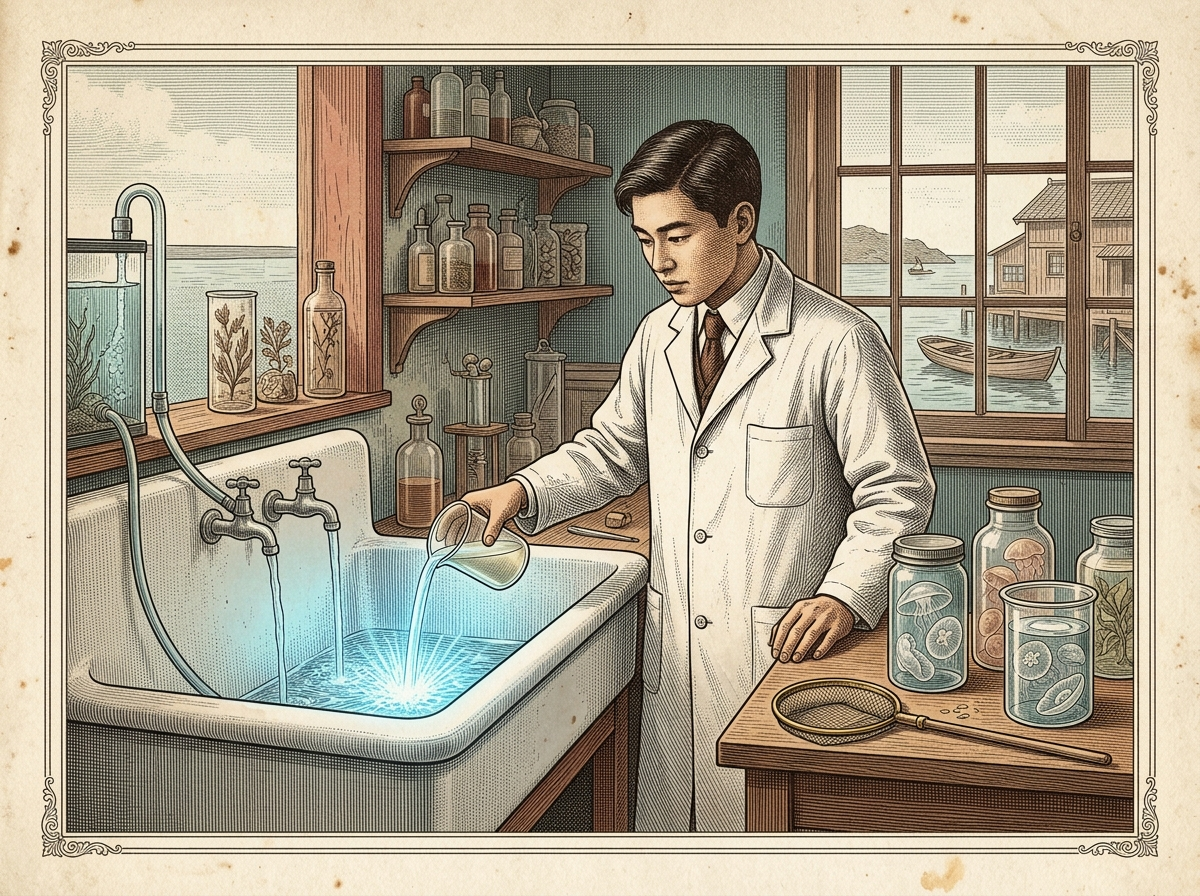
In the summer of 1961, in a small marine lab on an island in Washington State, a young Japanese chemist named Osamu Shimomura finished an experiment and poured the leftovers into the sink. The inside of the sink lit up with a bright blue flash. It wasn't a spill or a fire. It was the answer to the problem he had been stuck on for days, and it showed up in the drain.
By the Curiosities Desk · · 5 min read · Filed under Biology · Today’s round
What happened?
Shimomura had come to Princeton University in 1960 to work with the biologist Frank Johnson, who studied bioluminescence, the light that living things make with chemistry. Johnson wanted to know how a jellyfish called Aequorea glows. It’s a nearly transparent animal about the size of a saucer, and a ring of tiny light organs around the edge of its bell gives off a faint greenish light.
So in June 1961, the team drove about 5,000 kilometers (roughly 3,100 miles) from New Jersey to the University of Washington’s Friday Harbor Laboratories in the San Juan Islands, where the jellyfish drift past the docks. They scooped them up with shallow dip nets and snipped off the glowing rings with scissors.
Then they got stuck. At the time, scientists assumed that biological light always came from two ingredients: a fuel molecule called luciferin and an enzyme called luciferase, which helps it react. Firefly light works that way. So the team tried to pull those two ingredients out of the jellyfish. As Shimomura later put it in his Nobel lecture, after only a few days of work they “ran out of ideas.”
Shimomura suspected that the luciferin idea itself was the problem. Johnson disagreed. By Shimomura’s account, the two couldn’t settle it, so he worked by himself at one end of a lab table while Johnson and an assistant kept hunting for luciferin. He later called it “an awkward, uncomfortable situation.” Over the next several days, he often rowed a boat alone into the middle of the bay to think.
On one of those afternoons on the water, he had an idea. Maybe the light came from a single protein. If so, he might be able to switch it off by making the solution more acidic, and then switch it back on later. Back in the lab, he tested the light organs at different acidity levels. They glowed at pH 7, 6 and 5, but went dark at pH 4. He ground the rings up in an acidic liquid and filtered it. The liquid was nearly dark. When he neutralized it with sodium bicarbonate (baking soda), it glowed again.
That was a success. And then he threw the extract into the sink, and the sink flashed blue.
The sink happened to be catching the overflow from a seawater aquarium. Shimomura knew what’s in seawater, and he worked out which ingredient had set off the light: calcium. The glowing substance didn’t need a separate enzyme. It needed a dash of calcium. He and Johnson changed their recipe, adding a chemical called EDTA that grabs calcium and keeps it out of the way, and that summer they processed about 10,000 jellyfish. In 1962 they described a new protein they named aequorin, after the animal.
There was one more surprise in that 1962 report. While purifying aequorin, they noticed a tiny amount of a second protein that glowed green under ultraviolet light. They called it the “green protein.” Today it’s known as green fluorescent protein, or GFP.
Why was it strange?
The breakthrough didn’t come from a clever instrument. It came from a sink. If the aquarium overflow had drained somewhere else, the extract would have gone down the pipe in the dark.
It also broke the rule everyone was working from. Aequorin doesn’t follow the luciferin-and-luciferase pattern. It’s a “photoprotein,” a protein that holds its energy loaded and ready, like a set mousetrap, and releases it as light the instant calcium touches it.
And then there was the color mismatch. Aequorin makes blue light, but the living jellyfish glows green. That puzzle pointed straight at the second protein. You can find more finds like this in The Finds That Started on the Wrong Errand.
What did scientists learn?
Inside the jellyfish, the two proteins work as a relay. Calcium makes aequorin give off blue light, and GFP, sitting close by, soaks up that energy and gives off green light instead. Scientists later showed this hand-off in experiments published in 1974.
GFP had a rare property: it glows on its own. Shine blue or ultraviolet light on it and it fluoresces green, with no extra fuel needed. That meant if you could get a cell to make GFP, the cell would carry its own lamp.
That took decades. Shimomura kept coming back to Friday Harbor. Between 1961 and 1988 he collected about 850,000 jellyfish, with help from his wife, his children and local students. In 1992, Douglas Prasher at Woods Hole Oceanographic Institution published the gene for GFP. Martin Chalfie then put that gene into bacteria and into a tiny transparent worm, C. elegans, and showed the cells glowed green. Roger Tsien worked out how the glow forms and engineered new colors. In 2008, Shimomura, Chalfie and Tsien shared the Nobel Prize in Chemistry. For another discovery that nearly went out with the trash, see The Moldy Petri Dish That Almost Got Thrown Away.
How does it affect us today?
GFP turned biology from a science of snapshots into one of movies. Researchers attach its gene to the gene for a protein they care about, and then watch that protein move around a living cell. The Nobel committee pointed to uses such as tracking how cancer cells spread and following nerve damage in Alzheimer’s disease.
Aequorin had its own career. By the late 1960s, researchers were injecting it into muscle cells to see calcium flashes as the muscles worked. Modern calcium sensors built partly from GFP let neuroscientists watch brain cells light up as they fire. Labs around the world now use glowing proteins every day. For another sea creature that quietly keeps modern medicine running, see The Baby-Blue Blood of the Horseshoe Crab That Keeps Every Vaccine Safe.
Fun fact
When the 2008 prize was announced, Douglas Prasher, whose gene made the glowing cells possible, had lost his research funding and, later, a job at a NASA contractor. He was driving a courtesy shuttle for a car dealership in Huntsville, Alabama. Chalfie and Tsien invited him and his wife to Stockholm for the Nobel ceremony.
Sources
- Shimomura, O. “Discovery of Green Fluorescent Protein (GFP).” Nobel Lecture, December 8, 2008. https://www.nobelprize.org/uploads/2018/06/shimomura_lecture.pdf
- Shimomura, O., Johnson, F. H., and Saiga, Y. “Extraction, purification and properties of aequorin, a bioluminescent protein from the luminous hydromedusan, Aequorea.” Journal of Cellular and Comparative Physiology 59 (1962): 223–239. https://doi.org/10.1002/jcp.1030590302
- The Nobel Prize. “Osamu Shimomura: Biographical.” https://www.nobelprize.org/prizes/chemistry/2008/shimomura/biographical/
- The Nobel Prize. “Press release: The Nobel Prize in Chemistry 2008.” https://www.nobelprize.org/prizes/chemistry/2008/press-release/
- NPR. “Glowing Gene’s Discoverer Left Out Of Nobel Prize” (Douglas Prasher interview), October 2008. https://www.npr.org/transcripts/95545761