Accidental Discoveries · Medicine
The Moldy Petri Dish That Almost Got Thrown Away
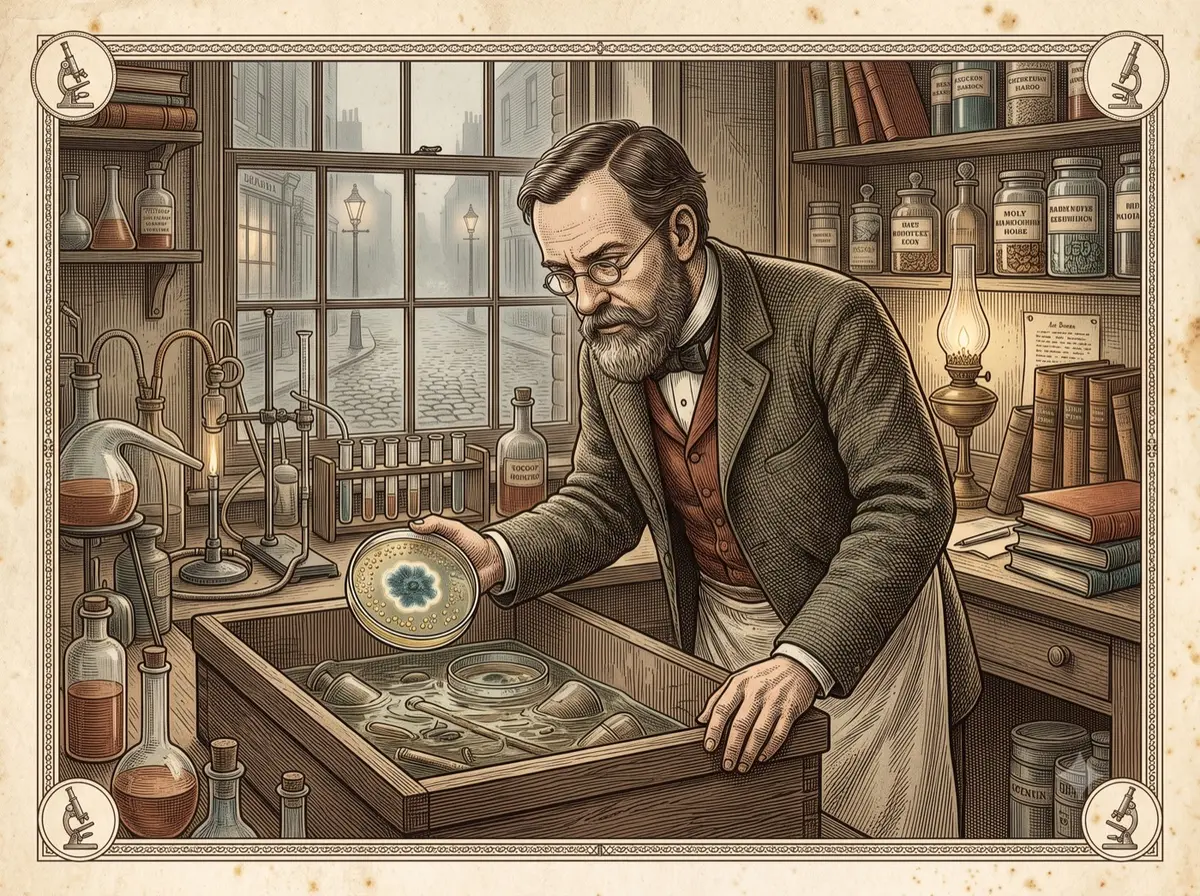
A stack of dirty petri dishes sat in a bin of disinfectant, waiting to be washed. One of them, still poking above the liquid, had a splotch of blue-green mold growing on it. Most bacteriologists would have tossed it without a second look. Alexander Fleming picked it up, squinted at it, and said, "That's funny."
By the Curiosities Desk · · 6 min read · Filed under Medicine · Today’s round
What happened: The Moldy Petri Dish That Almost Got Thrown Away
In the summer of 1928, Alexander Fleming, a bacteriologist at St. Mary’s Hospital in London, was studying Staphylococcus, the bacteria behind boils, abscesses, and sore throats. Before leaving for a family holiday in early August, he stacked his used culture plates — shallow dishes where he’d been growing the bacteria — on a bench in his cramped, cluttered laboratory instead of properly sterilizing them right away, a habit his colleagues later described as characteristically messy.
He returned to St. Mary’s on September 3, 1928. Going through the discarded plates before they were cleaned, he noticed something odd on one of them: a fuzzy patch of mold had contaminated the dish, and in a clear ring around it, the golden colonies of staph bacteria had died off. Everywhere else on the plate, the bacteria grew as thickly as ever. Only near the mold had something stopped them cold.
Fleming’s former lab assistant, D. Merlin Pryce, happened to stop by that day. Fleming fished the plate out of the bin to show him, remarking, “That’s funny.” Pryce reportedly joked that it sounded like Fleming’s earlier discovery of lysozyme, an antibacterial enzyme found in tears and saliva that Fleming had identified a few years before, also by accident.
Fleming identified the invading mold as a strain of Penicillium, later determined to be Penicillium notatum (now often classified as Penicillium rubens). He grew it in a broth, filtered out the mold itself, and found that the leftover liquid — which he called “mould juice,” then penicillin — could still kill a wide range of dangerous bacteria, including the microbes behind pneumonia, meningitis, and diphtheria, even when diluted hundreds of times over.
Exactly how the mold got onto Fleming’s plate has never been settled with certainty. Fleming himself later speculated that spores drifted in through an open window facing the street. Other researchers who worked in the building at the time disputed this, testifying that his window was normally kept shut, and pointed instead to a mycology lab one floor below, run by Charles J. La Touche, as the likelier source of stray spores. The site of contamination remains a matter of informed reconstruction rather than settled fact — a reminder that even famous scientific stories often have fuzzy edges.
Fleming published his findings in the British Journal of Experimental Pathology in June 1929. The paper barely mentioned penicillin’s potential as a medicine; Fleming was more interested in using it as a laboratory tool to isolate certain bacteria from mixed cultures. Attempts to purify the compound into something stable enough to inject into a patient failed, and for over a decade, penicillin remained a scientific curiosity gathering dust in the literature.
Why it was strange: The Moldy Petri Dish That Almost Got Thrown Away
The stranger part isn’t that mold killed bacteria on a dish — plenty of molds and bacteria compete with each other in nature, which is exactly why some produce antimicrobial compounds in the first place. It’s that this particular discovery depended on Fleming doing almost everything “wrong” by the standards of a tidy laboratory: leaving cultures unwashed, going on vacation, letting a stray contaminant take hold on an open plate. A more meticulous scientist might never have seen it. Fleming later reflected that he “was not the first to observe” mold killing bacteria, but he was the one who happened to notice, question, and follow up on it. Luck needed a curious, undisciplined observer to matter.
Another time the mistake was the invention: The Failed Heart Pill That Trial Volunteers Wouldn’t Give Back.
What scientists learned: The Moldy Petri Dish That Almost Got Thrown Away
Fleming had found the first true antibiotic — a compound that kills or halts the growth of bacteria without being toxic to the human body at effective doses — but turning that observation into medicine took a second act of science entirely. In 1939, over a decade after Fleming’s plate, a team at Oxford led by Howard Florey and Ernst Chain, working with biochemist Norman Heatley, revived his largely forgotten paper and set out to purify penicillin into something that could survive inside a patient. They grew mold in whatever containers they could find — bedpans, milk churns, biscuit tins — and eventually extracted enough stable penicillin to test on infected mice, then on people. Their work proved that penicillin worked not just in a petri dish but in a living body, and that it could be manufactured, even if not yet at scale.
Another accident worth keeping: The Farmer Who Drove Through a Blizzard With a Dead Cow and a Milk Can of Blood.
How it reaches us today: The Moldy Petri Dish That Almost Got Thrown Away
Every antibiotic in a modern medicine cabinet traces its lineage back to that overlooked dish. Before penicillin, a scratch from a rose thorn or a routine surgery could turn fatal from infection; the first patient treated with Oxford’s penicillin, a policeman named Albert Alexander, showed a remarkable recovery in February 1941 before supplies ran out and he died — a stark demonstration of both the drug’s power and how little of it existed. Wartime demand pushed American laboratories and pharmaceutical companies to scale up production using fermentation techniques originally developed for other industries, and by 1945 penicillin was being manufactured by the trillions of units a year. Fleming, Florey, and Chain shared the Nobel Prize in Physiology or Medicine that year. In his Nobel lecture, Fleming also issued a warning that reads as strikingly current: he described how easy it is to make bacteria resistant to penicillin by exposing them to doses too weak to kill them outright — the same mechanism behind today’s antibiotic-resistant infections, one of modern medicine’s most pressing challenges.
A close cousin: The Wrong Resistor That Grabbed a Heartbeat Out of Thin Air.
Fun fact: The Moldy Petri Dish That Almost Got Thrown Away
Fleming kept a sample of the original mold and, decades later, gave away small ink drawings he’d painted using live bacteria of different colors as his “paint” — a hobby he called “germ art.” One of his vials of the original penicillin-producing mold sold at auction in 2017 for over $14,000.
Sources: The Moldy Petri Dish That Almost Got Thrown Away
- Alexander Fleming’s Discovery and Development of Penicillin — American Chemical Society & Royal Society of Chemistry, International Historic Chemical Landmark
- Sir Alexander Fleming – Nobel Lecture, December 11, 1945 — NobelPrize.org
- Sir Alexander Fleming – Biographical — NobelPrize.org
- Discovery of Penicillin — Wikipedia (cross-referenced with cited primary accounts)
- The Discovery of Penicillin — New Insights After More Than 75 Years of Clinical Use — PMC, National Library of Medicine
Related stories: The Moldy Petri Dish That Almost Got Thrown Away
- The Battlefield Maggots That Became a Prescription Medical Device — Battlefield maggots that became an FDA-cleared medical device
- The Doctor Who Discovered Handwashing — and Was Locked Away for It — He proved handwashing saved mothers and was destroyed for it
- The Slice of Cork That Named the Cell — A slice of cork under a microscope gave the cell its name