Accidental Discoveries · Medicine
The Failed Heart Pill That Trial Volunteers Wouldn't Give Back
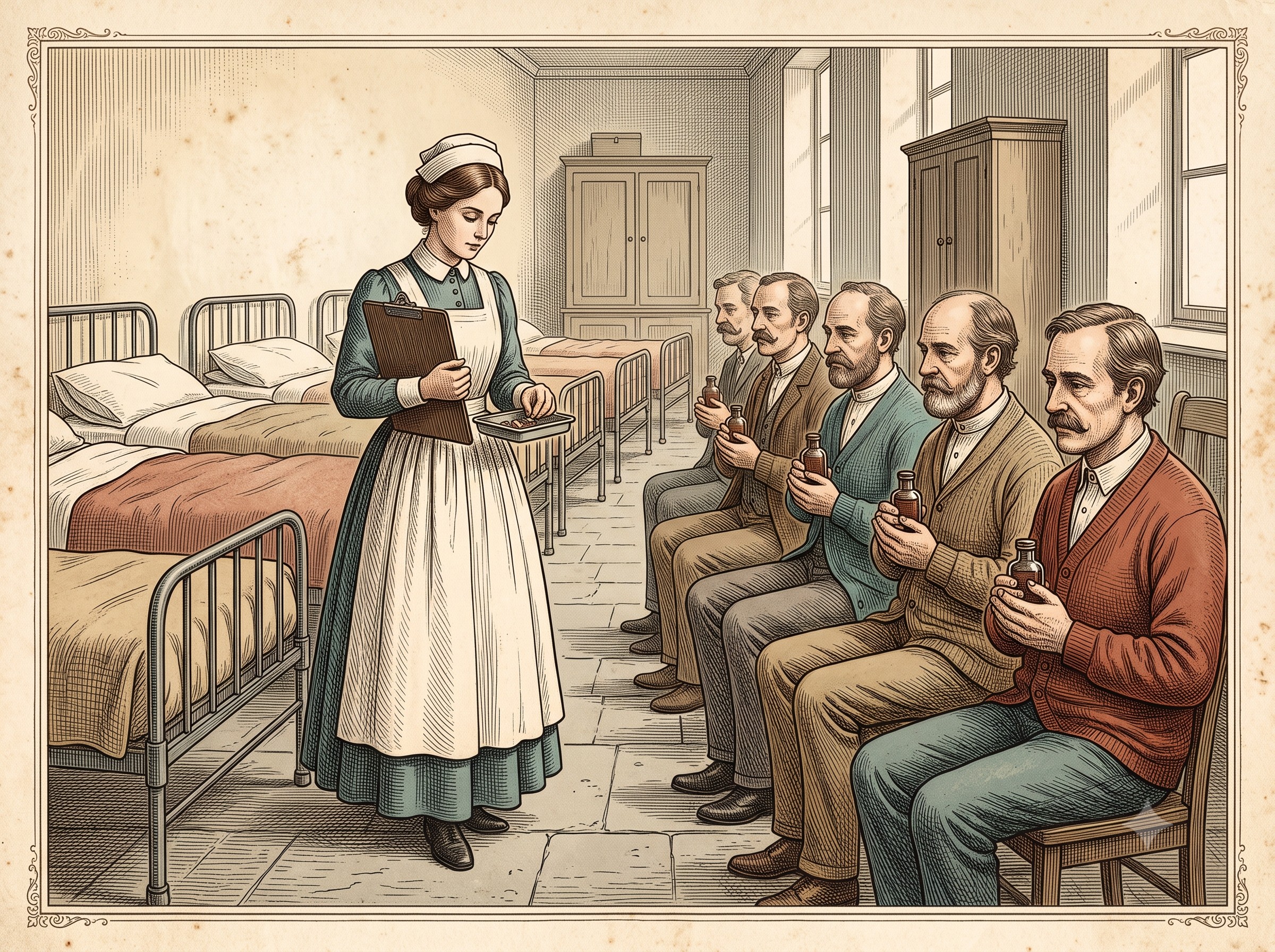
At the end of a chest-pain drug trial in south Wales in the early 1990s, a nurse went down the ward collecting the leftover tablets. It is the dullest step in clinical research: count what comes back, reconcile it against what went out. The men were polite. They were also, one after another, strangely unwilling to hand the bottles over. The drug had done very little for their angina. It had done something else entirely.
By the Curiosities Desk · · 5 read · Filed under Medicine · Today’s round
What happened?
The project began in the mid-1980s at Pfizer’s European research centre in Sandwich, Kent, and it had nothing to do with sex. Chemists there were chasing a molecule for angina — the crushing chest pain that comes when the heart muscle doesn’t get enough blood.
Their target came out of some of the most exciting cardiovascular biology of the decade. Nitroglycerin had been used for angina since the 1870s, and by the 1980s researchers had worked out why it worked: it releases nitric oxide, a gas that relaxes the smooth muscle wrapped around blood vessels. Nitric oxide does this indirectly, by raising levels of a messenger molecule called cyclic GMP (cyclic guanosine monophosphate). An enzyme called phosphodiesterase type 5 — PDE5 — exists to break cyclic GMP back down and end the signal. So the logic was clean: block PDE5, cyclic GMP hangs around longer, vessels stay open, the heart gets more blood.
In 1989 the Sandwich chemists — Andrew Bell, David Brown and Nicholas Terrett are the names usually credited — produced compound UK-92,480, a selective PDE5 inhibitor. Human studies began in the early 1990s, several of them in south Wales, including at Morriston Hospital in Swansea and a clinic in the former mining town of Merthyr Tydfil.
The angina results were flat. The compound barely separated from placebo in the one job it had been built for.
What the volunteers reported instead was unexpected: erections, often several days into a course of tablets, sometimes at night. The most-repeated versions of the story have nurses noticing men lying face-down during ward rounds, and trial staff struggling to get leftover pills returned. Those accounts come from people who were there and have been retold many times since; they don’t appear in the published trial reports, and it’s worth holding them a little loosely. What the record does show clearly is that the effect was reported, taken seriously, and followed.
That left Pfizer with an awkward choice: shelve a failed heart drug, or reopen it for a condition the company had never set out to treat, in a market that at the time consisted largely of injections, implants and silence.
They chose to look. In 1996, a team including Mitradev Boolell and Ian Osterloh published the pivotal small study in the International Journal of Impotence Research: twelve men aged 36 to 63, double-blind, placebo-controlled, crossover design. The same paper reported that PDE5 was the dominant phosphodiesterase in human erectile tissue and that sildenafil shut it down at vanishingly low concentrations. Larger trials followed, including a 1994 study at Morriston that enrolled men with diabetes and heart disease, in whom erectile dysfunction is common.
On 27 March 1998, the U.S. Food and Drug Administration approved sildenafil citrate as Viagra — the first pill for erectile dysfunction.
Why was it strange?
The strange part isn’t that a drug had a side effect. Drugs have side effects constantly. It’s that the failure and the success were the same pharmacology.
Sildenafil did exactly what it was designed to do: protect cyclic GMP and keep smooth muscle relaxed. It simply turned out that the tissue where that mattered most wasn’t the one written on the protocol. The molecule wasn’t wrong. The disease was.
It is also worth resisting the tidy “pure luck” version of this story. Pfizer’s scientists weren’t blindsided by biology they’d never heard of — their own 1996 paper documents PDE5 sitting right there in erectile tissue. The genuine surprise was that a tablet, taken by mouth, could produce an effect there strong enough to matter clinically.
And there’s a quieter oddity. No blood test would have caught this. The discovery depended on middle-aged men in 1990s Britain volunteering an acutely embarrassing piece of information to a stranger with a clipboard — and on that stranger writing it down instead of laughing.
Another accident worth keeping: The Farmer Who Drove Through a Blizzard With a Dead Cow and a Milk Can of Blood.
What did scientists learn?
Mostly, that an erection is a plumbing event, not a mood.
Nerve endings and vessel linings in the penis release nitric oxide, which drives up cyclic GMP, which relaxes the smooth muscle in the erectile tissue so blood can flood in. PDE5 is the off-switch. Sildenafil doesn’t create desire and doesn’t act on the brain; it blocks the off-switch, so a signal that is already there lasts longer. This is why the drug does nothing without sexual stimulation, and why the trials had to be designed with unusual care.
The second lesson was anatomical. PDE5 isn’t unique to the penis — it is also abundant in the small blood vessels of the lungs. That fact would send the drug back to cardiovascular medicine after all.
Another time the mistake was the invention: The Moldy Petri Dish That Almost Got Thrown Away.
How does it affect us today?
Erectile dysfunction stopped being treated as a purely psychological failing and started being treated as what it often is: a vascular problem. It is now recognised as an early warning sign of cardiovascular disease, which means the pill’s biggest medical contribution may be the conversations it started in doctors’ offices rather than the tablets themselves. Sildenafil also opened a whole drug class — tadalafil and vardenafil followed.
And the heart-and-lungs ambition eventually paid off. In 2005 the FDA approved the same molecule, at a lower dose and under the name Revatio, for pulmonary arterial hypertension — dangerously high blood pressure in the lung’s arteries. It is now used in intensive care for newborns with pulmonary hypertension. The compound built for chest pain, rerouted through the most famous side effect in pharmaceutical history, ended up saving infants’ lives.
A close cousin: The Wrong Resistor That Grabbed a Heartbeat Out of Thin Air.
Fun fact
On 12 October 1998 — barely six months after Viagra reached pharmacies — the Nobel Prize in Physiology or Medicine went to Robert Furchgott, Louis Ignarro and Ferid Murad for showing that nitric oxide acts as a signalling molecule in the cardiovascular system. The little blue pill got to market before the biology it depends on got to Stockholm.
Erectile dysfunction is common and frequently signals an underlying vascular or hormonal condition. Anyone concerned about it is better served by a conversation with a doctor than by anything ordered online.
Sources
- Boolell M, Allen MJ, Ballard SA, Gepi-Attee S, Muirhead GJ, Naylor AM, Osterloh IH, Gingell C. “Sildenafil: an orally active type 5 cyclic GMP-specific phosphodiesterase inhibitor for the treatment of penile erectile dysfunction.” International Journal of Impotence Research 8 (1996): 47–52. PubMed 8858389 — the pivotal primary study.
- Osterloh IH. “The discovery and development of Viagra® (sildenafil citrate).” In Sildenafil (Milestones in Drug Therapy), Birkhäuser, 2004. Springer — firsthand account by the clinician who led the programme.
- Ghofrani HA, Osterloh IH, Grimminger F. “Sildenafil: from angina to erectile dysfunction to pulmonary hypertension and beyond.” Nature Reviews Drug Discovery 5 (2006). Nature
- “The Nobel Prize in Physiology or Medicine 1998 — Press release.” NobelPrize.org
- “Viagra: Can BBC show help men talk about erectile dysfunction?” BBC News, December 2023. BBC — on the Welsh trials and the men who took part.