Accidental Discoveries · Medicine
The Wrong Resistor That Grabbed a Heartbeat Out of Thin Air
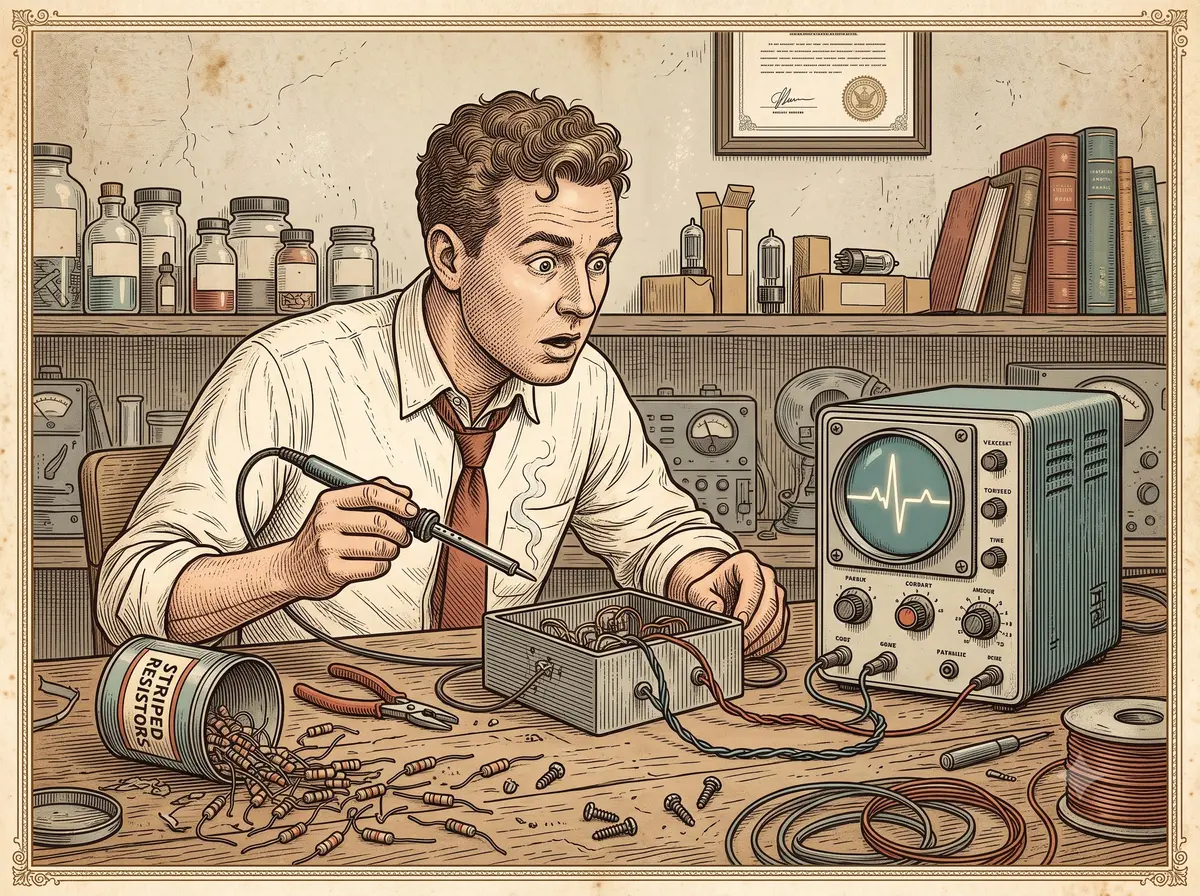
In 1956, an engineer in Buffalo, New York reached into a box of resistors, pulled out the wrong one, and soldered it into his circuit. The box hummed to life: a short tick, a one-second pause, a tick again. He knew that rhythm. It was a heartbeat. "I stared at the thing in disbelief," Wilson Greatbatch said later. He had been trying to build a device that *listened* to hearts. He had accidentally built one that could run them.
By the Curiosities Desk · · 5 min read · Filed under Medicine · Today’s round
What happened: The Pacemaker by Mistake
Wilson Greatbatch was not, by his own account, a prodigy. He was a Navy radioman in the Second World War, then a telephone repairman, then a Cornell engineering student on the G.I. Bill who tested poorly and worked too many jobs. One of those jobs was wiring instruments to sheep and goats at Cornell’s animal behavior farm — attaching sensors that tracked blood pressure, heart rate, and brain waves.
It was there, over brown-bag lunches in 1951, that two visiting surgeons described a condition called heart block: the electrical signal that normally travels from the heart’s upper chambers to its lower chambers fails to arrive. The ventricles beat too slowly, or fall out of sync, and the patient faints, gasps, or dies. To Greatbatch, a radio man, it sounded like a familiar problem in unfamiliar clothing. The signal wasn’t getting through. “When they described it, I knew I could fix it,” he recalled.
He filed that away for five years. By 1956 he was back in Buffalo, teaching electrical engineering at the University of Buffalo and moonlighting at the Chronic Disease Research Institute, where he was building a marker oscillator — a small circuit meant to help record fast heart sounds. The circuit needed a 10,000-ohm resistor. A resistor is just a component that throttles the flow of electric current; the amount it throttles is measured in ohms, and the value is painted on the body in colored stripes. Greatbatch reached into the box and came out with one striped almost identically — but rated at one megohm, a hundred times the resistance he wanted.
He soldered it in. Instead of doing what a marker oscillator does, the circuit fired a pulse lasting 1.8 milliseconds, went quiet for a full second, then fired again. Lub. Dub. Lub. Dub.
Three weeks after showing the idea to William Chardack, chief of surgery at Buffalo’s Veterans Administration Hospital, Greatbatch arrived with a hand-built device roughly two cubic inches in size, running on two Texas Instruments transistors. On May 7, 1958, Chardack and fellow surgeon Andrew Gage exposed a dog’s heart and Greatbatch touched two wires to it. The device took over the heartbeat. Everyone in the room stared.
Then reality arrived. The team had sealed the electronics in electrical tape, which turned out to be a poor defense against the inside of a living body; fluid seeped in and shorted the circuit after about four hours. They switched to casting the whole unit in a solid block of epoxy. Greatbatch quit his jobs, moved into an unheated barn behind his house warmed by a wood stove, and built fifty pacemakers by hand on $2,000 in savings. Forty went into animals. His wife Eleanor helped run reliability tests, tapping transistors with a pencil to see which ones would fail.
Starting April 15, 1960, Chardack and his colleagues implanted the devices in ten human patients. The first, a 77-year-old man with complete heart block, lived another eighteen months. Another was a young man who had collapsed at a rubber factory; he retrained as a hairdresser and lived thirty more years. The team published the results that October in the journal Surgery.
Why it was strange: The Pacemaker by Mistake
Accidents in the lab usually produce a mess or a wasted afternoon. This one produced a signal that happened to match, closely enough to matter, the timing of a human pulse — and it landed in front of one of the very few people on earth primed to recognize what he was looking at.
That’s the part worth sitting with. The resistor didn’t invent anything. Greatbatch’s five-year-old lunchtime conversation about heart block did the real work; the resistor just supplied the coincidence. He was blunt about how little credit he deserved for the moment itself: “if I didn’t do it, someone else would have. Most new developments are like that — not somebody getting a Eureka flash.”
Another time the mistake was the invention: The Failed Heart Pill That Trial Volunteers Wouldn’t Give Back.
What scientists learned: The Pacemaker by Mistake
The circuit Greatbatch stumbled into is called a blocking oscillator — a design that charges up, dumps its energy in one sharp pulse, then goes silent while it recharges. Change the resistance and you change how long the silence lasts. At one megohm, the silence lasted about a second, which is where a resting human pulse happens to live.
The deeper lesson was that the heart is an electrical organ that will obey an outside signal. A healthy heart’s own pacemaker cells fire on their own; when the wiring between chambers fails, an artificial pulse can substitute for the missing instruction. Doctors already knew this — Paul Zoll had built a plug-in external pacemaker in 1952, and it worked, but its shocks were painful and burned the skin. The unsolved problem was never whether you could pace a heart. It was how to make something small enough, sealed well enough, and reliable enough to live inside a person.
That turned out to be a materials and engineering problem more than a medical one, and the answers came slowly: epoxy instead of tape, then Greatbatch’s lithium-iodine battery, introduced to device makers in 1971, which stretched battery life from about two years to a decade or more and ended the ritual of cutting patients open just to swap cells.
Another accident worth keeping: The Farmer Who Drove Through a Blizzard With a Dead Cow and a Milk Can of Blood.
How it reaches us today: The Pacemaker by Mistake
The pacemaker was the first electronic device routinely implanted inside human bodies — the opening act for cochlear implants, deep brain stimulators, implantable defibrillators, and everything else we now put under the skin and expect to keep working. Estimates of annual pacemaker implants worldwide run past a million. Lithium-iodine cells of the type Greatbatch commercialized remain a standard power source.
Greatbatch ended up with more than 140 patents and gave away much of what he earned. He kept a habit of telling students the same line: “Don’t fear failure. Don’t crave success. The reward is not in the results, but rather in the doing.”
A close cousin: The Moldy Petri Dish That Almost Got Thrown Away.
Fun fact: The Pacemaker by Mistake
For roughly five years after the accident, most of the world’s pacemakers used Greatbatch’s simple blocking-oscillator design — meaning a large share of early implanted hearts were, in a real sense, ticking to the rhythm of a part someone grabbed by mistake.
If heart symptoms are on your mind — fainting, a pulse that races or drags, breathlessness — that’s worth a conversation with a doctor rather than a search engine.
Sources: The Pacemaker by Mistake
- Chardack WM, Gage AA, Greatbatch W. “A transistorized, self-contained, implantable pacemaker for the long-term correction of complete heart block.” Surgery 48:643–654 (1960) — the original clinical report
- Smithsonian Lemelson Center, “Innovative Lives: Making Hearts Beat: Wilson Greatbatch” — Greatbatch’s own account of the accident, the barn, and the dog experiment
- Aquilina O. et al. / “50th Anniversary of the First Successful Permanent Pacemaker Implantation in the United States,” American Journal of Cardiology (2010) — resistor values, device specifications, and clinical timeline
- University at Buffalo Jacobs School of Medicine, “Internal Pacemaker”
- Greatbatch W, Holmes CF. “The Lithium/Iodine Battery: A Historical Perspective,” Pacing and Clinical Electrophysiology (1992)
Related stories: The Pacemaker by Mistake
- The Two Vacuum Cleaners That Learned to Breathe — Two vacuum cleaners became the first iron lung
- The Surgeon Who Threaded a Tube Into His Own Heart — He threaded a catheter into his own heart and walked to the X-ray room
- The Rescue Kits That Tried to Revive the Drowning by Blowing Smoke Up Their Backsides — Rescue kits that revived drowning victims with tobacco smoke enemas