The Rescue Kits That Tried to Revive the Drowning by Blowing Smoke Up Their Backsides
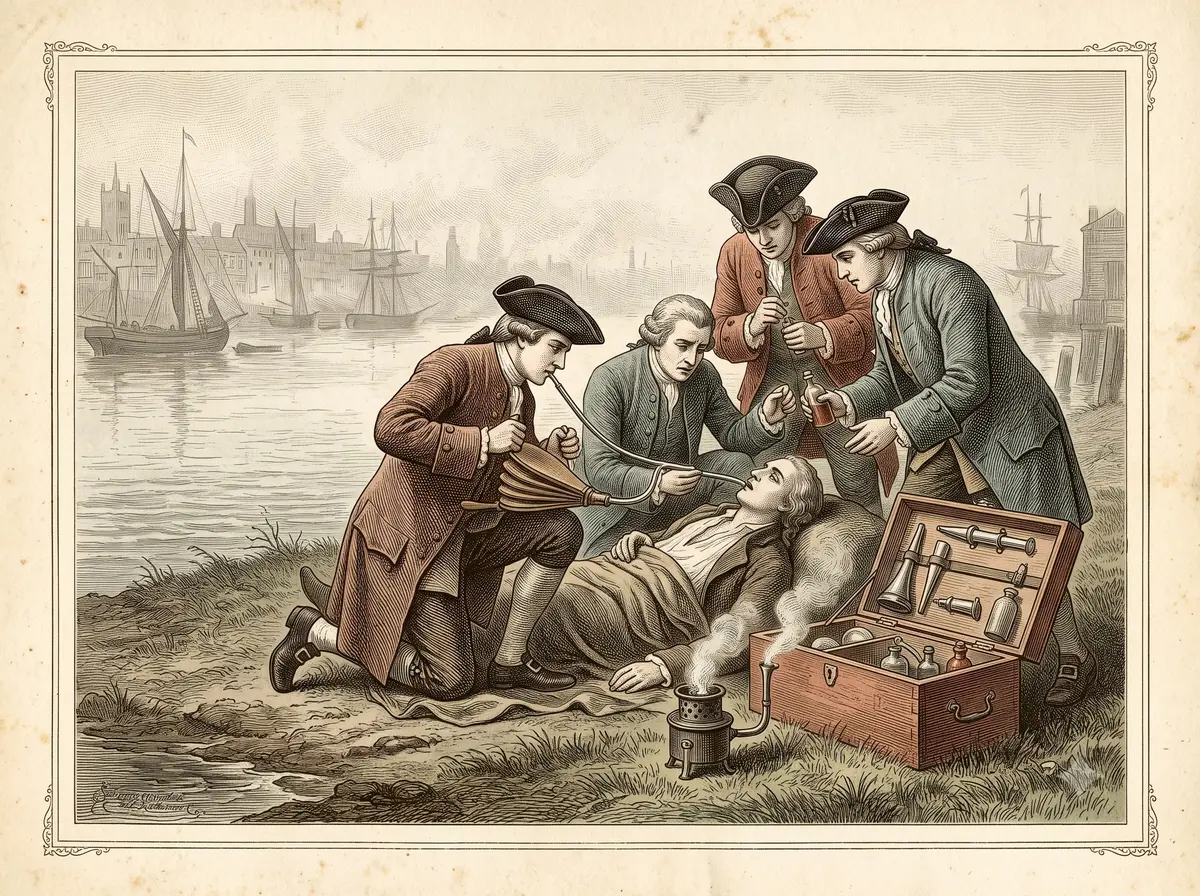
Chained to posts along the banks of the River Thames in the 1780s, next to the boat hooks and the ropes, sat little wooden cases that any passerby could grab in an emergency. Inside each was a set of bellows, a fumigator, and an assortment of tubes and nozzles. If you pulled a drowning person from the water, the recommended treatment was to light some tobacco, attach the bellows, and pump warm smoke — not into their lungs, but up their rectum.
By the Curiosities Desk · · 5 min read · Filed under Medicine · Today’s round
What happened: The Rescue Kits That Tried to Revive the Drowning by Blowing Smoke Up
In the middle of the eighteenth century, a genuinely humane idea took hold across Europe: that a person who appeared to be dead from drowning might not be dead at all, and might be brought back with the right treatment. Cities founded societies to try. Amsterdam started one in 1767. In 1774, an apothecary named William Hawes and a physician named Thomas Cogan founded the London version, the Society for the Recovery of Persons Apparently Drowned — later renamed the Royal Humane Society. Its first thirty-four volunteers bought rescue equipment, published manuals, set up “receiving houses” where the near-drowned could recover, and offered cash rewards to anyone who successfully revived someone.
One of their standard tools was the tobacco smoke enema. The technique came to Europe from North American Indigenous peoples, who used tobacco smoke to stimulate breathing, and European physicians adopted it for an astonishing range of complaints — headaches, colds, hernias, abdominal cramps, even cholera. The English physician Richard Mead was among the first to recommend it specifically for drowning, around 1745. One of the earliest documented cases, from 1746, reads like a scene from a play: a seemingly drowned woman, a passing sailor who suggested his pipe, and her husband inserting the pipe’s stem, covering the bowl with perforated paper, and — in the words of the account — blowing “hard.” The woman reportedly recovered.
By the 1780s the Royal Humane Society had installed resuscitation kits at points along the Thames, a river where drownings were common and few Londoners could swim. Early on, the smoke was delivered the way that sailor did it, through a pipe or tube powered by a rescuer’s own lungs — a method with an obvious and unpleasant hazard, since the rescuer risked inhaling the contents of the patient’s bowel. The bellows-and-fumigator kit was, among other things, a safer redesign: it let you pump the smoke without putting your mouth on the other end. By the turn of the nineteenth century, humane societies rated the smoke enema as roughly as important as artificial respiration.
Why it was strange: The Rescue Kits That Tried to Revive the Drowning by Blowing Smoke Up
It is easy to laugh, and the laugh is fair. But the strangeness runs deeper than the punchline. These were not quacks working in the dark. They were reformers, some of the most forward-thinking medical people of their day, and blowing smoke up a drowning victim was, to them, a rational treatment backed by the leading theory of the body.
That theory was humorism, the ancient idea that health depended on balancing four bodily fluids: blood, phlegm, black bile, and yellow bile. A person pulled cold and waterlogged from a river was thought to be overloaded with wet, cold humours. The obvious fix was to add warmth and dryness — and what could be warmer and drier than the smoke of burning tobacco, pushed deep into the body where it could do the most good? The logic was internally consistent. It was just built on a model of the body that was wrong.
Another ambitious failure: The Olympic Marathon That Rationed Water — and Fed the Winner Rat Poison.
What scientists learned: The Rescue Kits That Tried to Revive the Drowning by Blowing Smoke Up
The correction, when it came, was the opposite of everything the treatment assumed. Doubts about tobacco smoke were already circulating in the 1780s. Then, in 1811, the surgeon Benjamin Brodie ran careful experiments on animals and showed that nicotine — the active agent in tobacco smoke — is not a gentle stimulant but a poison that can act on the heart and stop the circulation of blood. The very substance thought to jump-start a stalled heart could, in enough quantity, stop a healthy one.
Around the same time, the other half of the kit was also found wanting. In 1829 the French physician Leroy d’Étiolles demonstrated that inflating the lungs too forcefully with bellows could rupture their delicate air sacs. Piece by piece, the resuscitation kit was dismantled by evidence.
But the larger idea survived, and it mattered. The humane societies had insisted that “apparent death” was sometimes reversible and worth fighting — a claim that pushed resuscitation out of the realm of miracle stories and into medicine. The specific tools were wrong; the ambition was right, and it set researchers looking for methods that actually worked.
Another experiment that taught more by not working: The Navy Tried Everything to Give 100 Sailors the Flu — and Not One Got Sick.
How it reaches us today: The Rescue Kits That Tried to Revive the Drowning by Blowing Smoke Up
The direct descendant of those Thames-side boxes is the first-aid station: the idea that rescue equipment should be public, portable, and ready before an emergency, not summoned after. The automated external defibrillator (AED) bolted to a wall in an airport or train station is the same instinct, updated with two centuries of evidence about what genuinely restarts a heart. Modern CPR and mouth-to-mouth resuscitation, which only became standard practice around 1959, trace their lineage back through this long, halting effort to bring the “apparently dead” back to life.
The tobacco smoke enema also left a mark on the language. As the treatment’s absurdity became clear, the phrase “blowing smoke up your ass” survived as a way of describing insincere flattery — telling someone something pleasant and useless. Most people who use it have no idea it was once a literal medical procedure.
The same thread — Tobacco — continues in When Doctors Recommended Cigarettes.
Fun fact: The Rescue Kits That Tried to Revive the Drowning by Blowing Smoke Up
The Royal Humane Society printed a mnemonic verse to guide would-be rescuers, recorded in 1774: “Tobacco glyster, breath and bleed. / Keep warm and rub till you succeed. / And spare no pains for what you do; / May one day be repaid to you.” “Glyster” was the old word for enema — so the very first line of the official rescue jingle was, essentially, a reminder to bring the smoke.
Sources: The Rescue Kits That Tried to Revive the Drowning by Blowing Smoke Up
- Tobacco smoke enema — Wikipedia (with primary citations to Sydenham, Mead, Brodie, and the 1774 Houlston verse)
- Isabelle Lawrence, “Saving lives with a puff of smoke?” — Science Museum Blog (2019), based on the museum’s Royal Humane Society resuscitation kit
- Ghislaine Lawrence, “Tools of the Trade: Tobacco smoke enemas,” The Lancet 359 (2002): 1442
- Sterling Haynes, “Special feature: Tobacco smoke enemas,” BC Medical Journal 54 (2012): 496–497
This article touches on drowning and death. If you or someone you know is struggling, support is available — you don’t have to face it alone.
Related stories: The Rescue Kits That Tried to Revive the Drowning by Blowing Smoke Up
- The Seesaw That Was Built to Raise the Dead — A machine built to seesaw the dead back to life
- The Two Vacuum Cleaners That Learned to Breathe — Two vacuum cleaners became the first iron lung
- The Wrong Resistor That Grabbed a Heartbeat Out of Thin Air — A wrong resistor turned a recording device into the pacemaker