Impossible Inventions · Medicine
The Two Vacuum Cleaners That Learned to Breathe
On October 12, 1928, an eight-year-old girl named Bertha Richard was carried into Boston Children's Hospital barely able to draw a breath. Doctors sealed her, up to the neck, inside a seven-foot metal cylinder wired to a motor built from vacuum cleaner parts. Fifteen minutes later, color back in her face, she asked for ice cream.
By the Curiosities Desk · · 6 min read · Filed under Medicine · Today’s round
Part of Built to Do the Impossible
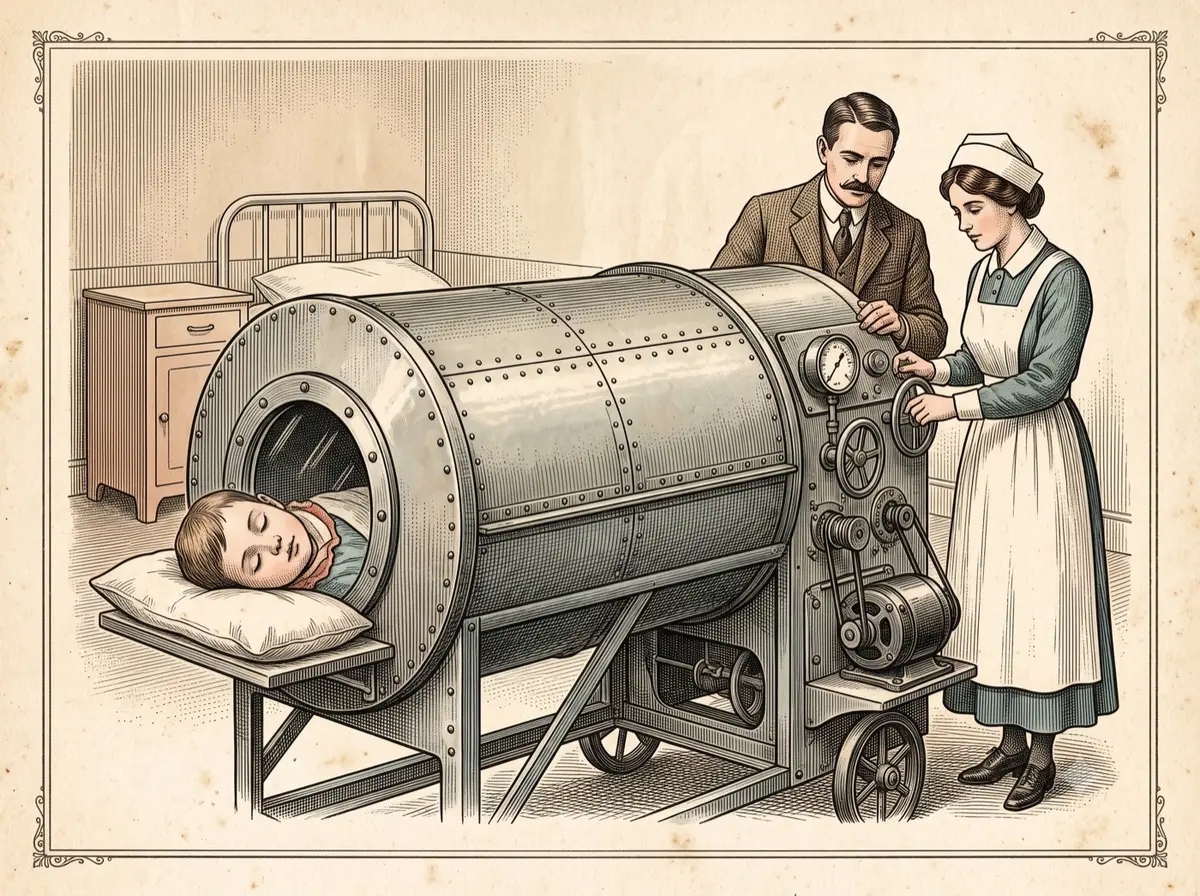
What happened: The Iron Lung
By the mid-1920s, polio outbreaks were a summer terror across the United States. The poliovirus could paralyze the diaphragm and the muscles between the ribs, and a fully conscious patient might suffocate over a matter of hours because the nerves that once told those muscles to move no longer worked.
Philip Drinker and Louis Agassiz Shaw Jr., two researchers in industrial hygiene at the Harvard School of Public Health, weren’t trying to solve polio when they started. Their lab studied resuscitation for victims of gas poisoning and electric shock, and Drinker had been experimenting with ways to move air mechanically in and out of a person’s lungs. Working through 1927 and 1928, he and Shaw built a machine: an airtight metal box just large enough to hold a human body, with a rubber collar sealing around the neck so the head stayed outside. Two motorized blowers — repurposed from ordinary household vacuum cleaners — alternately pumped air in and out of the sealed chamber, changing the pressure around the patient’s chest.
The first patient was Bertha Richard, a construction worker’s daughter from Waltham, Massachusetts, admitted with polio-related breathing failure. Sealed inside the device, her breathing improved almost immediately. It seemed like a triumph — until five days later, when she died of heart failure; the same virus that had paralyzed her breathing muscles had also damaged her heart. The machine itself had done exactly what it was built to do, and hospitals began ordering more.
Drinker’s “respirator” wasn’t cheap — early units cost roughly $1,500, about the price of an average house in 1930s America. That changed in 1931, when engineer John Haven Emerson built a lighter, quieter version using a flexible diaphragm instead of Drinker’s valve-and-blower system, and sold it for well under half the price. Drinker sued him for patent infringement and lost: the courts found the underlying techniques weren’t novel enough to patent exclusively, helping keep the machine affordable and widely copied. The informal nickname that stuck was more memorable than “respirator”: the iron lung.
Through the 1930s, 40s, and into the 1950s, polio epidemics filled hospital wards with rows of iron lungs, mirrors sometimes rigged above patients so they could see the room. The United States’ worst year was 1952, with nearly 58,000 reported cases and more than 3,100 deaths. That same year in Copenhagen, anesthesiologist Bjørn Ibsen faced an epidemic so severe the city’s iron lungs ran out entirely; he pioneered an alternative, having teams of medical students hand-pump air into patients’ lungs through a throat tube, around the clock, for weeks. It worked, and it planted the seed of the modern intensive care unit.
The last iron lungs stayed in use far longer than most people realize. Paul Alexander contracted polio in 1952 at age six and spent nearly 72 years — the rest of his life — relying on one, becoming a lawyer, an author, and briefly a TikTok personality before he died in March 2024 at age 78.
Why it was strange: The Iron Lung
The iron lung didn’t push air into the lungs the way we now picture a “breathing machine” working. It did the opposite: it changed the pressure around the outside of the chest, so the chest itself expanded and pulled air in — mimicking, mechanically, exactly what a diaphragm does naturally. A device that looked like something out of a submarine, built partly from vacuum cleaner motors, was actually a very literal impersonation of a human ribcage.
It’s also strange how completely the treatment demanded the whole body. There was no half measure. To breathe, a patient had to be encased, alone, in a sealed metal tube — sometimes for a few weeks, sometimes, as with Paul Alexander, for the rest of a very long life.
Another machine that should not have worked: The £50-a-Night Electric Bed That Promised Couples a Baby.
What scientists learned: The Iron Lung
The iron lung proved that breathing could be taken over mechanically when the nerves and muscles that normally do the work fail — a principle now called negative-pressure ventilation, because it works by lowering the pressure around the chest rather than forcing air directly into the airway. That confirmed something basic but important about respiratory physiology: air moves into the lungs purely because of a pressure difference, and a machine can create that difference just as well as a diaphragm can, at least for a while.
The Copenhagen epidemic taught doctors the reverse approach also works — positive-pressure ventilation, forcing air directly down the windpipe — and that this method could be scaled up and managed by a coordinated team, not just a single machine per patient. Comparing the two crises showed clinicians that keeping someone breathing during paralysis, poisoning, or surgery was itself a specialized skill worth building an entire ward, and eventually an entire specialty, around.
Another invention that refused to stay on paper: The Head-Bump Machine That Printed Your Personality on Ticker Tape.
How it reaches us today: The Iron Lung
Nearly every mechanical ventilator in a modern intensive care unit — the machines that kept hundreds of thousands of COVID-19 patients breathing in 2020 and 2021 — is a positive-pressure descendant of the approach Bjørn Ibsen improvised when Copenhagen’s iron lungs ran out. The ICU itself, as a dedicated ward staffed for continuous critical care, traces its origin to that same epidemic.
Negative-pressure ventilation, the iron lung’s core idea, didn’t disappear either. Smaller, portable versions called cuirass ventilators — form-fitting shells that cover just the chest and torso instead of the whole body — are still prescribed today for some patients with chronic neuromuscular breathing problems. And the urgency the iron lung wards created, page after page of paralyzed children photographed for newspapers, helped build public support for the Salk and Sabin polio vaccines of the 1950s and early 1960s — vaccines that have brought the disease to the edge of global eradication, though not fully eliminated everywhere.
A close cousin: The 3,000 Letters the Post Office Fired at Florida Inside a Cruise Missile.
Fun fact: The Iron Lung
Paul Alexander eventually learned a technique called glossopharyngeal breathing, or “frog breathing” — gulping mouthfuls of air and using his tongue and throat muscles to push them down into his lungs, letting him leave the iron lung for short stretches. His physical therapist promised him a puppy if he could do it unassisted for three full minutes; it took him about a year, but he got the puppy, and later titled his memoir Three Minutes for a Dog.
Sources: The Iron Lung
- Boston Children’s Hospital Archives / Mass Moments, “Boston Doctors Use First Iron Lung.” https://www.massmoments.org/moment-details/boston-doctors-use-first-iron-lung.html
- Dhawan, Naveen, and Kenneth Iserson. “Philip Drinker versus John Haven Emerson: Battle of the Iron Lung Machines, 1928–1940.” Journal of Medical Biography, 2020. https://journals.sagepub.com/doi/abs/10.1177/0967772017733680
- Smithsonian Magazine, “How a Polio Outbreak in Copenhagen Led to the Invention of the Ventilator.” https://www.smithsonianmag.com/innovation/how-polio-outbreak-copenhagen-led-to-invention-ventilator-180975045/
- CNN, “Paul Alexander: ‘Polio Paul,’ Who Spent Most of the Past 70 Years in an Iron Lung, Dies at 78.” https://www.cnn.com/2024/03/13/health/paul-alexander-polio-iron-lung
- “Iron lung,” Wikipedia (used as a starting point and cross-checked against the sources above). https://en.wikipedia.org/wiki/Iron_lung
A note on this story: it touches on paralysis, chronic illness, and death. If reading about long-term disability or medical dependence brings up anything difficult for you, it may help to talk it through with someone you trust or a healthcare professional.
Related stories: The Iron Lung
- The Rescue Kits That Tried to Revive the Drowning by Blowing Smoke Up Their Backsides — Rescue kits that revived drowning victims with tobacco smoke enemas
- The Seesaw That Was Built to Raise the Dead — A machine built to seesaw the dead back to life
- The Wrong Resistor That Grabbed a Heartbeat Out of Thin Air — A wrong resistor turned a recording device into the pacemaker