Impossible Inventions · Medicine
The £50-a-Night Electric Bed That Promised Couples a Baby
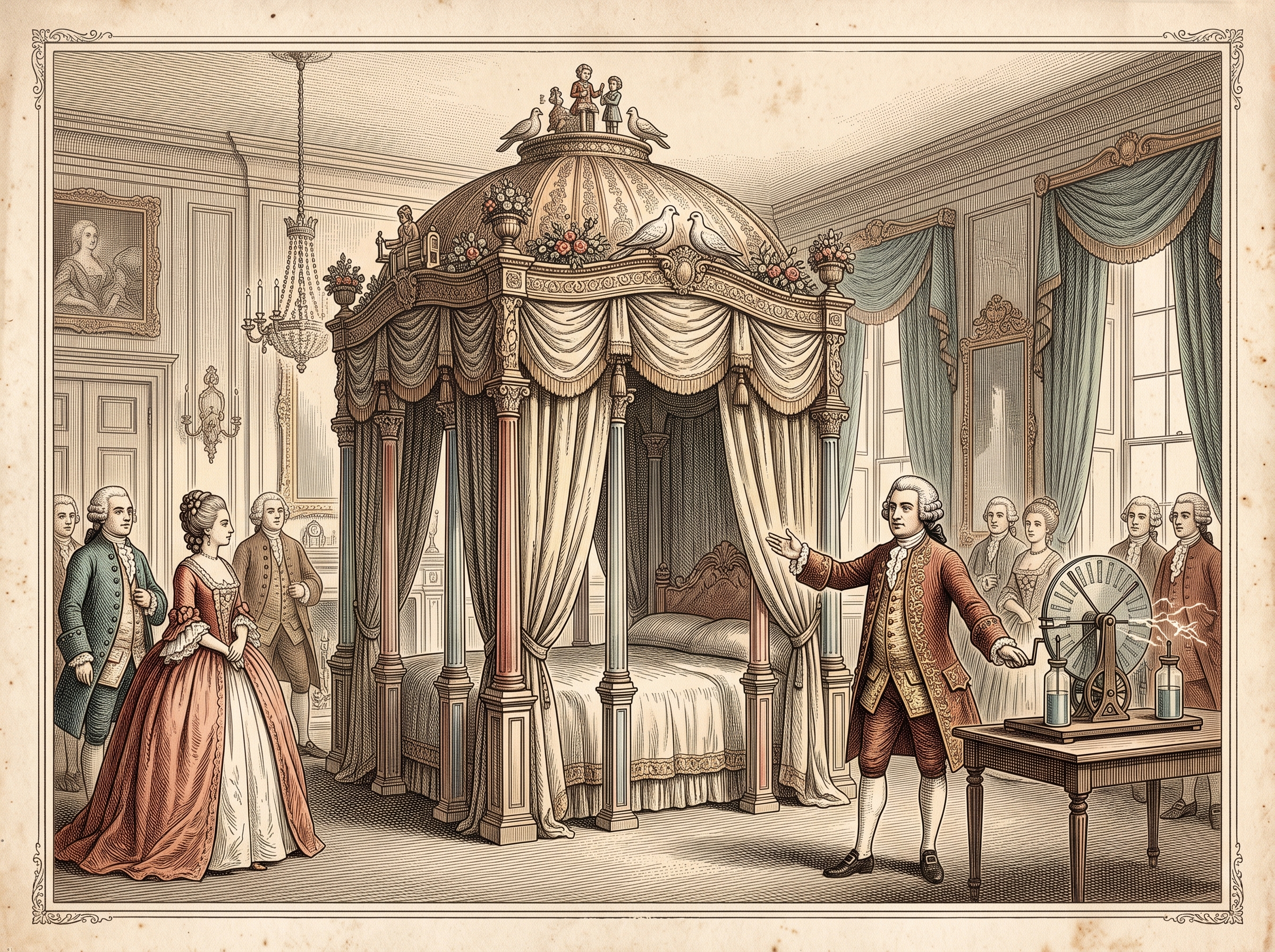
In 1781, in a grand house on Pall Mall in London, you could rent a bed for the night. It was 12 feet long and 9 feet wide. It stood on glass pillars, hummed with electricity, played music from a dome overhead, and came with a pair of live turtle doves. The price was £50, and the man who built it swore that any couple who slept in it would be "blessed with progeny."
By the Curiosities Desk · · 5 read · Filed under Medicine · Today’s round
What happened?
The bed’s inventor was James Graham, born in Edinburgh in 1745. He studied medicine at the University of Edinburgh under some of the most respected teachers of the day, but he left without taking a degree or getting a license to practice as a physician. That didn’t slow him down. He set up as an apothecary in Doncaster, then traveled to America, where he worked in Philadelphia and New York, before returning to Britain to treat patients in Bristol and Bath.
Somewhere along the way, Graham fell in love with electricity. In the 1700s it was the most exciting force in science. Researchers were filling glass jars with static charge and making sparks leap across rooms, and many people believed that a force this mysterious must have something to do with life itself.
In May 1780, Graham opened his first “Temple of Health” at the Adelphi, a fashionable new riverside development in London. It was part clinic, part theater. Visitors walked past displays of electrical and magnetic machines, glass jars crackling with sparks, and piles of crutches and walking sticks supposedly left behind by cured patients. Hidden musicians played. Graham lectured on health and sold remedies with names like “Electrical Aether” and “Nervous Aetherial Balsam.”
A year later, in June 1781, he went bigger. He moved into Schomberg House on Pall Mall and opened a new venue, the Temple of Hymen, named for the Greek god of marriage. Its centerpiece was the Celestial Bed.
By the descriptions that survive, the bed was a masterpiece of excess. It measured about 12 by 9 feet and rested on dozens of pillars of colored glass, which kept it electrically insulated from the floor. A dome above it held musical automata (small mechanical figures that moved and played) along with fresh flowers and the live turtle doves. Graham said the mattress was stuffed with fresh wheat or oat straw mixed with rose leaves, lavender, and balm, along with hair from the tails of stallions. Magnets were reportedly built into the frame, a mirror hung overhead, and the inner frame could be tilted to different angles. Electricity was piped through it, which Graham said would give “the necessary degree of strength and exertion to the nerves.”
The pitch was simple: couples struggling to have children could pay £50 for a night in the bed, and the combination of electricity, magnetism, music, and perfume would do the rest. Fifty pounds was an enormous sum at the time, more than many working Londoners earned in a year. Historians don’t know how many couples actually paid it.
There’s also a famous story attached to the Temple. A teenage Emy Lyon, who later became Emma Hamilton (the celebrated beauty and lover of Admiral Nelson), supposedly posed there in flowing robes as a goddess of health and youth. Some historians repeat this; others call it a later rumor. Nobody has confirmed it with records from the time.
The spectacle didn’t last. Graham’s temples were expensive to run, and by early 1784 he was forced to sell his possessions. He went home to Edinburgh, and what became of the bed is unknown.
Why was it strange?
The Celestial Bed sounds like pure showmanship, but it was built on the cutting-edge science of its day. Electricity really was new and astonishing. Respected scientists were experimenting with it, and some doctors were already using mild shocks as treatment. Graham took that real excitement and stretched it as far as it could possibly go.
That’s what makes him so interesting. He wasn’t selling a potion made of nothing. He was selling a real force of nature, wrapped in glass, gold paint, and music. To a visitor in 1781, the idea that electricity might help bring new life into the world wasn’t obviously crazy. Nobody yet understood how electricity worked inside the body, so nobody could prove it didn’t.
Another invention that refused to stay on paper: The Head-Bump Machine That Printed Your Personality on Ticker Tape.
What did scientists learn?
Graham’s bed couldn’t do what he promised. Conceiving a child depends on things like hormones, the timing of ovulation, healthy sperm, and open reproductive pathways. Static electricity, magnets, and lavender-scented straw don’t touch any of them.
But the larger story taught medicine an important lesson. In the late 1700s, “electrical medicine” was booming, and it was hard for the public to tell a careful experimenter from a showman. Real progress came from testing. In 1784, a French royal commission that included Benjamin Franklin tested another fashionable cure, Franz Mesmer’s “animal magnetism,” and concluded that its effects came from patients’ expectations rather than any invisible force. That kind of controlled comparison became one of the foundations of modern medical evidence.
And electricity did turn out to matter to the body. In the 1790s, Luigi Galvani showed that electrical signals make muscles move. Graham was right that electricity and life were connected. He was just wrong about almost everything else.
Another machine that should not have worked: The Two Vacuum Cleaners That Learned to Breathe.
How does it affect us today?
Today, medicine uses electricity with great precision: pacemakers keep hearts in rhythm, defibrillators restart them, and nerve stimulators can ease some kinds of pain. None of these were invented by Graham, but they grew out of the same question that made his temple feel thrilling.
Fertility treatment has also come a very long way. IVF (in vitro fertilization, where an egg is fertilized outside the body and then placed in the womb) has helped millions of babies be born since 1978. And modern rules about medical advertising exist partly because of showmen like Graham, who sold hope with no evidence behind it.
A close cousin: The Motor That Ran for Twenty-Six Years on a Secret Room Full of Compressed Air.
Fun fact
After the Celestial Bed, Graham found a new miracle cure: dirt. In 1786 he gave public demonstrations in London of “earth-bathing,” lecturing while buried up to his neck in soil, and he later published a pamphlet praising the “all-cleansing, all-healing, all-vigorating” powers of the earth.
Sources
- All-cleansing, all-healing, all-vigorating: James Graham’s earth cure — Royal College of Physicians, Library and Archives
- A lecture on the generation, increase, and improvement of the human species (James Graham, c. 1783) — Wellcome Collection
- The Prince of Quacks and How He Captivated London — JSTOR Daily
- Graham’s Celestial Bed — Museum of Hoaxes
- James Graham (sexologist) — Wikipedia
If you’re navigating infertility, you’re far from alone. A doctor or fertility clinic can talk through evidence-based options, and support groups can help with the emotional side of the journey.