Impossible Inventions · Medicine
The 'Electric' Hairbrush With No Electricity in It — and the Tiny Compass Packed In to Prove It Worked
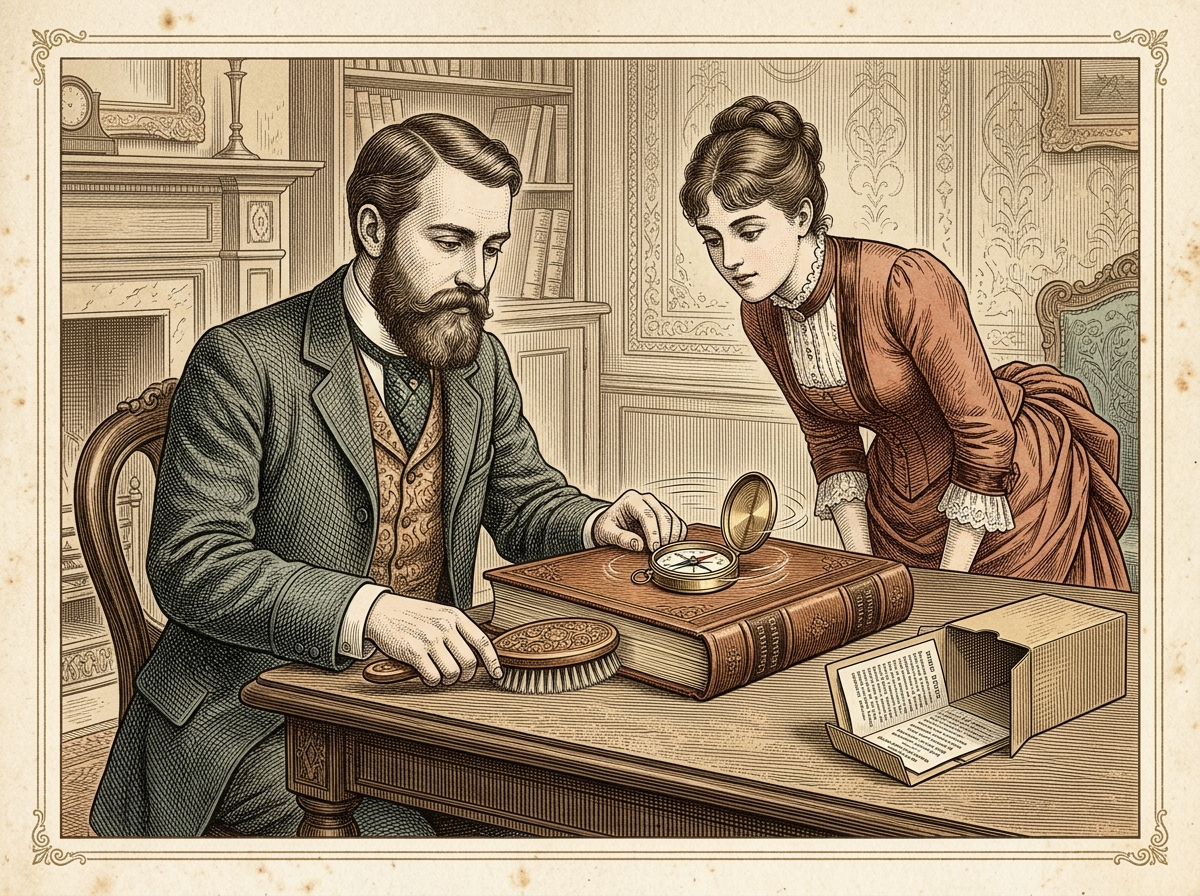
Open the box, and alongside a perfectly ordinary-looking hairbrush you'd find a little pocket compass. The instructions told you to set the compass on a thick book, then slide the brush around underneath. The needle would twitch and spin. That, the makers suggested, was the power that would cure your headache, stop your hair from falling out and keep it from going gray. The brush was sold as electric. There was no electricity in it at all.
By the Curiosities Desk · · 5 min read · Filed under Medicine · Today’s round
What happened?
In November 1879, a New York businessman named George A. Scott filed a patent for a brush. It was granted on March 1, 1881, as U.S. Patent 238,444, and its stated purpose was simple: to “secure within the interior of such a brush one or more natural or artificial magnets.” The patent explained that “many persons” believed magnets made brushes useful “for relieving headache,” preventing baldness and similar purposes. Scott didn’t claim to have tested the idea. He just built a brush to hold it.
Scott sold his products as “Dr. Scott,” and sources disagree about whether he had any medical training. A 19th-century biographical dictionary listed him among notable men of the century; a South Dakota State University museum history describes him as a businessman with no medical training. Either way, he was very good at selling.
By the early 1880s, “Dr. Scott’s Electric Hair Brush” was advertised on both sides of the Atlantic, with a London arm called the Pall Mall Electric Association. A promotional leaflet now held by the Wellcome Collection in London, dated to around 1883, calls the brush “an honest remedy” and says it is “warranted to cure nervous headache,” with help for falling hair, dandruff and graying thrown in. An 1882 ad for its sibling, the Electric Flesh Brush, promised relief from rheumatism, sciatica, gout, lumbago, neuralgia and toothache — plus, delicately, “backaches peculiar to ladies.”
The line kept growing. There were Dr. Scott’s electric corsets “for delicate ladies,” electric belts, wristlets, toothbrushes, and even electric curry combs for horses. The brush handles carried a heraldic crest and a motto: “The germ of all life is electricity.”
What was actually inside? Museum examples show a slightly magnetized iron rod tucked into the handle. Because the magnet was far too weak to pick up a pin, each brush came with that small compass so customers could see for themselves that something was in there. Users were told to rub the bristles on their hair or clothes first — building up a bit of static — and then hold the brush over the sore spot. Some boxes added a warning that the brush shouldn’t be shared with other family members, or it would lose its curative power.
Scott died in Colorado Springs in 1890, and his brushes outlived him; versions were still being advertised in the early 1900s. Fashion moved on to battery-powered “galvanic” gadgets, but the magnet-in-a-handle idea never fully disappeared.
Why was it strange?
The compass test was a clever bit of showmanship, because it was completely honest about the wrong thing. A magnet really does move a compass needle. So the demonstration proved, truthfully, that there was a magnet in the brush. What it couldn’t prove was any of the claims that mattered: that the brush made electricity, that the magnet did anything to a human scalp, or that it cured headaches.
There’s also a mismatch hiding in the name. A magnet sitting still isn’t an electric current, and it doesn’t make one. The brush was “electric” the way a rubber duck is a duck. In the 1880s, though, electricity was the most exciting force on Earth — Edison opened his Pearl Street power station in New York in 1882, the same year the flesh-brush ad ran — and the word sold itself. Customers weren’t foolish for being curious. Electricity really was transforming the world; it just wasn’t happening inside their hairbrushes.
What did scientists learn?
Electricity and magnetism are deeply connected — two faces of the same force, called electromagnetism — but the connection works through motion. In 1831, Michael Faraday showed that moving a magnet near a loop of wire pushes a current through the wire. That’s how power-station generators work. A magnet buried in a plastic handle, with no wire circuit and nothing to drive the current anywhere useful, does none of this. Brushing your hair with it just waves a weak magnet past your head.
The static from rubbing the bristles was real too, but static electricity is a buildup of charge that jumps away in a small zap. It’s the same thing you get from a wool sweater, and it doesn’t treat anything.
So why did people swear by the brushes? Headaches come and go on their own, and a ritual that feels scientific can make people feel better. Doctors call that the placebo effect: real relief caused by expectation rather than by the treatment itself. That’s also why testimonials are such weak evidence. To know whether a treatment works, you have to compare it fairly against something that looks the same but lacks the supposed active ingredient.
How does it affect us today?
Magnetic bracelets, insoles and mattress pads are still sold for aches and pains. In 2007, researchers Max Pittler, Elizabeth Brown and Edzard Ernst pooled the results of randomized trials of static magnets for pain in the Canadian Medical Association Journal. They found no significant benefit over placebo and did not recommend them, though they noted the evidence for osteoarthritis was too thin to rule out a benefit completely.
Dr. Scott’s era also helped push lawmakers toward regulating health gadgets. In the United States, the 1938 Federal Food, Drug, and Cosmetic Act gave regulators power over medical devices for the first time — though a device still didn’t have to be proven to work before it went on sale until the Medical Device Amendments of 1976.
If you deal with frequent headaches or ongoing pain, it’s worth talking with a doctor or pharmacist — there are treatments with real evidence behind them.
Fun fact
Those advertising compasses outlasted most of the brushes’ promises. Collectors still trade them today, sometimes with Dr. Scott’s name printed right on the dial.
Sources
- George A. Scott, U.S. Patent 238,444, “Brush”, filed November 29, 1879, issued March 1, 1881.
- Pall Mall Electric Association, “Dr. Scott’s electric hair brush: an honest remedy”, advertising leaflet, c. 1883, Wellcome Collection.
- Pall Mall Electric Association, “Dr. Scott’s electric corset”, advertising broadside, c. 1882, Wellcome Collection.
- South Dakota Agricultural Heritage Museum, “Dr. Scott’s Electric Flesh Brush”, South Dakota State University.
- Max H. Pittler, Elizabeth M. Brown and Edzard Ernst, “Static magnets for reducing pain: systematic review and meta-analysis of randomized trials”, CMAJ 177, no. 7 (2007): 736–742.