Impossible Inventions · Medicine
The Head-Bump Machine That Printed Your Personality on Ticker Tape
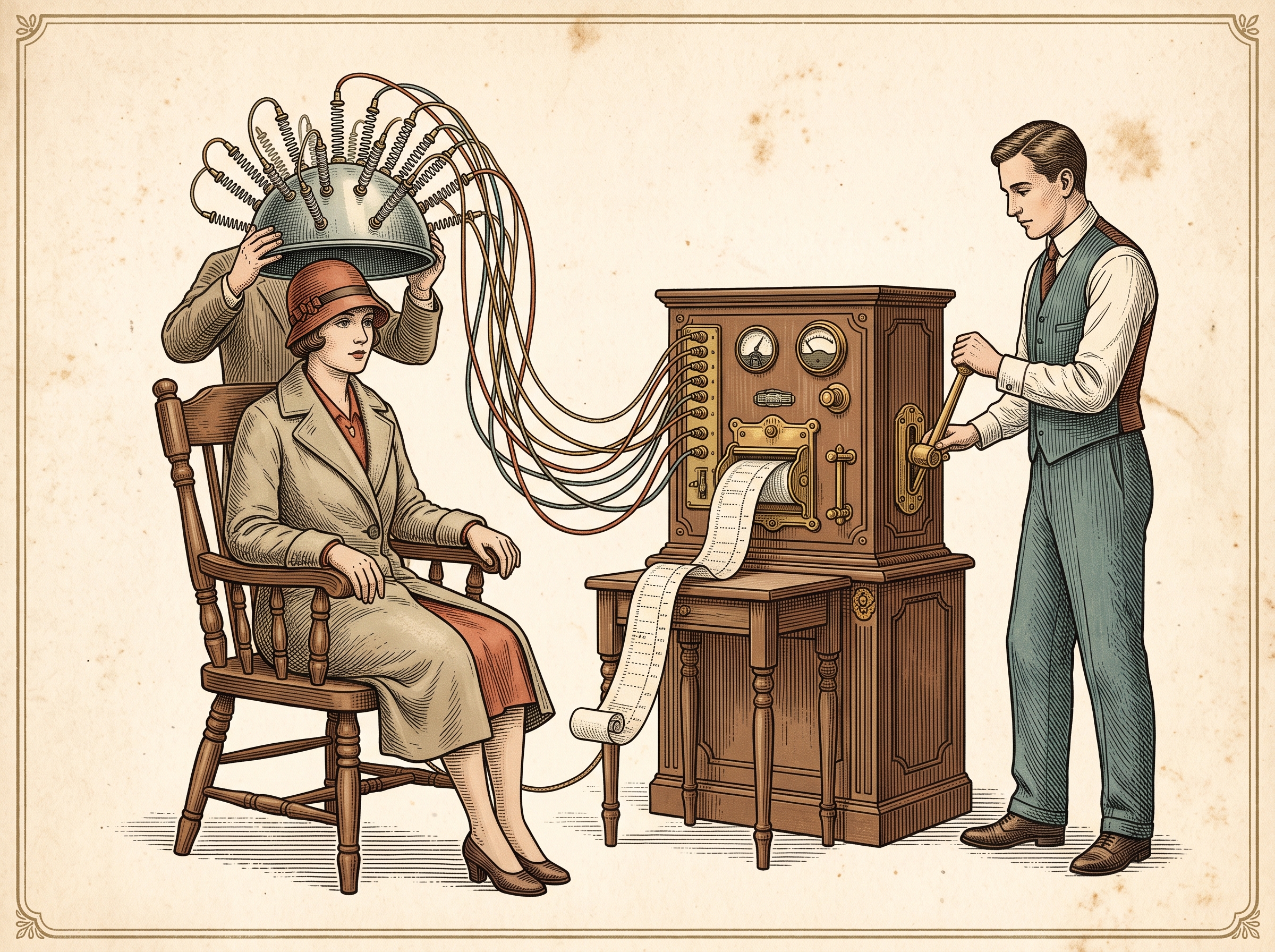
In 1931 in Minneapolis, a customer sits down in a chair, and a metal helmet bristling with 32 spring-loaded probes is lowered onto their head. An operator pulls a lever. A motor hums inside a walnut cabinet, and out clatters a strip of paper tape rating the customer's mind, one faculty at a time, from "deficient" to "very superior." All the machine had actually measured was the shape of their skull.
By the Curiosities Desk · · 5 read · Filed under Medicine · Today’s round
What happened?
The idea behind the machine was more than a century old. Around 1800, the Viennese physician Franz Joseph Gall proposed that the brain was made of separate “organs,” each responsible for a trait such as cautiousness, self-esteem, or the love of laughter. A bigger organ, he reasoned, would push the skull outward, so you could read a person’s character by feeling the bumps on their head. His collaborator Johann Spurzheim helped spread the system, which came to be called phrenology (from the Greek for “study of the mind”). By the mid-1800s it was a popular craze, with plaster heads divided into labeled zones and traveling practitioners offering readings by hand.
Henry C. Lavery of Superior, Wisconsin, wanted to take the human fingers out of the process. According to Bob McCoy, curator of the Museum of Questionable Medical Devices, Lavery became convinced in 1901 that phrenology was true and spent the next 26 years trying to build it into a machine. He patented his first version in 1905. The museum notes, with some affection, that this first machine, with around 1,900 parts, didn’t work.
Lavery kept at it. He eventually teamed up with Frank P. White, a Minneapolis businessman. According to McCoy, White financed the venture by cashing out his $39,000 of life savings — money he had invested in a local sandpaper manufacturer called 3M. The Psychograph Company operated out of Minneapolis from 1929 to 1937, and on January 29, 1931, the partners announced their finished invention. A later Lavery patent, “Anatomical Measuring and Recording Machine,” was granted on February 14, 1933.
The finished Psychograph (the company often spelled it “Psycograph”) was an impressive piece of engineering. It had 1,954 parts. Its headpiece carried 32 probes, one for each phrenological faculty, and each probe had five contact points. Depending on which points touched the scalp, the machine sent low-voltage signals to a belt-driven printer in the cabinet. With five possible ratings for each of 32 faculties, there were 160 possible printed statements — and an enormous number of combinations. Customers also received a vocational chart suggesting careers that suited their “results.”
About 33 machines were built. They were leased to operators around the country for $2,000 down plus $35 a month and set up in theater lobbies and department stores, where they drew crowds during the Great Depression. McCoy recounts that two promoters ran a standing-room-only booth at Chicago’s Century of Progress Exposition in 1934 and cleared $200,000.
The boom didn’t last. By the mid-1930s, growing public skepticism and falling income had caught up with the company, which closed in 1937. The machines went into storage for decades.
Why was it strange?
The Psychograph was a precise instrument for measuring the wrong thing. Every wire, probe, and printed phrase was carefully built — but it rested on a theory that scientists had already abandoned. During the 1800s, other researchers had struggled to replicate phrenologists’ findings, and in 1861 the French physician Paul Broca linked speech to a specific region of the brain by studying patients with brain damage. That kind of evidence didn’t match the phrenology maps. As the Oxford team behind a 2018 study (more on that below) put it, Broca and Carl Wernicke found language areas on the side of the brain, roughly around the ear — while phrenologists had placed the “Organ of Language” below the eye.
So by the time Lavery’s device went on sale, it was mechanizing an idea that had been discredited for decades. The machinery gave the readings an air of objectivity that no palm reader could match. A strip of printed tape from a humming motor simply felt scientific.
Another invention that refused to stay on paper: The £50-a-Night Electric Bed That Promised Couples a Baby.
What did scientists learn?
Phrenology got one big idea partly right: different areas of the brain do handle different jobs. Neuroscientists call this localization of function. What phrenology got wrong was nearly everything else — the list of “faculties,” where they supposedly lived, and above all the assumption that the brain reshapes the skull enough to be read from the outside.
In 2018, a team at the University of Oxford decided to test that assumption directly rather than dismissing it. Using MRI scans from 5,724 volunteers in the UK Biobank study, they measured the curvature of each person’s scalp and compared it with lifestyle and personality measures chosen to match Victorian “faculties.” Publishing in the journal Cortex, they reported that they “found no evidence” for phrenology’s central claim. The folds of the brain explained very little about the shape of the scalp, and no region of the head lined up with any trait they tested. A more accurate phrenology bust, they concluded, would be left blank.
Another machine that should not have worked: The Two Vacuum Cleaners That Learned to Breathe.
How does it affect us today?
The Psychograph lives on as a teaching tool. Bob McCoy and White’s son John got several machines working again in the 1960s, and hundreds of thousands of visitors to McCoy’s Minneapolis museum had their heads “examined.” When McCoy retired in 2002, he donated his collection to the Science Museum of Minnesota, where a Psychograph remains part of its exhibit on questionable medicine.
Its lesson still applies. Dials, printouts, and screens can make a claim look rigorous whether or not the idea underneath has been tested. Asking “what exactly is being measured, and has anyone checked that it means anything?” is as useful for a modern gadget or app as it was for a helmet of probes in a department store.
The same thread — Quackery — continues in The Fake Metal Rods That Accidentally Invented the Placebo-Controlled Trial.
Fun fact
The Oxford researchers noted that phrenology had one lucky near-miss: in 1998, electrically stimulating a brain area close to Gall’s supposed “Organ of Mirthfulness” reportedly made a patient laugh. The team concluded the match was most likely a coincidence.
Sources
- History of Phrenology and the Psycograph — Bob McCoy, Museum of Questionable Medical Devices
- The Psycograph — Museum of Questionable Medical Devices
- Parker Jones, Alfaro-Almagro & Jbabdi (2018), “An empirical, 21st century evaluation of phrenology,” Cortex 106 (PMC)
- U.S. Patent 1,897,941: Anatomical Measuring and Recording Machine, H. C. Lavery (Google Patents)
- Quackery Museum Closes — NPR (2002)