Weird Medical History · Medicine
The Fake Metal Rods That Accidentally Invented the Placebo-Controlled Trial
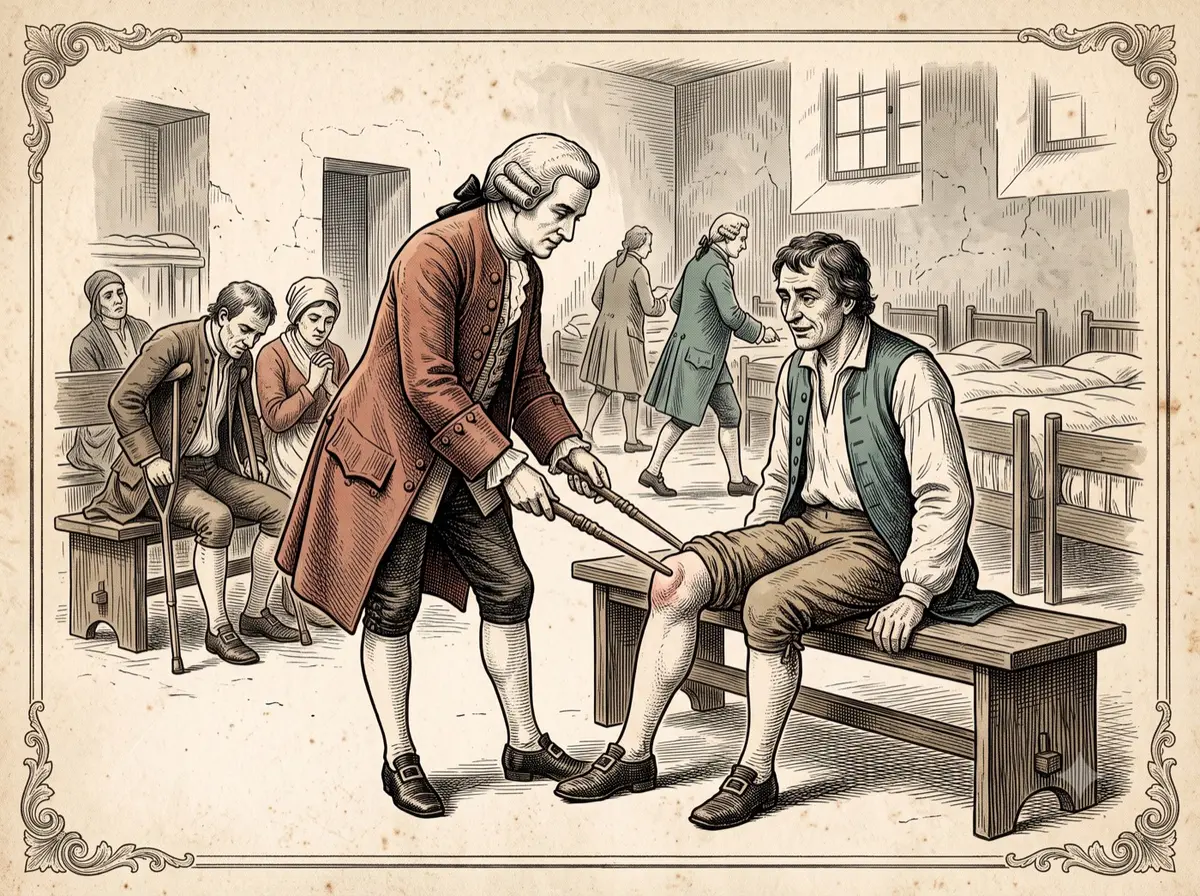
In the winter of 1799, a doctor in Bath, England, carved two small wooden rods, painted them to look like metal, and pressed them against the aching joints of five rheumatic patients. Four of them felt better. The trouble was that the rods weren't supposed to work at all — they were fakes, built specifically to prove that a wildly popular, five-guinea "miracle" medical device was doing absolutely nothing except convincing people it was.
By the Curiosities Desk · · 6 min read · Filed under Medicine · Today’s round
Part of Medicine, Before It Was Sure
What happened: The Fake Metal Rods That Accidentally Invented the Placebo-Controlled Trial
The real device was called Perkins Patent Tractors, and it was the invention of Elisha Perkins, a Connecticut physician who had served as a surgeon in the Continental Army during the Battle of Bunker Hill. Around 1795–96, Perkins began selling a pair of pointed metal rods, one supposedly brass and one supposedly iron, though skeptics later found them to be ordinary metals dressed up with a good story. He patented the design on February 19, 1796, claiming the rods could “draw off the noxious electrical fluid” that caused disease. A patient simply held one in each hand and stroked the tips over the painful area for about twenty minutes. Perkins claimed the tractors cured rheumatism, inflammation, and facial pain, among other ailments, and he built his pitch on the era’s genuine excitement about electricity and “animal magnetism,” fresh off the work of scientists like Luigi Galvani.
The tractors were an immediate sensation. Perkins claimed 5,000 cured cases, backed, he said, by certificates from eight professors, forty physicians, and thirty clergymen. George Washington reportedly bought a set for his household. Physicians at Copenhagen’s royal Frederiks Hospital endorsed the method. Perkins’s son Benjamin took the tractors to London in 1798, where they sold for five guineas a pair, a steep price, and where a charitable “Perkinean Institution” was founded to treat the poor with them.
Not everyone was convinced. In 1797 the Connecticut Medical Society expelled Perkins from its ranks, condemning the tractors as “delusive quackery” and Perkins himself as a seller of nostrums. But condemnation from a state medical society couldn’t compete with celebrity endorsements and glowing testimonials, and sales kept climbing on both sides of the Atlantic.
The device met its real match in John Haygarth, a physician in Bath already well known for pioneering fever wards and inoculation campaigns against smallpox. In January 1799, Haygarth and a colleague tested the tractors on patients with chronic rheumatism at the Bath General Hospital — except the “tractors” they used were plain wood, carved and painted to resemble the metal originals. Three of the five patients reported significant relief and a fourth felt some improvement. The following day, the same patients were treated with genuine metal Perkins tractors, and the results were essentially identical. Haygarth published his findings in 1800 in a short book with the pointed title Of the Imagination, as a Cause and as a Cure of Disorders of the Body.
Perkins never saw his invention’s undoing. He died in New York City on September 6, 1799, of yellow fever, while testing a different remedy of his own devising — a vinegar-and-salt treatment he believed could cure the very disease that killed him.
Why it was strange: The Fake Metal Rods That Accidentally Invented the Placebo-Controlled Trial
The tractors weren’t a fringe curiosity peddled by a lone crank. They were endorsed by respected physicians, a head of state, and a hospital full of surgeons, and they made Perkins genuinely wealthy. The expectation being violated here wasn’t just “does this device work” — it was the assumption that visible, tangible results (patients said they felt better!) were reliable proof that a treatment worked at all. Haygarth’s fake wooden rods produced the same relief as the “real” ones, which meant the cure had never been in the metal in the first place.
The same thread — Quackery — continues in The Rooster Diagnosed by Mail With Malaria, Diabetes, Cancer, and Syphilis.
What scientists learned: The Fake Metal Rods That Accidentally Invented the Placebo-Controlled Trial
Haygarth’s experiment is now recognized as one of the earliest documented demonstrations of what we call the placebo effect — the measurable, real physiological and psychological improvement a person can experience from a treatment with no active therapeutic ingredient, driven by expectation and belief rather than the treatment itself. Haygarth didn’t have that vocabulary yet; he described it as showing “what powerful influence upon diseases is produced by mere imagination.” Crucially, he isolated the variable that mattered by changing only the material of the rods while keeping everything else about the treatment — the ritual, the ceremony, the doctor’s attention — the same. That structure, a “sham” version of a treatment tested against the real one, is the direct ancestor of the placebo-controlled trials that now underpin modern medical research.
It’s worth being precise about what this does and doesn’t prove. Haygarth’s sample was tiny — five patients, no randomization — so it wasn’t a rigorous experiment by today’s standards. Its importance is historical: it was among the first times someone deliberately built a fake version of a treatment to test whether belief alone explained the results, and it got that question right.
Another odd chapter in medicine: The Tomato Pills That Cured Everything — and Contained No Tomato.
How it reaches us today: The Fake Metal Rods That Accidentally Invented the Placebo-Controlled Trial
Every time a new drug goes through a clinical trial, some patients typically receive a placebo — an inert pill or sham procedure — so researchers can measure how much of the drug’s apparent effect is due to the chemistry and how much is due to expectation. Regulatory agencies like the FDA generally require this comparison before approving new medicines. The placebo effect itself remains an active area of research; scientists now study the neurochemistry behind it, including the release of the body’s own pain-relieving compounds when a patient believes they’re being treated. None of that erases the value of expectation and care in medicine, but it does mean doctors and researchers can no longer mistake “the patient felt better” for proof that a given treatment caused the improvement.
Another treatment that history kept the receipt for: The Goat-Gland Surgery That Ended Up Rewriting American Radio Law.
Fun fact: The Fake Metal Rods That Accidentally Invented the Placebo-Controlled Trial
The tractors’ champions didn’t go quietly. In 1803, American poet Thomas Green Fessenden published a mock-heroic poem called “Terrible Tractoration,” defending Perkins and mocking his medical critics — turning a scientific dispute over metal rods into a genuine literary satire that circulated on both sides of the Atlantic.
Sources: The Fake Metal Rods That Accidentally Invented the Placebo-Controlled Trial
- Booth, C. “The Rod of Aesculapios: John Haygarth (1740–1827) and Perkins’ Metallic Tractors.” Journal of Medical Biography, 2005: https://pubmed.ncbi.nlm.nih.gov/16059528/
- Miller, William Snow. “Elisha Perkins and His Metallic Tractors.” Yale Journal of Biology and Medicine, 1935 (hosted by PubMed Central): https://www.ncbi.nlm.nih.gov/pmc/articles/PMC2601307/
- “Elisha Perkins” — Wikipedia (cross-referenced with cited sources): https://en.wikipedia.org/wiki/Elisha_Perkins
- “John Haygarth” — Wikipedia (cross-referenced with cited sources): https://en.wikipedia.org/wiki/John_Haygarth
- “Perkins’ Metallic Tractors: Doctors Used To Think These Metal Rods Could Cure Everything,” IFLScience: https://www.iflscience.com/perkins-metallic-tractors-doctors-used-to-think-these-metal-rods-could-cure-everything-70051
Related stories: The Fake Metal Rods That Accidentally Invented the Placebo-Controlled Trial
- Clever Hans: The Horse That Could ‘Do Math’ — A horse that seemed to do arithmetic, and the bias it exposed
- The Everlasting Pill That Families Fished Out of the Chamber Pot and Passed Down — An antimony pill that families recovered, cleaned, and passed down
- When Doctors Recommended Cigarettes — Doctors once appeared in cigarette ads recommending brands