Weird Medical History · Chemistry
The Everlasting Pill That Families Fished Out of the Chamber Pot and Passed Down
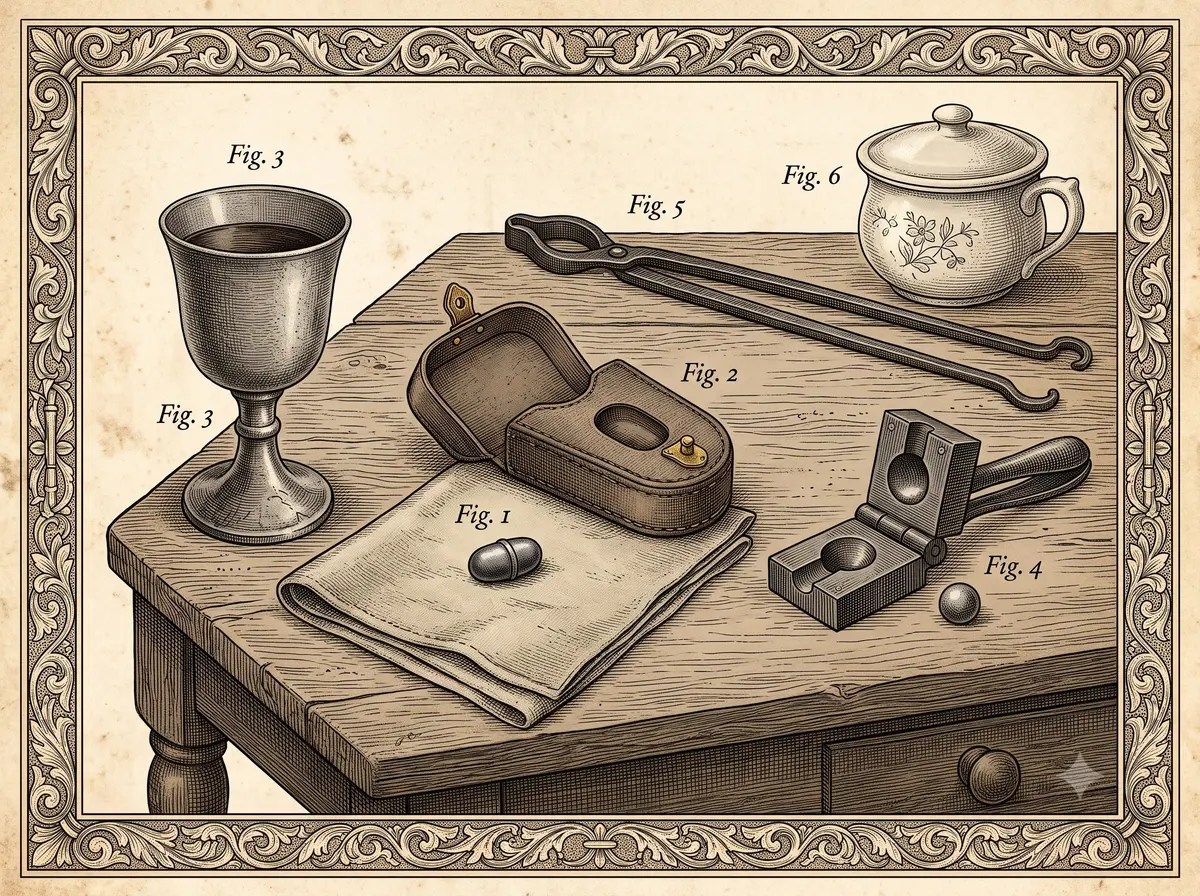
Somewhere in a seventeenth-century European household, an everlasting pill — a small grey metal ball — is being retrieved from a chamber pot with a stick. It is rinsed, dried, and put back in the box on the shelf. It cost real money, it has already worked on three members of the family, and it will keep working for decades. It is a laxative. It is also, as far as its owners are concerned, permanent.
By the Curiosities Desk · · 5 min read · Filed under Chemistry · Today’s round
What happened: An Everlasting Pill
The object was an antimony pill — pilula perpetua, the everlasting pill. Antimony is a brittle, silvery metalloid (an element with properties partway between a metal and a nonmetal), and from roughly the sixteenth through the early nineteenth century, European medicine was fascinated by what it did to the human gut.
The fascination came from the alchemical fringe. Paracelsus had championed mineral remedies against the older, plant-based Galenic tradition, and in 1604 a German book called Triumph Wagen Antimonii — “The Triumphal Chariot of Antimony,” translated into English in 1678 — turned antimony into a bestseller. The book was credited to a Benedictine monk named Basil Valentine, who almost certainly never existed; historians generally attribute it to Johann Thölde, a salt manufacturer from Hesse.
The medical establishment was not charmed. On 3 August 1566, the Faculty of Medicine of Paris formally forbade antimony’s therapeutic use, and the ban held while the profession split into feuding camps — a hundred-year academic brawl remembered as the querelle de l’antimoine.
What broke the deadlock was a sick king. In July 1658, after inspecting the captured fort at Mardyck, the twenty-year-old Louis XIV collapsed with high fever and delirium. His first physician, Antoine Vallot, recorded the treatment in the royal health journal with unnerving precision: he mixed three ounces of emetic wine into three doses of laxative tisane and gave the king one-third of the mixture. The king, Vallot wrote, was purged twenty-two times and vomited twice — and recovered. Whether the antimony deserved the credit is another question. Guy Patin, the former dean of the Paris faculty, wrote to a colleague that rest and bleeding had beaten a simple fever, and called antimony “this poison, which the charlatans call a precious remedy.” Precious or pernicious, the cure was a public relations triumph. On 19 March 1666, almost exactly a century after banning it, the Paris faculty voted antimony back in.
Meanwhile, a workaround had already spread across Europe. If you could not legally buy antimony, you could own an antimonial cup — a small goblet, three to four ounces, cast from the metal itself. Leave wine in it overnight and the wine’s tartaric acid attacks the metal, producing potassium antimonyl tartrate, better known as tartar emetic. Drink in the morning, results shortly thereafter. The Science Museum Group holds one such cup from the 1500s or 1600s; the Victoria and Albert Museum holds another in its fitted leather case. The Royal College of Physicians’ example was bought in London’s Gunpowder Alley, at the sign of the Magpie, in 1637, for fifty shillings.
The pill was the cup’s cheaper, cruder sibling. Pierre Pomet, chief druggist to Louis XIV, gave the recipe in his Compleat History of Drugs: get a founder to cast you one, “or you may easily make them yourself with a Musket Ball Mould.” As for the aftermath, Pomet is entirely matter-of-fact. “When they are returned from out of the Body, 'tis but washing and cleansing of them again, and they’ll serve as oft as you please; which gives them the Name of Perpetual.”
Why it was strange: An Everlasting Pill
Nearly every medicine in history has been a consumable. You take it, it is gone, you buy more. The everlasting pill was durable goods — closer to a kitchen knife than to a prescription. One purchase, one household, indefinitely.
The most-repeated detail is that these pills were willed to children as heirlooms alongside the furniture. That claim is worth handling carefully: it traces back to nineteenth-century medical writers such as John Ayrton Paris, quoted approvingly in later journals, rather than to surviving wills anyone has produced. It is very likely that families kept and reused a pill for generations. That it was formally bequeathed is a good story that has not been nailed down.
It shares a shelf with When Doctors Recommended Cigarettes, in Cures That Were Worse Than the Disease.
What scientists learned: An Everlasting Pill
The everlasting pill worked, when it worked, because metallic antimony barely dissolves — but barely is not the same as not at all. A trace of the surface reacts with stomach acid and gut contents to form soluble antimony compounds. Antimony in its trivalent form binds tightly to thiol groups, the sulfur-containing hooks on many enzymes, and the resulting damage to the gut lining triggers violent vomiting and purging. The rest of the pill passed through unchanged, which is exactly why it was reusable.
That also made it uncontrollable. The dose depended on the pill’s surface oxidation, how long it lingered, and what else was in the stomach. In 1925, Sir StClair Thomson had a chemist, Sir Herbert Jackson, test two antimonial cups for the Royal Society of Medicine. White wine left standing seventeen hours held roughly half a grain of antimony oxide per ounce — meaning a cupful delivered one and a half to two grains of a metal that had, in documented cases, killed people. Two deaths from an antimonial cup, a Sir Nathanael Kitch and a Lady Amye Blunt, appear in a College of Physicians minute from March 1634.
The lesson early modern medicine could not yet act on, and modern pharmacology is built around, is that a remedy is not a substance. It is a substance at a measured dose, delivered the same way every time.
Also in Cures That Were Worse Than the Disease: The Doctor Who Toured America in a ‘Lobotomobile’.
How it reaches us today: An Everlasting Pill
Antimony never left medicine. Pentavalent antimonials — sodium stibogluconate and meglumine antimoniate — remain first-line treatment for leishmaniasis, a parasitic disease affecting hundreds of thousands of people a year, in much of the world. They are given by injection, on a weight-based schedule, for weeks, under supervision, with monitoring for cardiac and liver toxicity: everything the everlasting pill was not. Outside the clinic, antimony is in flame-retardant compounds, in the catalysts used to make PET plastic bottles, and alloyed with lead in car battery plates.
Another from Cures That Were Worse Than the Disease: The Watch Painters Who Glowed in the Dark.
Fun fact: An Everlasting Pill
When Sir StClair Thomson presented those antimonial cups to the Royal Society of Medicine in 1925, he brought along white wine that had been standing in one of them for exactly twenty-four hours. He noted that it had stripped the polish from the inside of the cup, then offered it to the room: “If anyone would like to quaff it he is very welcome to do so at his own peril.” No taker is recorded.
Sources: An Everlasting Pill
- StClair Thomson, “Antimonyall Cupps: Pocula Emetica or Calices Vomitorii,” Proceedings of the Royal Society of Medicine, 1926 — includes the Pomet quotations and Sir Herbert Jackson’s chemical analysis of two surviving cups.
- R. I. McCallum, “President’s address: Observations upon antimony,” Proceedings of the Royal Society of Medicine 70(11), 1977.
- Science Museum Group Collection, “Antimony cup, Europe, 1501–1700” (object A641035).
- Victoria and Albert Museum, “Antimonial cup with case and box.”
- Stanis Perez, “Antimoine, médecine et alchimie à la cour autour de la guérison de Louis XIV en 1658,” Bibliothèque interuniversitaire de santé — quotes Vallot’s health journal and Guy Patin’s correspondence directly.
A note: antimony compounds are toxic, and this article describes historical practices, not anything to try. If you are dealing with a health question, a clinician is the right place to take it.
Related stories: An Everlasting Pill
- The Fake Metal Rods That Accidentally Invented the Placebo-Controlled Trial — Fake metal rods that accidentally invented the placebo-controlled trial
- Eben Byers and the Radium Water That Dissolved His Jaw — Eben Byers and the radium water that took his jaw
- Part of Cures That Were Worse Than the Disease
- The Rescue Kits That Tried to Revive the Drowning by Blowing Smoke Up Their Backsides — Rescue kits that revived drowning victims with tobacco smoke enemas