Weird Medical History · Biology
The Doctor Who Prescribed 30 Leeches for Everything — and the Paris Dresses Embroidered in His Honor
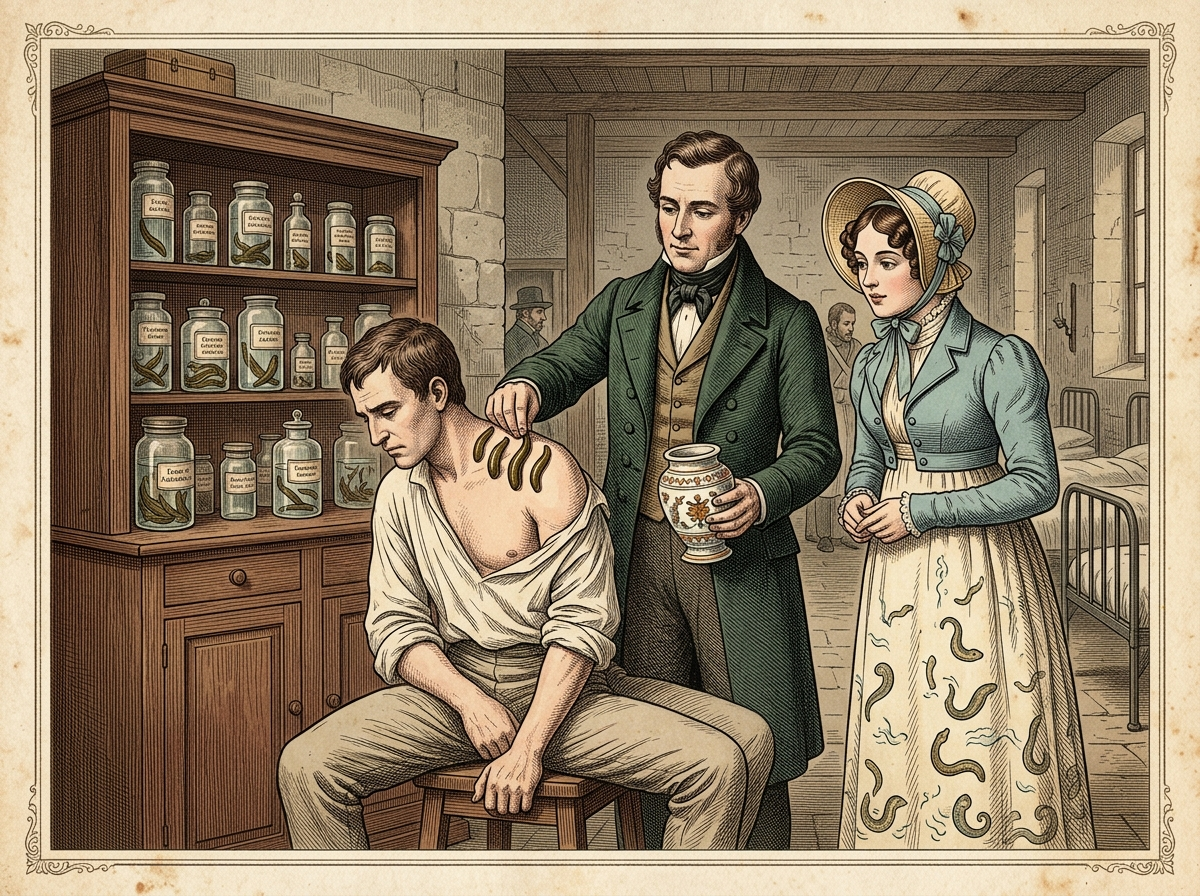
In the 1820s, a new patient arriving at the Val-de-Grâce military hospital in Paris could expect the same first treatment almost regardless of what was wrong: about thirty live leeches, pressed onto the skin and left to drink. The man behind the routine, François-Joseph-Victor Broussais, was one of the most celebrated doctors in France. His enthusiasm caught on so thoroughly that the country went through tens of millions of leeches a year — and, according to several histories, fashionable Parisian women wore dresses trimmed with leech-shaped embroidery, a look called *à la Broussais*.
By the Curiosities Desk · · 5 min read · Filed under Biology · Today’s round
What happened?
Broussais was born in Brittany in 1772 and learned medicine the hard way, as a surgeon in the French navy and later in Napoleon’s armies. By the 1810s he was a professor at Val-de-Grâce, the great military hospital and teaching school in Paris, and the leader of what he called “physiological medicine.”
His big idea was simple and sweeping. Most disease, he argued, was really inflammation — an organ that had become over-irritated — and very often the culprit was the stomach and intestines. Fevers weren’t separate diseases with separate causes; they were signs that some organ somewhere was inflamed. The cure followed logically: calm the irritation by drawing blood away from the inflamed spot, and keep the patient on a very sparse diet.
Bloodletting was already ancient. What Broussais changed was the tool and the scale. Instead of opening a vein with a blade, his followers placed leeches directly over the organ they believed was inflamed. A patient suspected of having inflamed lungs might have leeches spread across the chest; a stomach complaint meant leeches on the belly. At Val-de-Grâce, new patients were reportedly given about thirty leeches as standard, and Broussais sometimes used fifty or more in a single session.
The leech in question was Hirudo medicinalis, the European medicinal leech: a muscular, olive-and-brown worm a few inches long, with three tiny jaws that leave a distinctive three-pointed bite. Once attached, it drinks until full and then drops off.
France’s appetite for them became enormous. Historian Erwin Ackerknecht calculated that France imported about 42 million leeches in 1833 alone; other accounts put the yearly figure at the height of the craze at more than 33 million. Either way, the country’s own wetlands couldn’t keep up. Leeches were collected by people who waded into ponds with bare legs and waited to be bitten, then peeled off their catch. As local supplies ran low, merchants imported leeches from Spain and farther east, and entrepreneurs tried, with mixed success, to farm them.
The leech even crossed into culture. Pharmacies displayed them in ornate decorated jars, poems were written about them, and the leech-embroidered dresses became part of the craze’s legend. (The dresses come down to us through later histories rather than surviving garments, so treat them as a well-repeated story more than a museum exhibit.)
Why was it strange?
Broussais wasn’t a quack on the fringe. He was a respected professor, a member of the Royal Academy of Medicine, and a sharp critic of older medical theories. His system felt modern: it tied illness to specific organs that could be examined after death, rather than to vague imbalances of bodily “humors.”
That’s what makes the leech craze so striking. A theory that sounded scientific produced a treatment that was applied to almost everyone, for almost everything — and nobody had actually counted whether the patients did better. The confidence came first. The evidence never arrived.
For more treatments that backfired, see Cures That Were Worse Than the Disease.
What did scientists learn?
The counting came from one of Broussais’s own Paris colleagues. Pierre-Charles-Alexandre Louis, a physician at the Charité hospital, did something unusual for his time: he kept careful records and compared groups of patients by the numbers. He called it the “numerical method.”
In his 1835 book on the effects of bloodletting, Louis looked at 77 previously healthy patients with the same well-defined form of pneumonia. Forty-one had been bled early, in the first four days of illness; 36 had been bled later. The early-bled group recovered slightly faster on average — but a much larger share of them died: about 44 percent, compared with 25 percent of the later group. Louis himself called the result “startling and apparently absurd.” His conclusion was cautious: bloodletting did far less good than doctors believed.
Louis didn’t single-handedly end the craze — Broussais’s influence was already fading by the time the book appeared, and Broussais died in 1838. But the method mattered more than the verdict. Comparing groups of patients and counting outcomes is the seed of the modern clinical trial and of epidemiology, the study of how diseases spread and who they affect.
Meanwhile, the leech kept its own secret. In the 1880s, Scottish physiologist John Berry Haycraft showed that leech secretions stop blood from clotting. The substance, later named hirudin, explained why leech bites keep oozing long after the animal lets go.
Another early experiment in fair testing: The Fake Metal Rods That Accidentally Invented the Placebo-Controlled Trial.
How does it affect us today?
The leech never fully left the hospital. When surgeons reattach a finger or an ear, or move a flap of skin, the tiny arteries can be reconnected more easily than the even more delicate veins. Blood flows in but can’t drain out, and the tissue can die of congestion. A leech solves exactly that problem: it removes pooled blood, and its anticoagulant keeps the bite bleeding for hours afterward.
In 2004, the U.S. Food and Drug Administration cleared medicinal leeches, supplied by the French company Ricarimpex, as a medical device for relieving venous congestion and helping grafts heal. Hirudin’s chemistry also inspired anticoagulant drugs, including bivalirudin, used today during heart procedures.
The deeper legacy belongs to Louis. Every time a new treatment has to prove itself in a trial before it’s prescribed to everyone, medicine is doing what the leech craze skipped.
Leeches have a regulatory cousin: The Battlefield Maggots That Became a Prescription Medical Device.
Fun fact
Leech farming had a predator problem. One leech farm reportedly lost 20,000 leeches in a single day — to a flock of migrating ducks.
Sources
- Louis, Pierre-Charles-Alexandre. Recherches sur les effets de la saignée dans quelques maladies inflammatoires (Paris, 1835), with translated excerpts, James Lind Library.
- Morabia, Alfredo. “Pierre-Charles-Alexandre Louis and the evaluation of bloodletting”, Journal of the Royal Society of Medicine 99(3): 158–160, 2006.
- Martucci, Jessica. “Medicinal Leeches and Where to Find Them”, Distillations, Science History Institute, 2020.
- JSTOR Daily. “Why Did the Victorians Harbor Warm Feelings for Leeches?”
- U.S. Food and Drug Administration. “510(k) Premarket Notification K040187: Medicinal Leeches (Ricarimpex)”, cleared June 21, 2004.
Related stories
Bloodletting is no longer a treatment for fevers or infections. If you or someone you care about is unwell, a doctor or local health service is the best place to start.