Strange Animals Scientists Studied · Medicine
The Battlefield Maggots That Became a Prescription Medical Device
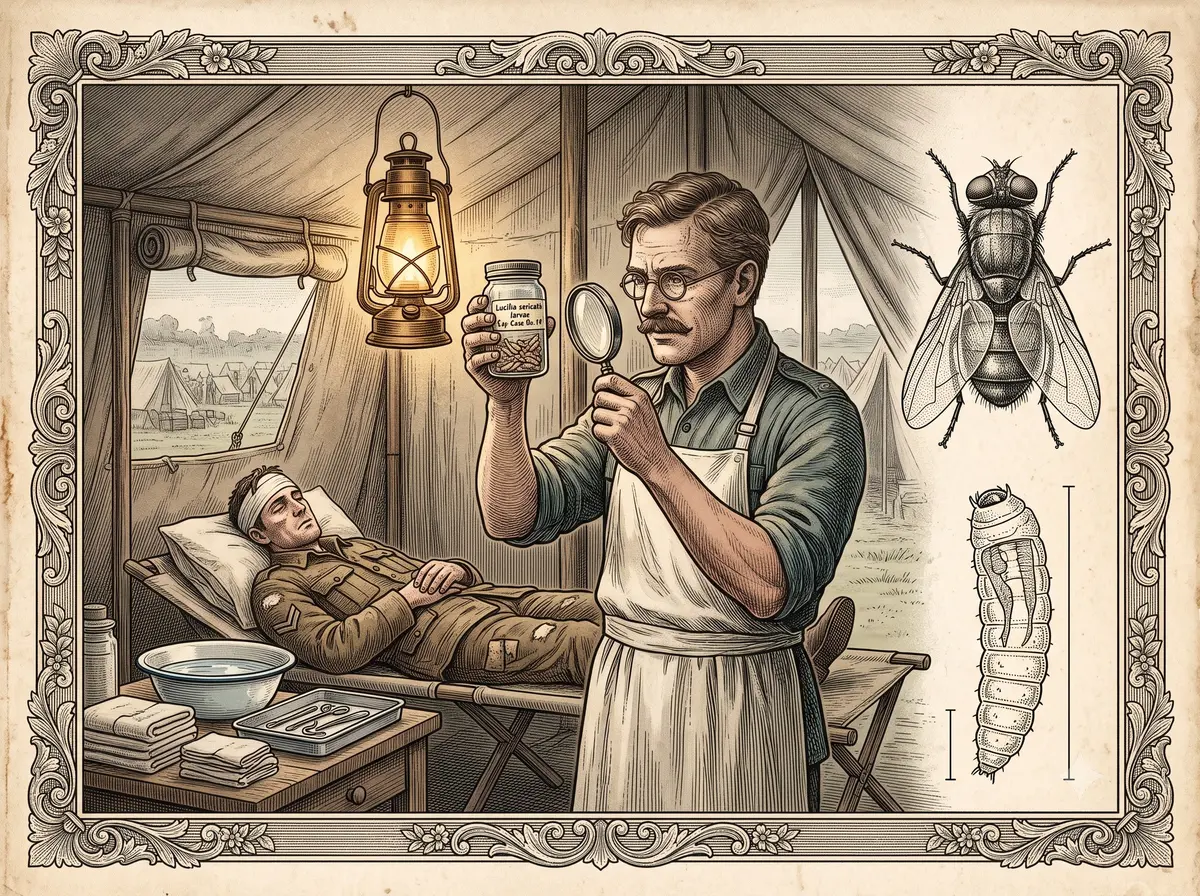
Two soldiers were carried into a field hospital in France having lain in the open for seven days with shattered thigh bones, no food and no water. The surgeon peeled back their clothing and found the wounds packed with thousands of squirming blow fly maggots. He expected the worst. Instead he found no fever, no blood poisoning, and underneath the writhing mass, clean pink tissue. He spent the next decade trying to reproduce it on purpose.
By the Curiosities Desk · · 5 read · Filed under Medicine · Today’s round
What happened: Maggot Therapy
The surgeon was William Stevenson Baer, an American orthopaedist serving in France in 1917. Wounds like the ones in front of him — compound fractures of the femur, left untreated for a week in a filthy trench — were close to a death sentence. Open-wound mortality in the First World War ran catastrophically high, and the antiseptics of the day were often no match for the bacteria already established in the tissue. Yet these two men had neither fever nor septicaemia, the potentially fatal spread of infection through the bloodstream. Both survived.
Baer filed the observation away and went home. In 1929, by then Professor of Orthopaedic Surgery at Johns Hopkins in Baltimore, he pulled it back out. He selected 21 patients with chronic osteomyelitis — a stubborn bone infection — for whom conventional treatment had already failed. Then he put maggots in their wounds.
It worked, and quickly. Baer reported that within about two months, the wounds of all 21 patients had healed. Larval therapy became, briefly, the fastest and most reliable treatment available for chronic osteomyelitis.
It was not a smooth ride. Baer’s early maggots came from wild flies, and wild flies carry whatever is on the meat they landed on — including Clostridium tetani and Clostridium perfringens, the bacteria behind tetanus and gas gangrene. Patients were infected. The problem forced Baer and his colleagues into a second research programme entirely: how to sterilise a fly egg so that the larva hatching from it is surgically clean. That work became the foundation of every maggot therapy programme since.
Baer died in 1931. His landmark paper, “The Treatment of Chronic Osteomyelitis with the Maggot (Larva of the Blow Fly),” ran to 38 pages in The Journal of Bone & Joint Surgery that same year, and it travelled fast. More than 300 American hospitals folded maggots into their wound-care programmes between 1930 and 1940, and more than 100 papers on the subject appeared in the same decade.
Then the technique fell off a cliff. Sulfa drugs spread through the early 1940s, penicillin went into industrial production in 1944, and a treatment that required a live insectary suddenly looked like a museum piece. By 1988 one British scientist could write that maggot therapy was “relegated to a historical backwater… a therapy the demise of which no one is likely to mourn.”
He was writing at almost exactly the moment it came back. In the early 1990s Ronald Sherman set up a small fly-rearing facility at the VA Medical Center in Long Beach, California, to supply sterile larvae for controlled trials. In Britain, retired orthopaedic surgeon John Church and researcher Stephen Thomas founded a biosurgical research unit in Bridgend, Wales, which began distributing sterile larvae commercially in 1995. And in January 2004, the U.S. Food and Drug Administration cleared live maggots of the common green bottle fly, Lucilia sericata, for production and marketing as a prescription-only medical device — for debriding non-healing necrotic skin and soft tissue wounds, including pressure ulcers, venous stasis ulcers, neuropathic foot ulcers, and non-healing traumatic or post-surgical wounds.
Why it was strange: Maggot Therapy
Because it ran backwards through everything nineteenth-century medicine had just learned. Ambroise Paré noticed maggots helping wounds in the 1500s. Baron Dominique-Jean Larrey, Napoleon’s surgeon-general, recorded during the Egyptian and Syrian campaign that a particular fly’s larvae removed only dead tissue. The Maryland surgeon John Forney Zacharias treated gangrenous Civil War wounds with them deliberately and wrote that “in a single day, they would clean a wound much better than any agents we had at our command.”
Then Pasteur and Koch established germ theory, and the entire profession — correctly, in general — resolved never again to put dirty things into open wounds. Maggots looked like the dirtiest thing imaginable. The knowledge did not so much get disproved as get filed under “obviously wrong” for fifty years, until a war put it back in front of someone.
It shares a shelf with The Radioactive Tonic That Dissolved a Millionaire’s Jaw, in Cures That Were Worse Than the Disease.
What scientists learned: Maggot Therapy
The reason maggots clean a wound so well is that they cannot chew. Blow fly larvae have no mouthparts capable of biting off solid food. They have two small mouth hooks and a chemistry set: they flood their surroundings with proteolytic enzymes, which break proteins apart, liquefy the dead tissue outside their own bodies, and then drink the result. This is called extracorporeal digestion — digestion outside the body — and it is exquisitely selective, because their enzymes work on necrotic tissue and wound fluid, not on healthy, living tissue.
Their secretions also carry compounds with antimicrobial activity, including allantoin, urea and phenylacetic acid. In laboratory tests, maggot secretions inhibit a range of pathogens including MRSA. And their constant scrambling and probing physically disrupts biofilms — the slick bacterial communities that shield microbes from both antibiotics and the immune system.
They are not magic. Maggots do poorly against Pseudomonas aeruginosa, which can kill the larvae outright. A Cochrane review of debridement methods for venous leg ulcers found maggot therapy broadly as effective as most alternatives, while noting the quality of the underlying data was poor. The honest summary is that it is a good tool, not a miracle.
Also in Cures That Were Worse Than the Disease: The Doctor Who Toured America in a ‘Lobotomobile’.
How it reaches us today: Maggot Therapy
Maggot therapy is a live, prescribable option in the United States, the United Kingdom and much of Europe, used most often for diabetic foot ulcers, pressure sores and other chronic wounds where surgical debridement is risky or repeated antibiotics have stopped working. A 2013 survey found that about 10% of U.S. Army physicians polled had used it. Its biggest advantage is also its oddest: it needs no operating theatre, no imaging and no electricity — only a supply of clean larvae — which makes it a serious candidate for disaster zones, conflict zones and low-resource clinics, exactly where the burden of untreated wounds is heaviest and antibiotic resistance is worst.
Another from Cures That Were Worse Than the Disease: The Watch Painters Who Glowed in the Dark.
Fun fact: Maggot Therapy
At the FDA, live medicinal maggots share a regulatory neighbourhood with medicinal leeches. Both are handled as devices rather than drugs — which means, in the eyes of American law, a fly larva sits on the same shelf as a bandage and a pacemaker.
Sources: Maggot Therapy
- Baer, W. S. (1931). “The Treatment of Chronic Osteomyelitis with the Maggot (Larva of the Blow Fly).” The Journal of Bone & Joint Surgery, 13(3), 438–475. — the primary paper, published the year Baer died.
- Whitaker, I. S., et al. (2007). “Larval therapy from antiquity to the present day.” Postgraduate Medical Journal, 83(980), 409–413.
- Stadler, F. (ed.) (2022). A Complete Guide to Maggot Therapy. Open Book Publishers — open-access scholarly reference on clinical practice and production.
- U.S. Food and Drug Administration. “Transfer of Regulatory Responsibility… Medical Maggots and Medicinal Leeches.”
- Gethin, G., Cowman, S., & Kolbach, D. N. (2015). “Debridement for venous leg ulcers.” Cochrane Database of Systematic Reviews.
A note: chronic wounds are painful and isolating, and they are also treatable. If you or someone you care for is living with a wound that isn’t healing, a clinician or specialist wound-care service is the right place to start — not the internet, and definitely not a jar.
Related stories: Maggot Therapy
- The Twelve Leeches That Were Supposed to Ring a Bell When a Storm Was Coming — Twelve leeches in jars, wired to ring a storm-warning bell
- The Moldy Petri Dish That Almost Got Thrown Away — A contaminated petri dish that nearly went in the bin
- The Baby-Blue Blood of the Horseshoe Crab That Keeps Every Vaccine Safe — The crab blood that screens nearly every vaccine for contamination
- Part of Cures That Were Worse Than the Disease