Strange Animals Scientists Studied · Engineering
The Twelve Leeches That Were Supposed to Ring a Bell When a Storm Was Coming
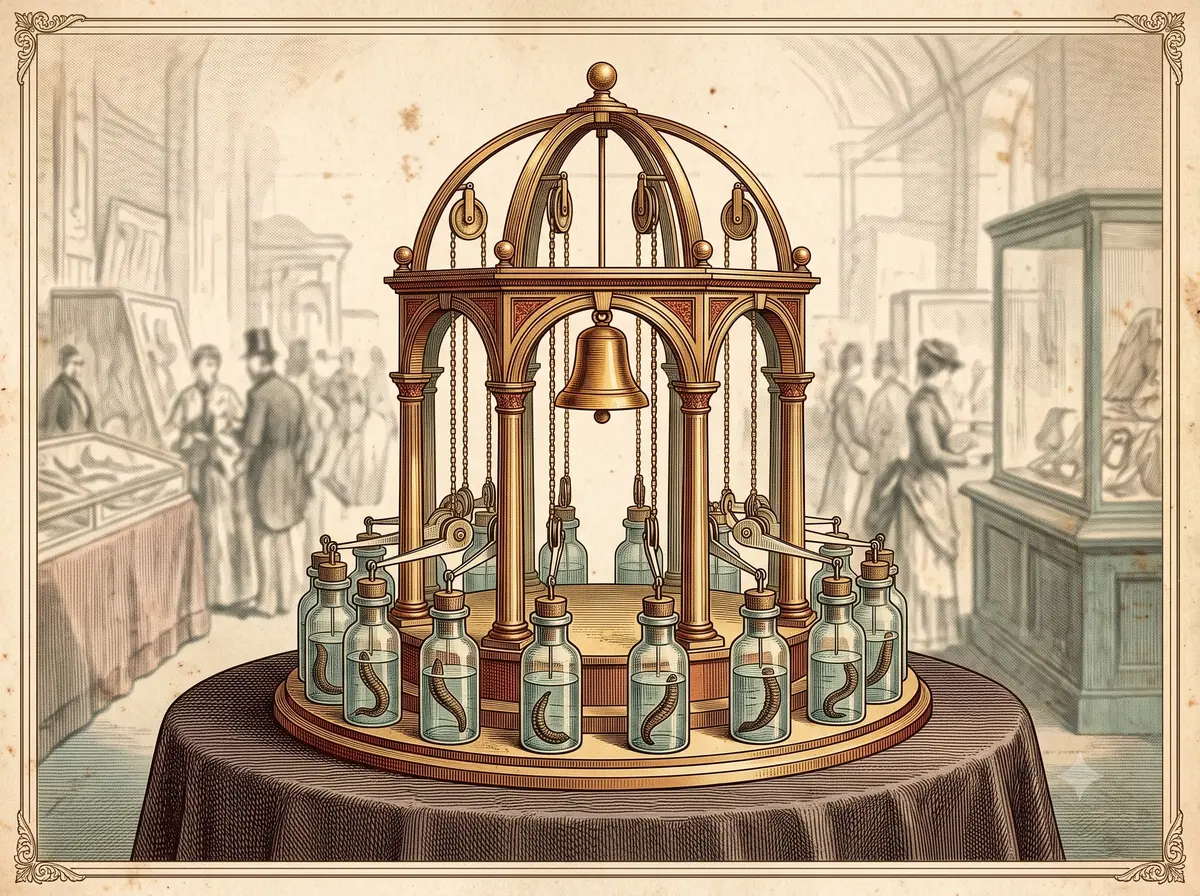
In the summer of 1851, among the locomotives and diamonds and steam hammers of London's Great Exhibition, there stood a miniature brass-and-glass Indian temple ringed by twelve pint bottles. Inside each bottle sat one and a half inches of rainwater and one live medicinal leech. If a storm was coming, the leeches were expected to climb — nudging a sliver of whalebone loose, tugging a small gilt chain, and ringing the little bell on top. Their inventor had arranged them in a circle, he explained, so that his "little comrades" could see one another and not suffer the affliction of solitary confinement.
By the Curiosities Desk · · 5 read · Filed under Engineering · Today’s round
Part of Creatures That Changed Science
What happened: The Tempest Prognosticator
The man behind the bottles was Dr. George Merryweather, a general practitioner in the Yorkshire seaside town of Whitby and honorary curator of the Whitby Museum for most of the years between 1840 and 1861. He was a tinkerer by temperament — an earlier invention was a lamp he claimed could burn for a fortnight on a cheap mixture of alcohol and whisky.
Sometime around 1850 he noticed something in his surgery. Medicinal leeches, which every Victorian doctor kept on hand for bloodletting, seemed restless before bad weather. They climbed the walls of their jars. He decided this was not a nuisance but an instrument waiting to be built.
He gave it a name only a Victorian could love: “An Atmospheric Electromagnetic Telegraph, conducted by Animal Instinct.” Mercifully, he also gave it a shorter one — the Tempest Prognosticator.
The mechanism was simple. Twelve pint bottles of white glass stood in a ring around a circular stand. Each had a metal tube in its neck holding a loose piece of whalebone attached to a wire and a small gilt chain, and each chain ran up to one of twelve hammers arranged around a bell. A leech climbing into the neck of its bottle dislodged the whalebone, released the hammer, and struck the bell. One ring meant one restless leech. Several rings in succession meant a storm was, in Merryweather’s word, “prognosticated.”
He spent all of 1850 testing it, and he tested it cleverly. Every time the bell rang, he posted a letter announcing the coming storm to Henry Belcher, then president of the Whitby Literary and Philosophical Society. Victorian Britain had several mail deliveries a day, so the postmark stamped the prediction with a date and time before the weather arrived. It was, in effect, a tamper-proof timestamp — a nineteenth-century version of publishing your prediction before the result. His records of those forecasts are preserved in the Whitby Museum library.
On 27 February 1851 he read his findings to the Society in an essay whose title runs longer than some of its paragraphs. By one later account it took him nearly three hours to deliver. The essay was printed in London and handed out to visitors at the Great Exhibition, which Merryweather called “one of the grandest ideas that ever emanated from the mind of man.”
He had drawn six versions of the machine, from a plain model for modest budgets up to No. 6, the ornate one at the Crystal Palace, which he described as “adapted for any drawing-room.” His plan was for the cheaper models to be installed at stations around the British coast, each with lifeboats and a responsible officer, and eventually all over the world. “Mr. President and Gentlemen,” he told the room, “you will perceive that I am ambitious.”
Nobody bought one. The original was displayed once more at the Society of Arts after the Exhibition closed, and then it vanished from the record entirely.
Why it was strange: The Tempest Prognosticator
Strip away the leeches and Merryweather had built something recognizable: a sensor array with twelve redundant channels and an alarm. He wasn’t trusting a single animal. He wanted a dozen independent readings, and a real alert only when several agreed — the same logic behind redundant sensors on aircraft today.
What makes it strange is the choice of sensor. A mercury barometer that measured falling pressure directly had existed since the 1640s, and Merryweather kept one. He simply believed the leeches were better, because he thought they were responding to something a barometer could not see: an “electromagnetic state” of the atmosphere that animals could feel and instruments could not. He built a machine of glass, brass and whalebone around a phenomenon that wasn’t there.
Another animal the lab could not ignore: The Kingfisher That Redesigned the Bullet Train.
What scientists learned: The Tempest Prognosticator
The leeches were not entirely making it up. Falling atmospheric pressure slightly reduces how much oxygen water can hold, and aquatic animals commonly respond by moving toward the surface. Leeches also react to light, vibration, and temperature. So a jar of leeches genuinely does contain a weak, noisy signal about the weather.
Weak and noisy is the problem. A leech that climbs because oxygen dipped looks exactly like a leech that climbs because someone slammed a door. The machine could announce that something might be coming, but not when, from which direction, or how hard — while a glance at a barometer gave a number that could be compared against numbers from anywhere else. Modern research confirms that many animals do detect barometric change and alter their behavior accordingly. It just never made them into instruments.
What solved the problem was not a better sensor but a better network. In February 1861, Vice-Admiral Robert FitzRoy — Darwin’s old captain on the Beagle — began issuing storm warnings by telegraph, collecting barometer readings from coastal stations and wiring alerts back out. That August he published the first newspaper weather forecast, a word he coined. Merryweather had wanted stations all around the coast. He was right about the architecture and wrong about what to put in it.
Another creature that ended up in the notes: The Pigeons Trained to Spot Breast Cancer — and the Flock That Got It Right 99% of the Time.
How it reaches us today: The Tempest Prognosticator
Every severe-weather alert on your phone descends from FitzRoy’s telegraph network, not Merryweather’s temple. But the Tempest Prognosticator survives as a useful cautionary object: an elegantly engineered, carefully tested, honestly reported device built on a mechanism that didn’t exist. Good methodology around a wrong premise still produces a wrong answer.
The machine itself has led an odd afterlife. For the Festival of Britain’s 1951 Dome of Discovery, designers built a full-scale replica from the copperplate engraving in Merryweather’s essay. It went to the Whitby Museum the following year, where it still stands — though its bell was made of cardboard, so it has never rung. A genuinely working model was later built at Barometer World in Devon and now lives at the National Meteorological Library and Archive in Exeter, a fitting address for the strangest weather instrument ever exhibited.
A close cousin: The Two Tortoises That Flew Around the Moon Before Any Human Did.
Fun fact: The Tempest Prognosticator
Whitby Museum’s replica cost the society ten guineas just to transport from London, plus seventeen pounds for a table to stand it on — and after all that expense, it is the one part of the whole story that cannot make a sound.
Sources: The Tempest Prognosticator
- Merryweather, George. An Essay Explanatory of the Tempest Prognosticator in the Building of the Great Exhibition for the Works of Industry of All Nations (1851), read before the Whitby Philosophical Society, 27 February 1851 — Internet Archive / Royal College of Physicians of Edinburgh (primary source)
- Whitby Museum, “Tempest Prognosticator”
- The Victorian Web, “Dr. George Merryweather’s 1851 ‘Tempest Prognosticator’” — quoting the Whitby Museum Report for 1952 and the Whitby Gazette, 20 June 1952
- Met Office, “Robert FitzRoy and the early Met Office”
- Pellegrino, A. C., et al., “Weather Forecasting by Insects: Modified Sexual Behaviour in Response to Atmospheric Pressure Changes”, PLoS ONE 8(10), 2013
Related stories: The Tempest Prognosticator
- The Battlefield Maggots That Became a Prescription Medical Device — Battlefield maggots that became an FDA-cleared medical device
- The Horses That Battled an Army of Electric Eels — Humboldt drove horses into a pond full of electric eels
- Clever Hans: The Horse That Could ‘Do Math’ — A horse that seemed to do arithmetic, and the bias it exposed