Strange Animals Scientists Studied · Physics
The Horses That Battled an Army of Electric Eels
On March 19, 1800, a Prussian naturalist stood at the edge of a muddy pool in the Venezuelan plains and watched local fishermen drive thirty wild horses and mules into the water. Within minutes, the water churned with panicked animals, eels surged up from the mud to press themselves flat against the horses' bellies, and two of the horses went still and sank. The naturalist, Alexander von Humboldt, had asked for eels to study. He had not expected a battle.
By the Curiosities Desk · · 7 min read · Filed under Physics · Today’s round
Part of Creatures That Changed Science
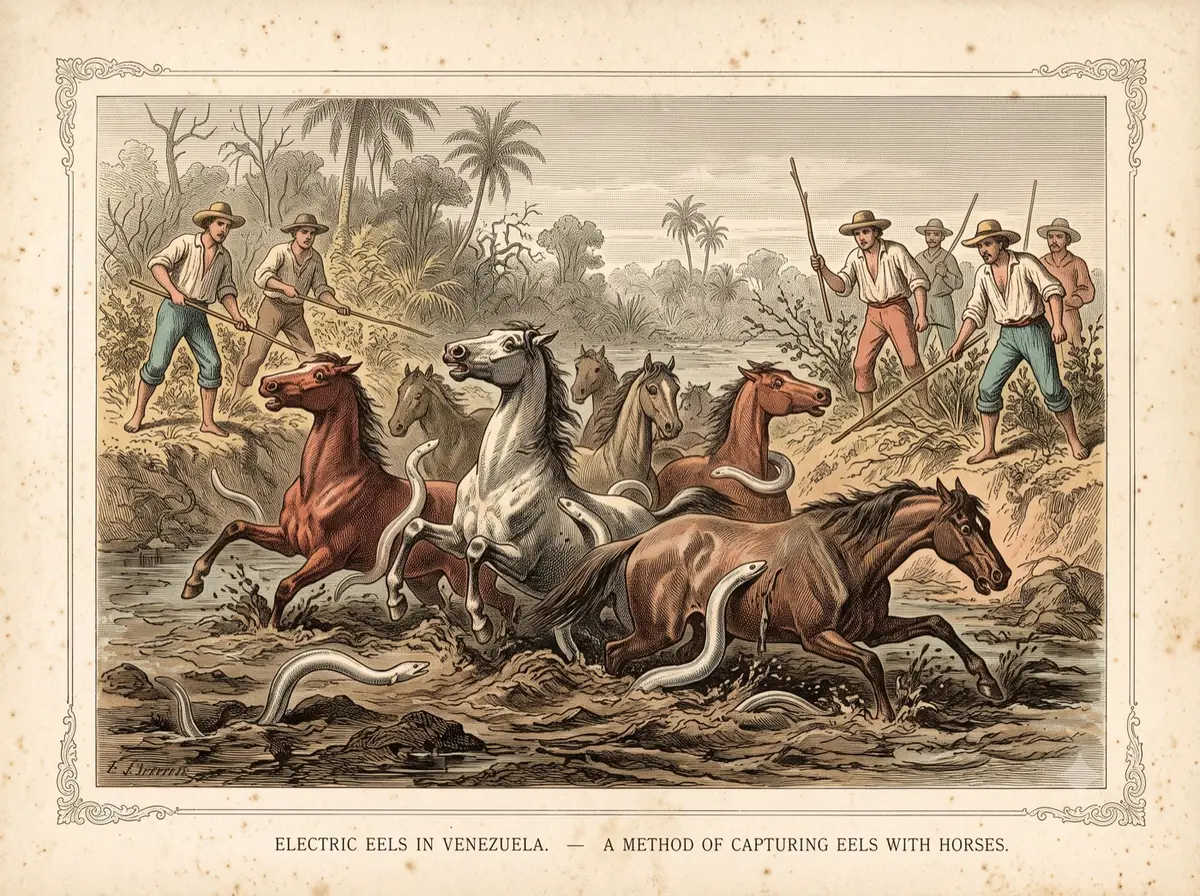
What happened: The Horses That Battled an Army of Electric Eels
Humboldt and his travel companion, the French botanist Aimé Bonpland, were roughly a year into a five-year scientific expedition through Latin America when they reached the cattle town of Calabozo, in Venezuela’s Llanos grasslands. They wanted to examine Gymnotus electricus — what locals called the temblador, or “the one that trembles” — a fish capable of delivering a powerful electric shock. Ordinary nets were useless; the eels buried themselves in mud too fast to catch. So, according to Humboldt’s own account, the fishermen at a nearby pool called Rastro de Abaxo suggested something else: “fishing with horses.”
The idea was to make the eels discharge their shocks against the horses first, so they’d be too exhausted to hurt the people collecting them afterward. Horses and mules were rounded up from the surrounding savanna and forced into the shallow, eel-filled pool. The eels, cornered, rose to the surface and threw themselves against the horses’ bodies in what Humboldt described as a scene of “singular spectacle” — pale yellow eels like enormous water snakes weaving between legs and pressing against chests. Some horses were knocked down by the shocks and, unable to rise, drowned. Others staggered out of the pool exhausted. After about five minutes, the surviving eels’ electric organs were depleted enough that fishermen could scoop them out with dry sticks and insulated harpoons.
Humboldt didn’t stop there. He and Bonpland handled some of the weakened eels themselves, and Humboldt — by his own later admission, unwisely — grabbed one with both hands. He described the resulting shock as violent pain and numbness that lingered in his joints for the rest of the day. He and Bonpland spent the following days running crude experiments: testing how the shock traveled through different materials, how it weakened with repeated discharge, and how it compared to the jolt of a Leyden jar, an early device for storing static electric charge.
Why it was strange: The Horses That Battled an Army of Electric Eels
The story sounds too dramatic to be true, and for close to two centuries, plenty of scientists agreed. Humboldt’s account was retold and illustrated for generations, but it also picked up a reputation as an exaggeration — a colorful travel tale rather than careful science. That skepticism lasted until 2016, when Vanderbilt University biologist Kenneth Catania, while transferring eels between tanks with a net, noticed something startling: when threatened, the eels didn’t just discharge underwater. They lunged partway out of the water and pressed their jaws directly against the perceived threat before firing off a volley of shocks. Catania realized he was watching the same defensive behavior Humboldt had described in 1800. His experiments, published in the Proceedings of the National Academy of Sciences, showed that an eel pressing its chin against a target delivers far more current into that target than a shock fired into open water — exactly the kind of concentrated jolt that could stun, and even kill, a horse. The “tall tale” turned out to be an accurate field report of real, if rarely observed, animal behavior.
The same thread — Bioelectricity — continues in The Roman Doctor Who Prescribed a Live Electric Fish for Your Headache.
What scientists learned: The Horses That Battled an Army of Electric Eels
Humboldt’s pool-side experiments fed into a much longer scientific argument: was the shock from an eel or a torpedo ray genuine electricity, the same force crackling from a Leyden jar, or some separate “animal” force unique to living tissue? The debate had divided scientists like Luigi Galvani and Alessandro Volta for decades. It wasn’t settled until 1838, when Michael Faraday obtained a live Gymnotus at London’s Adelaide Gallery and spent months pressing shaped copper plates against it, wiring the fish to a galvanometer and even producing visible sparks from its discharge. Faraday showed that the eel’s shock behaved identically to current from a voltaic battery in every measurable way — same direction, same detectable magnetism, same ability to be stored and released. He compared the charge released in a single discharge to that of a large bank of Leyden jars. Animal electricity, he demonstrated, was not a mystical separate substance. It was ordinary electricity, generated by a living body.
Modern science has filled in the mechanism further. An electric eel — actually a knifefish, not a true eel — carries three internal electric organs made of thousands of stacked, disc-shaped cells called electrocytes. Each cell contributes a small voltage; stacked in series, like cells in a battery, they add up. In 2019, researchers described a new Amazonian species, Electrophorus voltai, capable of discharges up to 860 volts — the highest voltage measured from any living animal, though the current involved (roughly 1 amp, lasting about a thousandth of a second) is what actually determines how dangerous a given shock is.
Another animal the lab could not ignore: The Cat Who Co-Authored a Physics Paper Because His Owner Used the Word ‘We’.
How it reaches us today: The Horses That Battled an Army of Electric Eels
Faraday’s electric eel experiments were part of the broader body of work that helped establish electrophysiology — the study of the electrical signals nerve and muscle cells use to communicate, which underlies everything from EKGs to modern neuroscience. More directly, the eel’s own stacked-cell design has become a blueprint for engineers: in 2017, a team of biophysicists published a synthetic “electric eel” battery in Nature, built from stacked gel compartments that mimic electrocytes, aimed at powering soft, flexible medical implants without the rigid metal and toxic chemicals of conventional batteries.
Another creature that ended up in the notes: The Falling Cat That Seemed to Break the Laws of Physics.
Fun fact: The Horses That Battled an Army of Electric Eels
Electric eels aren’t eels at all — they’re more closely related to catfish and carp than to true eels, and belong to a group of fish called Gymnotiformes, or knifefish. The “electric eel” name stuck from early European naturalists who judged by shape rather than lineage.
Sources: The Horses That Battled an Army of Electric Eels
- Michael Faraday, “Notice of the Character and Direction of the Electric Force of the Gymnotus,” Philosophical Transactions of the Royal Society, 1839 — https://royalsocietypublishing.org/doi/10.1098/rstl.1839.0002
- Kenneth C. Catania, “Leaping eels electrify threats, supporting Humboldt’s account of a battle with horses,” PNAS, 2016 — https://pmc.ncbi.nlm.nih.gov/articles/PMC4922196/
- C. David de Santana et al., “Unexpected species diversity in electric eels with a description of the strongest living bioelectricity generator,” Nature Communications, 2019 — https://www.nature.com/articles/s41467-019-11690-z
- “Electric eel,” Wikipedia — https://en.wikipedia.org/wiki/Electric_eel
- Smithsonian Magazine, “Science Proves Electric Eels Can Leap From Water to Attack,” 2016 — https://www.smithsonianmag.com/science-nature/science-proves-electric-eels-can-leap-from-water-attack-180959319/
Related stories: The Horses That Battled an Army of Electric Eels
- The Abbé Who Shocked 200 Monks in a Line a Mile Long to Time the Speed of Electricity — An abbe shocked 200 monks in a line to time electricity
- From Frog Legs to Lithium: A Short History of the Battery — Twitching frog legs to the lithium cell in your pocket
- The Physicist Who Levitated a Frog — and Then Won a Real Nobel Prize — A physicist floated a live frog with magnets, then won a real Nobel