Strange Animals Scientists Studied · Physics
The Inch-Long Shrimp That Drowned Out the Navy's Underwater Microphones — With a Bubble
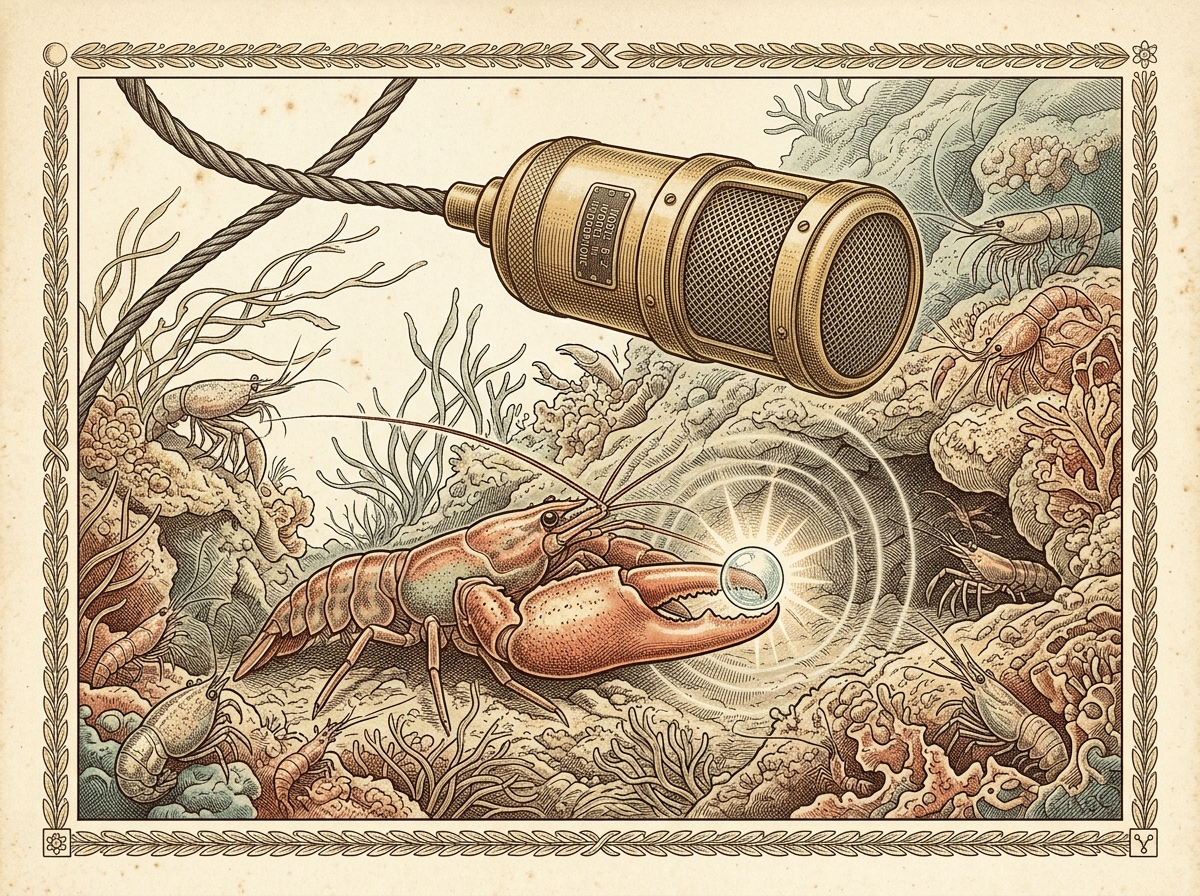
In 1946, a report from the University of California's Division of War Research described a racket coming up through Navy hydrophones, the underwater microphones used to listen for submarines. It sounded, the report said, like "the burning of dry twigs": a constant crackle that crowded the recordings. The culprit was not an enemy machine. It was a colony of shrimp no longer than your thumb, each one snapping a single oversized claw.
By the Curiosities Desk · · 5 min read · Filed under Physics · Today’s round
What happened?
During World War II, listening was one of the main ways to find a submarine. Ships and harbor defenses lowered hydrophones into the water and trained operators to pick out the sound of propellers and engines. The ocean, it turned out, was not a quiet place to listen. In warm, shallow waters, operators kept hearing a crackling hiss that seemed never to stop, and it made the job of hearing anything else much harder.
Part of the job of explaining it fell to Martin W. Johnson, a marine biologist at the Scripps Institution of Oceanography in La Jolla, California, who worked on wartime problems in underwater sound. Johnson and his colleagues tracked the noise to beds of small shrimp hiding in rocks, reefs, and seaweed. The 1946 war research report, “Underwater noise caused by snapping shrimp,” named the two main genera, Alpheus (then also called Crangon) and Synalpheus. These animals were about three-quarters of an inch to an inch and a half long. The report added a useful note: they were not the shrimp people eat, which are silent.
Each snapping shrimp has one claw far bigger than the other. When it shuts, it makes a sharp snap. A single snap is a click. A colony of thousands, snapping all the time, makes a continuous crackle. The report noted that farther from the shrimp bed, the crackle blurs into a sizzle or a hiss. In 1947, Johnson and the acoustics researchers F. Alton Everest and Robert W. Young published the findings in the scientific journal The Biological Bulletin.
The work paid off in an unexpected way. According to a memorial tribute published by the California Cooperative Oceanic Fisheries Investigations, Johnson’s “earlier success in recognizing signals produced by shrimp” is why the Navy then asked him to explain another puzzle: a mysterious sound-reflecting layer in the middle depths of the ocean. On the night of June 26–27, 1945, Johnson showed it rose toward the surface at dusk and sank at dawn, proving it was made of living animals. Oceanographers now call it the deep scattering layer.
A popular story says that American submarines took advantage of the noise by lurking near loud shrimp beds, where enemy listeners couldn’t hear them. A 2022 article in the science journal Frontiers for Young Minds repeats it, citing a 1959 newspaper report. It’s a great story, but we haven’t found official records confirming specific missions, so treat it as wartime lore rather than a documented tactic.
What nobody fully understood, even after the war, was how the snap worked. For decades, the natural assumption was that the two halves of the claw slammed together like a pair of castanets.
Why was it strange?
That assumption turned out to be wrong. In 2000, a team led by Michel Versluis and Detlef Lohse at the University of Twente in the Netherlands, working with the biologist Barbara Schmitz of the Technical University of Munich, gently tethered seven shrimp of the species Alpheus heterochaelis in an aquarium. They nudged each claw to make it snap while a hydrophone listened and a high-speed camera filmed at 2,000 frames per second.
The loudest sound did not come when the claw closed. It came a moment later, when a tiny bubble collapsed. A noise loud enough to trouble a navy came from something that was barely there at all. More physics hiding inside an animal: The Falling Cat That Seemed to Break the Laws of Physics.
What did scientists learn?
The claw slams shut in about half a millisecond and squirts out a jet of water at roughly 25 meters per second, about 56 miles per hour. Water moving that fast loses pressure, a trade-off described by Bernoulli’s principle. The pressure drops so low that the water briefly tears open into a vapor-filled bubble. This is called cavitation: the formation of bubbles in a liquid because pressure, not heat, has dropped. Then the surrounding water crushes the bubble. Its violent collapse sends out the snap, along with a shock wave strong enough to stun or kill small prey.
In 2001, Lohse, Schmitz, and Versluis reported in Nature that the collapsing bubble also gives off a flash of light. It is far too faint and brief for human eyes, so they caught it with a photomultiplier, an extremely sensitive light detector. Light from a collapsing bubble is called sonoluminescence, and the team nicknamed this version “shrimpoluminescence.” They calculated that, if the light comes from heat, the gas inside must reach more than 5,000 kelvins (about 4,700°C), close to the temperature of the Sun’s surface. That “if” matters: the temperature is an estimate from the light, not something anyone measured with a thermometer, and it lasts for only a tiny fraction of a second inside a bubble a few millimeters wide. A chemistry trick of a different kind: The Beetle That Explodes Inside a Predator’s Stomach — and Walks Away.
How does it affect us today?
Snapping shrimp are still one of the main sources of background noise in warm, shallow seas, and engineers who design sonar and underwater communication systems have to plan around their crackle. Cavitation is also a familiar enemy in engineering: collapsing bubbles pit and wear down ship propellers and pumps. The shrimp has been using the same force on purpose for a very long time.
Biologists now treat the crackle as a signal worth listening to. Researchers at the Woods Hole Oceanographic Institution, including Ashlee Lillis and Aran Mooney, record reef soundscapes to track shrimp activity, and Mooney’s team has reported that the warmer the water, the more the shrimp snap. Louder reefs could mask the sounds fish use to communicate, but the crackle may also help young fish and coral larvae find a reef to settle on. Another animal that ended up on a scientific job: The Horses That Battled an Army of Electric Eels.
Fun fact
When the 2001 flash discovery was announced, the chemist Kenneth Suslick told Science News he’d be “willing to bet pitchers of beer” that cracking your knuckles also makes a tiny glow, since that pop involves collapsing gas bubbles too.
Sources
- University of California Division of War Research, “Underwater noise caused by snapping shrimp” (1946), Scripps Institution of Oceanography Archives via eScholarship — the original wartime report.
- Johnson, M. W., Everest, F. A., and Young, R. W., “The Role of Snapping Shrimp (Crangon and Synalpheus) in the Production of Underwater Noise in the Sea”, The Biological Bulletin 93 (1947): 122–138.
- Versluis, M., Schmitz, B., von der Heydt, A., and Lohse, D., “How Snapping Shrimp Snap: Through Cavitating Bubbles”, Science 289 (2000): 2114–2117; with Lohse, Schmitz, and Versluis, “Snapping shrimp make flashing bubbles”, Nature 413 (2001): 477–478.
- Science News, “Shrimps spew bubbles as hot as the sun” (2001) — the flash discovery and the knuckle-cracking bet.
- CalCOFI Reports, “In Memoriam: Martin W. Johnson” (vol. 26) — Johnson’s wartime work on shrimp signals and the deep scattering layer.