Strange Animals Scientists Studied · Physics
The Cat Who Co-Authored a Physics Paper Because His Owner Used the Word 'We'
In 1975, one of the world's most respected physics journals published a dense paper on the quantum behavior of frozen helium. It listed two authors. The first was a professor at Michigan State University. The second, F. D. C. Willard, had four legs, a tail, and no working knowledge of magnetism whatsoever. He was a Siamese cat named Chester.
By the Curiosities Desk · · 5 min read · Filed under Physics · Today’s round
Part of Creatures That Changed Science
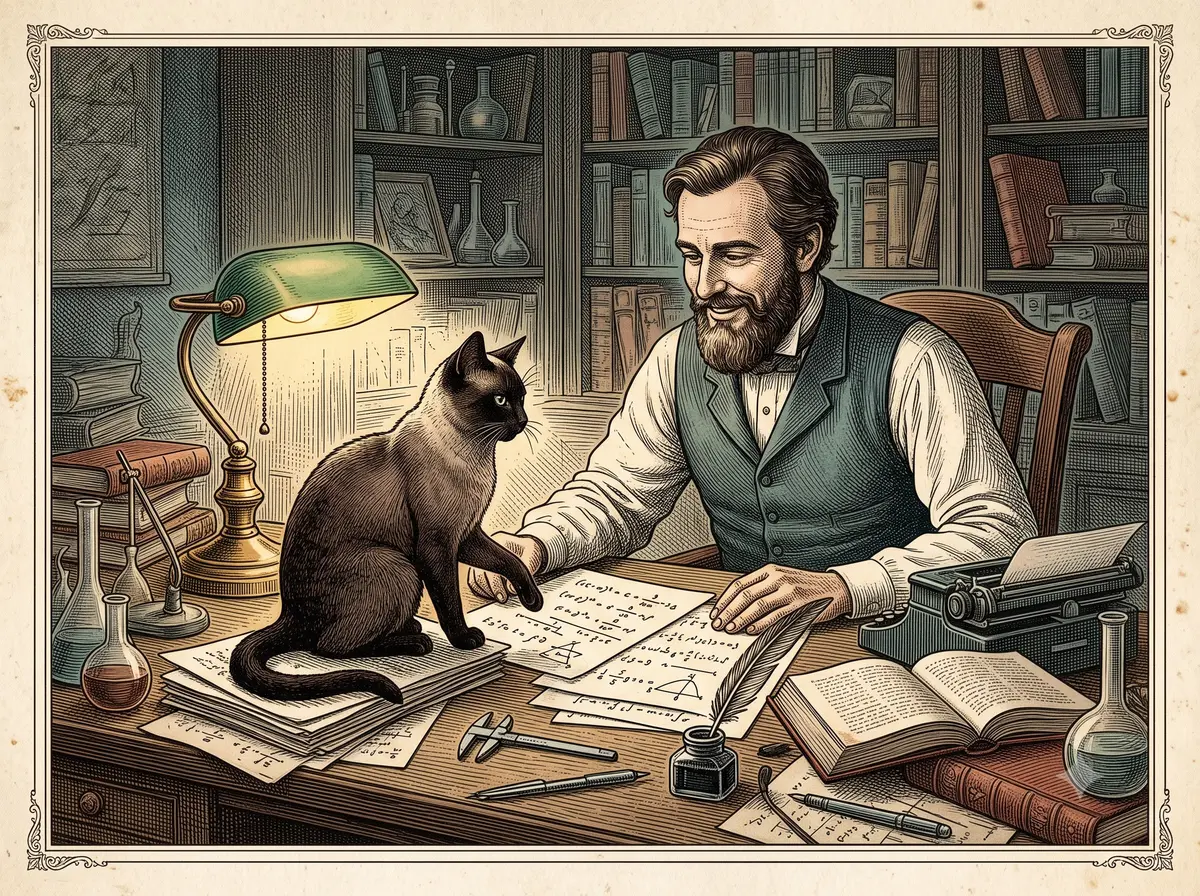
What happened: The Cat Who Co-Authored a Physics Paper Because His Owner Used the Word 'We'
Jack H. Hetherington was a physicist at Michigan State University working on a problem in low-temperature physics: how the atoms in solid helium-3 nudge one another when the material is chilled to within a few thousandths of a degree of absolute zero. He finished a paper laying out his calculations and, before submitting it to Physical Review Letters — then and now one of the field’s flagship journals — he handed a draft to a colleague for a sanity check.
The colleague spotted a problem, though not with the physics. Throughout the paper, Hetherington had written in the “editorial we” — sentences like “we calculate” and “our results” — even though he was the only author. Physical Review Letters, his colleague warned him, had a firm style rule: a single-author paper had to use “I,” not “we.” Every “we” and “our” would have to be changed.
This was 1975. The paper had been typed on a typewriter, most likely by a department secretary, equations and all. There was no find-and-replace, no cursor, no undo. Fixing every plural pronoun meant retyping the entire manuscript — a genuinely tedious job. Hetherington later explained that he weighed his options and found a third path: if the paper needed more than one author to justify all those "we"s, he would simply give it more than one author.
He did not want to share credit with a real colleague, so he invented one. At home he had a Siamese cat named Chester, whose father had been a cat named Willard. Worried that a sharp-eyed reader might recognize “Chester” as his pet, Hetherington reached for a more dignified disguise. He knew most Americans carry a couple of given names, so he built two out of the scientific name for the house cat, Felis domesticus, and stitched the whole thing together: F. (Felis) D. (Domesticus) C. (Chester) Willard. The cat now had the gravitas of a full academic byline.
The paper — “Two-, Three-, and Four-Atom Exchange Effects in bcc ³He,” by J. H. Hetherington and F. D. C. Willard — was accepted and published in Physical Review Letters in November 1975. It was good work, and other physicists cited it. For a while, only Hetherington knew that half of the author line purred.
The secret did not last. Hetherington began mailing signed reprints to friends and colleagues, and on some he added his co-author’s “signature” — an inked paw print next to his own. By the time low-temperature physicists gathered in Grenoble, France, in 1978, the joke was out. Willard’s fame only grew from there. In 1980 a solo article under his name alone, “L’hélium 3 solide. Un antiferromagnétique nucléaire,” appeared in the French popular-science magazine La Recherche, making Chester possibly the only cat to be both a co-author and a sole author of physics writing.
Why it was strange: The Cat Who Co-Authored a Physics Paper Because His Owner Used the Word 'We'
Peer review is built on a quiet assumption: that the names on a paper belong to people who did the work and stand behind it. Hetherington slipped a house pet past that filter, and nobody caught it — not the reviewers, not the editors, not the readers who cited the paper afterward. The physics was perfectly sound, which is exactly what makes the stunt land. A crank paper with a fake author is just a hoax. A rigorous, useful paper with a cat on the byline is a small, affectionate joke about how much of a scientist’s authority rests on a name printed in the right typeface.
It is worth being clear about what Chester did and did not do. He calculated nothing. The story is charming precisely because everyone understands the cat contributed only his name — a pseudonym with whiskers, not a claim that felines grasp quantum mechanics.
The same thread — Cats — continues in The Falling Cat That Seemed to Break the Laws of Physics.
What scientists learned: The Cat Who Co-Authored a Physics Paper Because His Owner Used the Word 'We'
The real content of the paper had nothing to do with cats. Helium-3 is a rare, light isotope of helium, and when you freeze it into a solid and cool it toward absolute zero, its atoms start behaving in strange, quantum ways. Hetherington was modeling how groups of these atoms swap places — two, three, and four at a time — and how those exchanges shape the material’s magnetism. His calculations helped explain how solid helium-3 could become a nuclear antiferromagnet, meaning the tiny magnetic moments of its atomic nuclei line up in an alternating, canceling pattern rather than all pointing the same way. It was a real contribution to understanding matter at the coldest edge of the temperature scale, which is why the paper earned citations on its merits alone.
Another animal the lab could not ignore: The Horses That Battled an Army of Electric Eels.
How it reaches us today: The Cat Who Co-Authored a Physics Paper Because His Owner Used the Word 'We'
F. D. C. Willard became a permanent, beloved footnote in the culture of science — a reminder that researchers have a sense of humor and that the machinery of publishing can be gently poked. He turns up on lists of famous cats and is cousin, in spirit, to the immunologist Polly Matzinger, who once listed her dog on a paper for much the same reason. In 2014, the American Physical Society leaned into the legend with an April Fools’ announcement that all cat-authored papers would be made open-access; to this day the actual Hetherington–Willard paper is labeled “Free to Read” on the journal’s site. Beyond the laughs, the story is a favorite teaching example in conversations about research ethics and authorship — a harmless prank that still raises a real question about what it means to put your name on scientific work.
Elsewhere in physics: The Physicist Who Cleaned His 40-Foot Spectrograph by Sending the Family Cat Through It.
Fun fact: The Cat Who Co-Authored a Physics Paper Because His Owner Used the Word 'We'
According to a story Hetherington enjoyed telling, the cat’s celebrity briefly outshone his own: when people phoned his office and found the professor out, some would cheerfully ask to speak with his co-author instead. He also joked that if a visitor ever seemed unimpressed by the physics, he could always boast that he had a colleague who worked for cat food.
Sources: The Cat Who Co-Authored a Physics Paper Because His Owner Used the Word 'We'
- Hetherington, J. H.; Willard, F. D. C. (1975). “Two-, Three-, and Four-Atom Exchange Effects in bcc ³He.” Physical Review Letters, 35 (21): 1442–1444. (Primary source: the paper itself.)
- “F. D. C. Willard.” Wikipedia (with links to the underlying primary citations).
- Grundhauser, Eric (2016). “In 1975, a Cat Co-Authored a Physics Paper.” Atlas Obscura.
- “A cat co-authored an influential physics paper.” Science (AAAS).
Related stories: The Cat Who Co-Authored a Physics Paper Because His Owner Used the Word 'We'
- Acoustic Kitty: The CIA Wired a Live Cat for Sound to Spy on the Soviets — The CIA surgically wired a live cat to eavesdrop on the Soviets
- The 23 Cats the RAF Parachuted Into Borneo to Fight a Rat Plague — The RAF airdropped cats into Borneo after a pesticide backfired
- The Physicist Who Levitated a Frog — and Then Won a Real Nobel Prize — A physicist floated a live frog with magnets, then won a real Nobel