The Scientist Behind It · Physics
The Physicist Who Cleaned His 40-Foot Spectrograph by Sending the Family Cat Through It
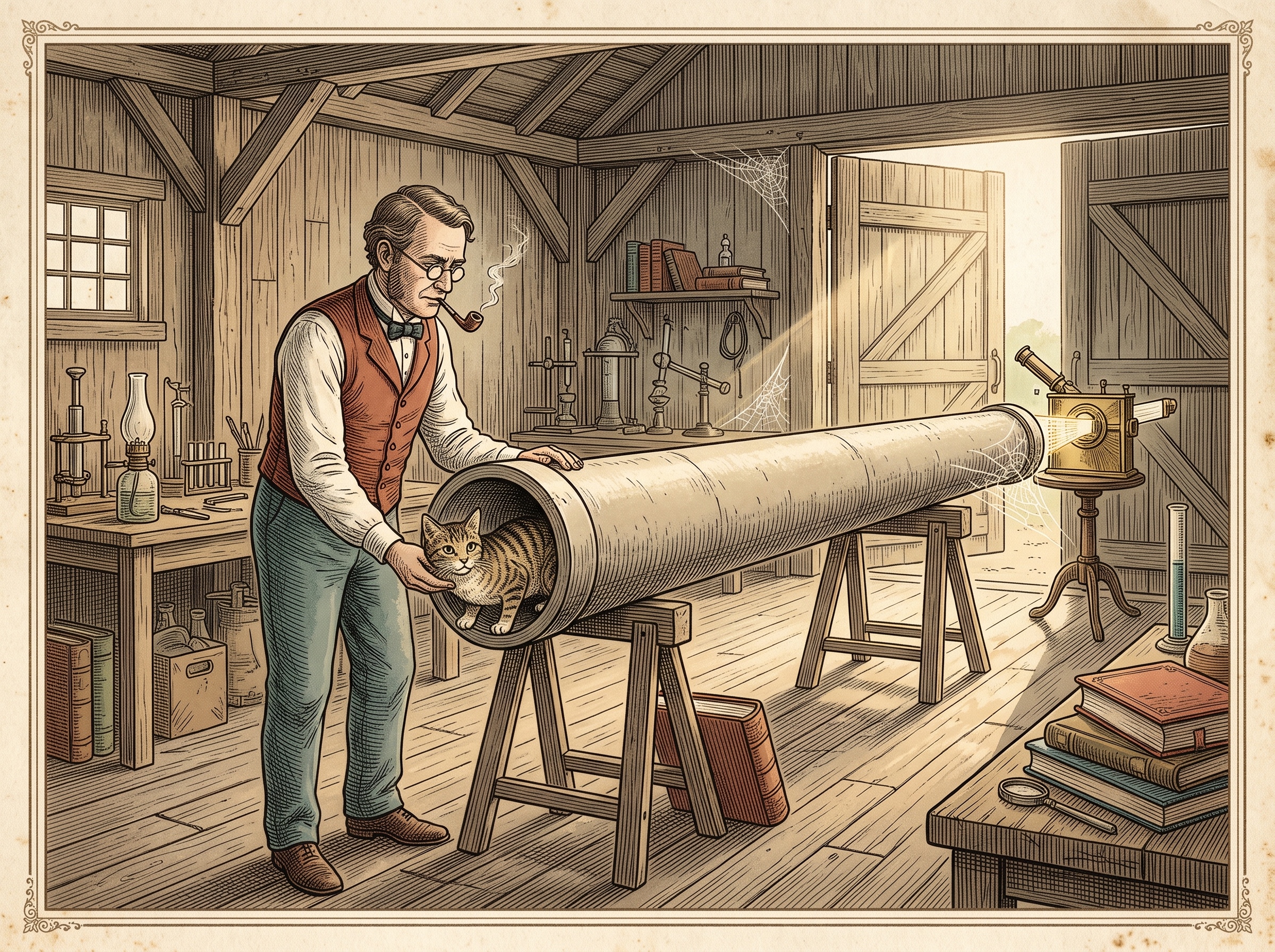
Every summer, physicist Robert Williams Wood came back to his barn on Long Island to find his giant light-measuring instrument full of spider webs. The tube was forty feet long and made of sewer pipe, so a feather duster wasn't going to reach. Wood's solution, as one of his colleagues recorded it, was to put the family cat in one end, close that end, and let the cat do the rest.
By the Curiosities Desk · · 5 min read · Filed under Physics · Today’s round
What happened?
Robert Williams Wood was born in Concord, Massachusetts, in 1868, and he was a restless student. He graduated from Harvard in 1891 with a chemistry degree, then drifted through Johns Hopkins, the University of Chicago, and Berlin, where he switched to physics for good. He never formally received a PhD. Even so, when the great Johns Hopkins physicist Henry Rowland died in 1901, the university picked the 33-year-old Wood to succeed him. He stayed there for the rest of his life.
Wood’s specialty was light, and above all spectroscopy, the science of splitting light into its component colors to learn what made it. His key tool was the diffraction grating, a mirror or glass plate ruled with thousands of fine, evenly spaced grooves that spread light into a rainbow far more finely than a prism can. Wood inherited Rowland’s grating-ruling engines and kept them running for decades. According to his biographer at the Royal Society, nearly every spectroscopy lab and most observatories in the world ended up with one of Wood’s gratings.
For his summer research, Wood built something unusual. His family spent summers on an old farm near East Hampton on Long Island, and in the barn he improvised a laboratory. Its centerpiece was a forty-foot grating spectrograph, an instrument that spreads light into a spectrum and photographs it. The light ran down a long tube made of sewer pipe that a local stonemason had laid. Physicist Gerhard Dieke, who knew Wood at Hopkins, wrote that it was “probably the largest then in existence,” and it often used the sun as its light source.
The trouble came in the off-season. For months at a time nobody used the instrument, and wildlife moved into the pipe. By summer, the light path was crossed with spider webs.
Dieke described what happened next in the memoir he wrote for the Royal Society after Wood’s death in 1955: “Wood’s method of cleaning the tube has become a classic. He put the family cat in one end and closed this end so that the cat, in order to escape, had to run through the whole length of the tube, ridding it very effectively of all spider webs.”
That is nearly all the record holds. Dieke doesn’t name the cat or say how often the trick was used, and the story has the ring of a tale polished by retelling. Still, it appears in a formal memoir by a close colleague, not a joke book.
It also fits the man. Dieke called Wood “a superb showman” who was “very fond of practical jokes.” As a student, annoyed that his landlady took too much interest in his affairs, Wood waited for a muddy day and pressed a trail of shoe prints from his window up the wall, across the ceiling, and down the other side. “The reactions of the landlady are not recorded,” Dieke added. Later retellings, drawing on William Seabrook’s 1941 biography Doctor Wood, add more: a Paris landlady whose pet tortoise seemed to grow at an astonishing rate because Wood kept swapping in slightly bigger tortoises, then reversed the trick.
Why was it strange?
Wood was not a hobbyist tinkering in a barn. He was elected to the National Academy of Sciences and won the Royal Society’s Rumford Medal. In 1904, the journal Nature sent him to France to check claims about a supposed new radiation called N-rays. In a darkened lab, he quietly removed an essential prism from the apparatus, and the French physicist kept reporting the effect anyway. That one act helped end the N-ray episode.
So one of the most exacting optical experimenters of his era was also the man who used a cat as a pipe cleaner. Dieke saw no contradiction. Wood, he wrote, “never worked with anything in the least complicated.” His equipment looked improvised and crude but was “always near perfection in its essentials.” A cat was cheap, already on the farm, and well motivated to reach the far end of a forty-foot tube.
The same thread — Optics — continues in The Needle Isaac Newton Slid Behind His Own Eyeball to Find Out Where Color Comes From.
What did scientists learn?
The cat story is really a story about how sensitive a spectrograph is. Spectroscopy works because every element absorbs and gives off light at its own precise wavelengths, like a barcode. To read that barcode, you need to separate wavelengths that are extremely close together.
A grating’s grooves send each wavelength off at a slightly different angle. The farther the light travels after the grating, the more those slightly different paths spread apart. That is one reason a forty-foot instrument could show details smaller ones blurred together. But a long, open light path is also a long target for dust, insects, and stray threads. Anything sitting in the beam can block light or scatter it, adding a faint haze across a photograph meant to catch thin, sharp lines. Clearing the tube was a real experimental problem, even if the fix was unusual.
Another person who would not drop the question: The Trumpeters Who Rode a Steam Train Back and Forth to Test a Theory About Stars.
How does it affect us today?
Wood’s fingerprints are scattered through modern life. In the early 1900s he developed a filter, now called Wood’s glass, that blocks visible light but lets ultraviolet through; during World War I it was used for signaling the enemy couldn’t see. It is the basis of the black light. Dermatologists still use a “Wood’s lamp” to make certain skin infections and pigment changes glow so they’re easier to see.
He was a pioneer of ultraviolet and infrared photography, and in 1902 he noticed strange dark bands in light reflected from metal gratings. These “Wood’s anomalies” were later traced to surface plasmons, waves of electrons rippling along metal surfaces, which are now studied for sensors and nanoscale optics. And diffraction gratings, the tools he spent his career perfecting, sit at the heart of the spectrometers astronomers use to work out what distant stars are made of.
Another scientist, told from the human side: The Physicist Who Levitated a Frog — and Then Won a Real Nobel Prize.
Fun fact
Wood also wrote a best-selling book of nonsense poems for his children, How to Tell the Birds from the Flowers (1907), which Dieke said went through about twenty editions. One verse explains that bees can be in clover, “While ety-molo-gists concur, there is no B in Plover.”
Sources
- Dieke, G. H. “Robert Williams Wood, 1868–1955.” Biographical Memoirs, National Academy of Sciences (1993; reprinted from Biographical Memoirs of Fellows of the Royal Society, 1956). https://www.nasonline.org/wp-content/uploads/2024/06/wood-robert-1.pdf
- Dieke, G. H. (1956). “Robert Williams Wood, 1868–1955.” Biographical Memoirs of Fellows of the Royal Society, 2: 326–345. https://doi.org/10.1098/rsbm.1956.0022
- Behrman, J. (2022). “Pipes, Poems, and Physics: The Life of R. W. Wood.” American Institute of Physics, Niels Bohr Library & Archives. https://www.aip.org/library/pipes-poems-and-physics
- Acoustics Today, Winter 2019, p. 41 (profile of R. W. Wood, citing Dieke 1956). https://acousticstoday.org/issues/2019AT/Winter2019/files/basic-html/page41.html
- Wood, R. W. (1907). How to Tell the Birds from the Flowers. Project Gutenberg. https://www.gutenberg.org/ebooks/1593