The Scientist Behind It · Physics
The Trumpeters Who Rode a Steam Train Back and Forth to Test a Theory About Stars
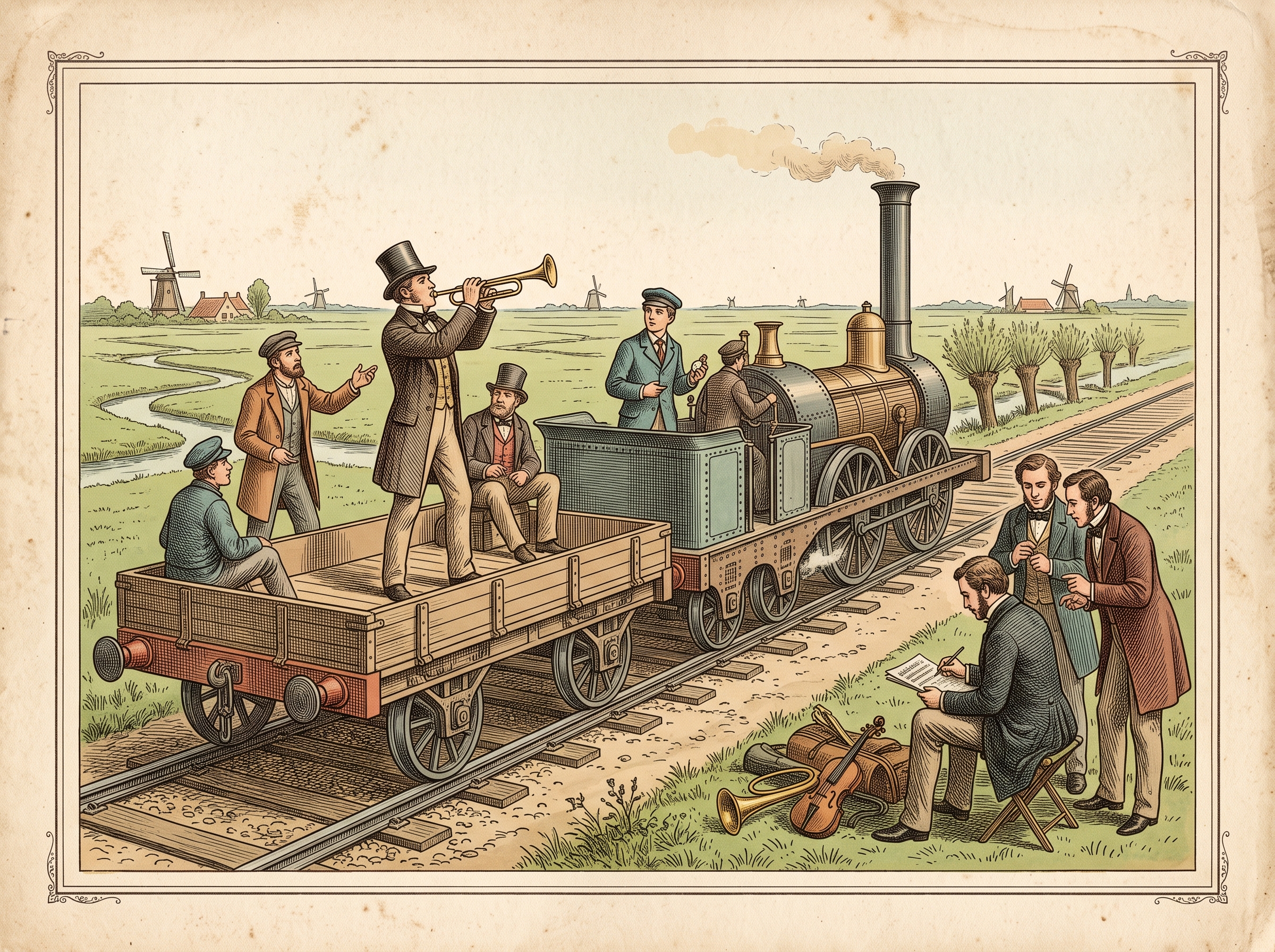
On 3 June 1845, a steam locomotive spent the day shuttling up and down the brand-new railway line between Utrecht and Maarssen in the Netherlands. It pulled a single open flatcar. On that flatcar stood a trumpet player, blowing one long note — a G — every time someone signaled him to. Beside the tracks, more musicians stood waiting with pencils, listening hard as he rushed past. They were not putting on a show. They were testing a theory about the color of stars.
By the Curiosities Desk · · 6 min read · Filed under Physics · Today’s round
What happened?
The man on the locomotive was Christophorus Henricus Diedericus Buys Ballot, a 27-year-old scientist who had just finished his doctorate at Utrecht University. A few years earlier, in 1842, an Austrian mathematician named Christian Doppler had published a paper with a bold claim: if a source of waves moves toward you, the waves bunch up and arrive more often; if it moves away, they stretch out and arrive less often. For light, Doppler argued, that would shift a star’s color. For sound, it would shift the pitch — the note you hear.
Doppler’s own interest was astronomical. He thought the motion of double stars (pairs of stars orbiting each other) explained why some of them looked colored. But nobody could check that by looking up, and according to several Dutch accounts, Buys Ballot was skeptical of the whole idea. Sound, though, offered a test you could run on Earth. Doppler had calculated that a sound source moving at roughly 70 kilometers an hour (about 43 mph) would shift a note by about a semitone — the step from one piano key to the next. In 1845, steam trains could finally go that fast.
Buys Ballot got permission to borrow a locomotive on the newly laid track. His first idea was to use the train’s own whistle, but its tone was too impure for anyone to pin down its exact pitch. So he recruited trumpet players from Utrecht instead — musicians with trained ears who could name a note on hearing it. One rode the flatcar with assistants. The others stood in groups beside the line, spaced about 400 meters apart, writing down what they heard as the train approached and receded. Then they switched: the trackside players blew while the musician on board listened.
His first attempt, in February 1845, had to be called off. Snow and hail swept the line, and the cold put the instruments out of tune. The June runs went better, but not smoothly. Going fast made the pitch shift bigger, yet it also made the trumpet harder to hear over the engine and shortened the moment it was audible. Going slowly made the shift too small to notice. Buys Ballot settled on speeds between about 18 and 72 km/h, timing them with watches — though the fireman couldn’t hold a steady speed. Then there were the humans. Musicians missed their cues; sometimes nobody played, sometimes two played at once. In his published report, Buys Ballot dryly recommended that anyone repeating the experiment use more disciplined assistants.
He ran the trials again on 5 June with louder natural trumpets (the kind without valves). Despite the irregularities, the listeners agreed: the note sounded higher as the trumpet came toward them and lower as it went away, by about the amount Doppler predicted. Buys Ballot published the results later that year in Annalen der Physik, one of the leading physics journals of the day, under a title that translates to “Acoustic Experiments on the Dutch Railway, with Occasional Remarks on the Theory of Prof. Doppler.”
Why was it strange?
It’s an odd sight on its face: a lab made of a locomotive, a flatcar, a railway timetable, and a small brass section. But the deeper strangeness is that the experiment both proved Doppler right and showed his favorite example was wrong.
The pitch shift was real. Yet in his paper, Buys Ballot argued that the effect could not explain the colors of stars. Starlight is a broad mix of colors, so shifting all of it slightly up or down doesn’t produce an obvious new color — light from just beyond the visible range simply slides in to replace what slides out. Stars really are different colors, but mostly because they have different surface temperatures. Doppler had the right physics attached to the wrong headline.
Another scientist, told from the human side: Nikola Tesla and the Pigeon He Loved.
What did scientists learn?
The experiment gave the first direct, on-the-ground confirmation of what we now call the Doppler effect for sound. The principle is simple: what you perceive as a wave’s frequency (how many wave crests reach you per second) depends on how fast the source and the listener are moving relative to each other. A trumpet coming toward you “catches up” with its own sound waves, squeezing them together, so more crests hit your ear each second and the pitch rises.
Light obeys the same rule, though the shift only becomes large at enormous speeds. In 1848 the French physicist Hippolyte Fizeau independently described the effect for light, and later astronomers learned to measure it not by color but by tiny shifts in the dark lines of a star’s spectrum — the barcode of colors a star gives off when its light is spread out through a prism.
Another person who would not drop the question: The Abbé Who Shocked 200 Monks in a Line a Mile Long to Time the Speed of Electricity.
How does it affect us today?
That shift is how astronomers measure whether stars and galaxies are moving toward or away from us, and it underpinned the 1920s discovery that the universe is expanding. Doppler radar tracks rotating storms and helps forecasters issue tornado warnings. Police speed guns, Doppler ultrasound scans of blood flow and unborn babies’ heartbeats, and many planet-hunting telescopes all rely on the same principle a few trumpeters demonstrated on a Dutch railway.
Buys Ballot himself went on to found the Royal Netherlands Meteorological Institute (KNMI) in 1854 and to give his name to Buys Ballot’s law, a rule of thumb for locating low pressure from the direction of the wind. Fittingly, the institute he founded now runs Doppler weather radar.
A close cousin: The Physicist Who Cleaned His 40-Foot Spectrograph by Sending the Family Cat Through It.
Fun fact
By one popular account of the experiment, the only practical use Buys Ballot foresaw for the effect was that it might someday help make better musical instruments.
Sources
- Buys Ballot, C. H. D. (1845). “Akustische Versuche auf der Niederländischen Eisenbahn, nebst gelegentlichen Bemerkungen zur Theorie des Hrn. Prof. Doppler.” Annalen der Physik 142(11): 321–351 — https://doi.org/10.1002/andp.18451421102
- KNMI (Royal Netherlands Meteorological Institute), “Doppler experiment Buys Ballot 160 jaar geleden” — https://www.knmi.nl/over-het-knmi/nieuws/doppler-experiment-buys-ballot-160-jaar-geleden
- Jonkman, E. J. (1980). “Doppler research in the nineteenth century.” Ultrasound in Medicine & Biology 6(1): 1–5 — https://doi.org/10.1016/0301-5629(80)90056-3
- The Quantum Universe (Delta Institute for Theoretical Physics), “Doppler, Buys Ballot en een kapotte hoorn” — https://www.quantumuniverse.nl/doppler-buys-ballot-en-een-kapotte-hoorn
- Reto U. Schneider, The Mad Science Book, “Trumpeters on the Steam Train (1845)” — https://www.weirdexperiments.com/steamtrain.htm