The Scientist Behind It · Physics
The Three Safes of Atomic Secrets That All Opened With the Same Number
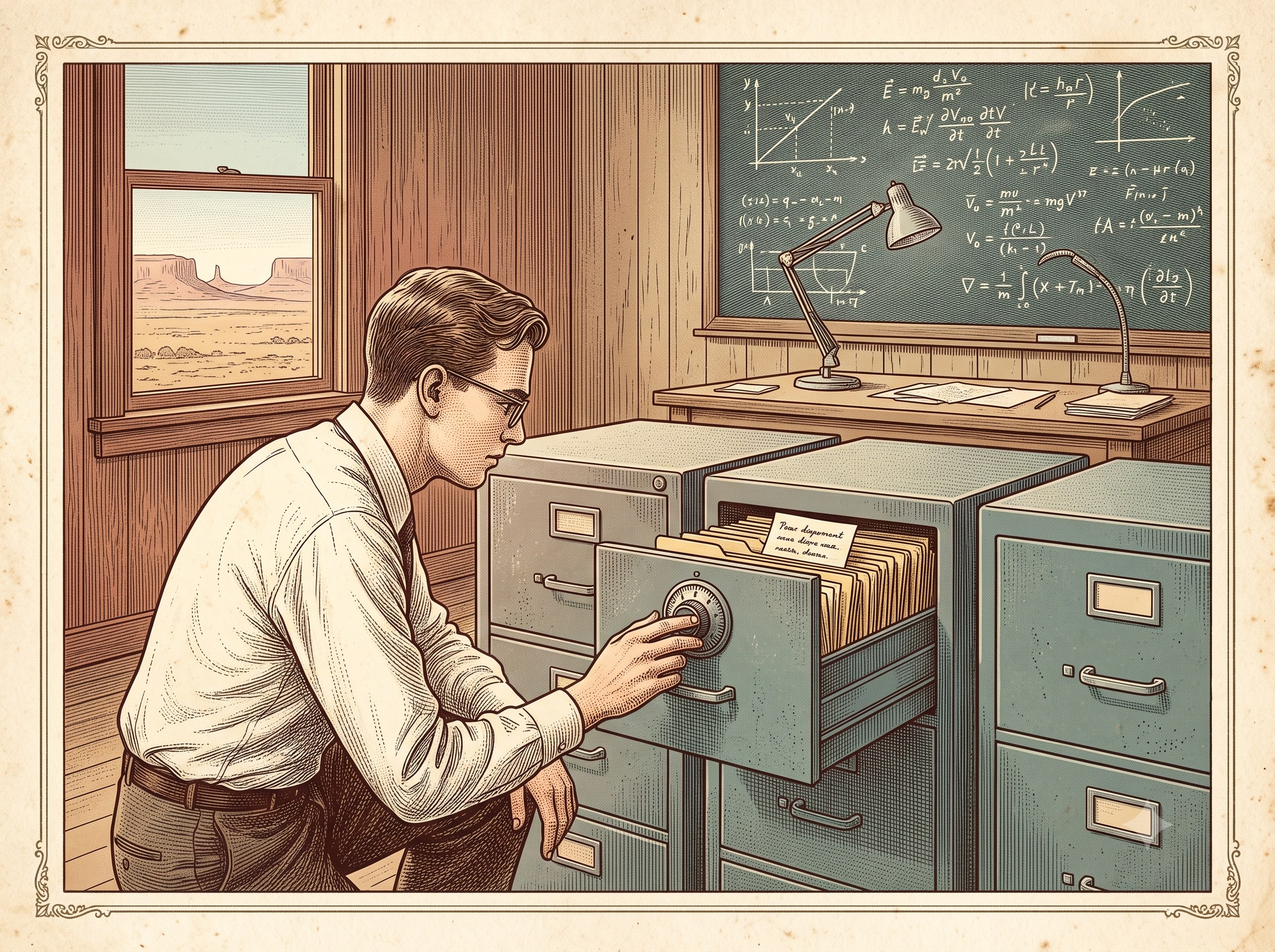
In a plywood office on a mesa in New Mexico stood three steel filing cabinets holding roughly everything the United States knew about how to build an atomic bomb. A young theoretical physicist knelt in front of the first one and spun the dial to 27, then 18, then 28 — the opening digits of the constant *e*. It opened. So did the second. So did the third. Then he pulled out a scrap of paper and left a note inside.
By the Curiosities Desk · · 5 read · Filed under Physics · Today’s round
What happened?
Richard Feynman arrived at Los Alamos in 1943, twenty-five and still finishing his Princeton doctorate. J. Robert Oppenheimer had written that year that he was “by all odds the most brilliant young physicist here, and everyone knows this.” He was put in Hans Bethe’s Theoretical Division, made a group leader, and helped wire up and run the lab’s first IBM punched-card machines.
He was also restless. His wife Arline was in a tuberculosis sanatorium in Albuquerque, a hundred miles away, and between visits Feynman collected puzzles. The best puzzles on the mesa were the locks.
At first they were easy. The early filing cabinets had simple locks he learned to work open, and he made a point of proving it. “To demonstrate that the locks meant nothing,” he later wrote, “whenever I wanted somebody’s report and they weren’t around, I’d just go in their office, open the filing cabinet, and take it out.” Then he’d hand it back: Thanks for your report. — Where’d you get it? — Out of your filing cabinet. — But I locked it! — I know you locked it. The locks are no good.
So the lab installed proper combination safes, advertised with a million possible settings: three numbers, a dial marked 0 to 99. Feynman took that as an invitation.
By his account he worked out three things. The dial had slop in it — you didn’t have to land exactly on a number for the bolts to clear, and within about two either way was good enough. That cuts a million settings down to roughly eight thousand: hours of patient turning, not lifetimes. If he could get a look at a safe while it stood open, he could quietly feel out the last two numbers and save them for later, leaving only about twenty candidates to try. And most usefully of all: a lot of people never changed the factory setting.
Then there was Frederic de Hoffmann, a young physicist who handled documents for the Theoretical Division — exactly the sort of person, Feynman reasoned, who would pick a mathematical constant. He tried pi: 31-41-59. Nothing. He tried e, the base of natural logarithms, 2.71828: 27-18-28. The drawer opened. So did the other two, on the same combination, and behind them sat the plutonium production schedules, the purification procedures, the numbers on how the weapon actually worked.
Feynman left notes. One read, “I borrowed document no. LA4312 — Feynman the safecracker.” In the second cabinet: “This one was no harder than the other one. — Wise Guy.” In the third: “When the combinations are all the same, one is no harder to open than another. — Same Guy.” De Hoffmann, finding them in the wrong order, had a bad few minutes believing a spy had been through his files.
Security’s eventual fix was almost sweeter than the prank. By Feynman’s account, a notice went around asking one question — had Feynman been in your office lately? — and anyone who answered yes was told to change their combination.
Why was it strange?
Los Alamos was the most closely guarded project on earth: barbed wire, armed guards, censored mail, a town that officially didn’t exist. Its filing cabinets were being opened by a bored twenty-something with a knack for guessing what a physicist would find memorable.
The strangeness isn’t that the locks were bad. It’s where the weakness was. The safes really did have a million settings. The people using them had about six.
There is a darker echo, too. While Feynman was proving that Los Alamos leaked, it was leaking — through Klaus Fuchs, a colleague and friend whose car Feynman borrowed for those drives to Albuquerque, and who was passing bomb design information to the Soviet Union. Fuchs never needed to crack a safe. He had a key.
A note on sourcing: most of the vivid detail comes from Feynman himself, in a 1975 talk and a memoir assembled from taped conversations, and he was a magnificent storyteller — stories told well get polished. The core is independently on the record, though. Los Alamos National Laboratory’s archive calls him “the lab’s premier safecracker,” and the National Park Service notes he was known for “picking locks on file cabinets in others’ offices, demonstrating that the security wasn’t very secure.”
Another scientist, told from the human side: The Scientist Who Weighed the Earth but Couldn’t Speak to His Housekeeper.
What did scientists learn?
Two things, one mechanical and one about people.
The mechanical lesson: a system’s real number of possibilities is usually smaller than its advertised number. If the dial tolerates being two off, you aren’t choosing among 100 values per wheel but about 20 — and 20 × 20 × 20 is 8,000, not 1,000,000. Two orders of magnitude vanished into engineering tolerance.
The human lesson is the one modern security is built on. The space of secrets people could choose is enormous; the space they actually choose is tiny and predictable — constants, birthdays, whatever the factory shipped. Researchers now call this the gap between theoretical entropy (how unpredictable a secret could be) and real-world entropy (how unpredictable it is, given how humans pick). Feynman found that gap with a filing cabinet and a hunch about a colleague’s taste in numbers.
Another person who would not drop the question: The Trumpeters Who Rode a Steam Train Back and Forth to Test a Theory About Stars.
How does it affect us today?
Every password-cracking tool runs on Feynman’s logic. Attackers don’t grind through every possible string; they try the common ones first, because a small handful of choices covers a startling share of real accounts. Unchanged factory defaults on routers, cameras, and other connected devices remain one of the most reliably exploited weaknesses in computing — the modern version of never spinning the dial off the setting the safe arrived with.
His other legacy is the practice itself. Hiring someone to break into your own building, to prove it can be done, is now a profession: penetration testing, red teaming, bug bounties. Feynman did it without authorization, without pay, and with a note left behind so the owner would know.
The same thread — Richard Feynman — continues in The Spaghetti That Stumped Richard Feynman by Refusing to Break in Two.
Fun fact
Feynman also entertained himself with the fence. He found a hole in the perimeter, walked out through it, came back in through the main gate — and repeated the loop, so the guards’ log showed him entering the site over and over without ever leaving.
Sources
- Richard P. Feynman, “Los Alamos From Below: Reminiscences 1943–1945”, Engineering & Science, Caltech Archives — Feynman’s own first-person account.
- Los Alamos National Laboratory, National Security Research Center, “Richard P. Feynman: Safecracking, cipher-creating, and ‘the most brilliant young physicist’” — includes his April 1945 letter to Arline and Oppenheimer’s 1943 assessment.
- National Park Service, Manhattan Project National Historical Park, “Manhattan Project Scientists: Richard P. Feynman”.
- Open Culture, “Learn How Richard Feynman Cracked the Safes with Atomic Secrets at Los Alamos” — quotes the “Safecracker Meets Safecracker” chapter of Surely You’re Joking, Mr. Feynman! directly.
#Richard Feynman #Los Alamos #Manhattan Project #World War II