The Spaghetti That Stumped Richard Feynman by Refusing to Break in Two
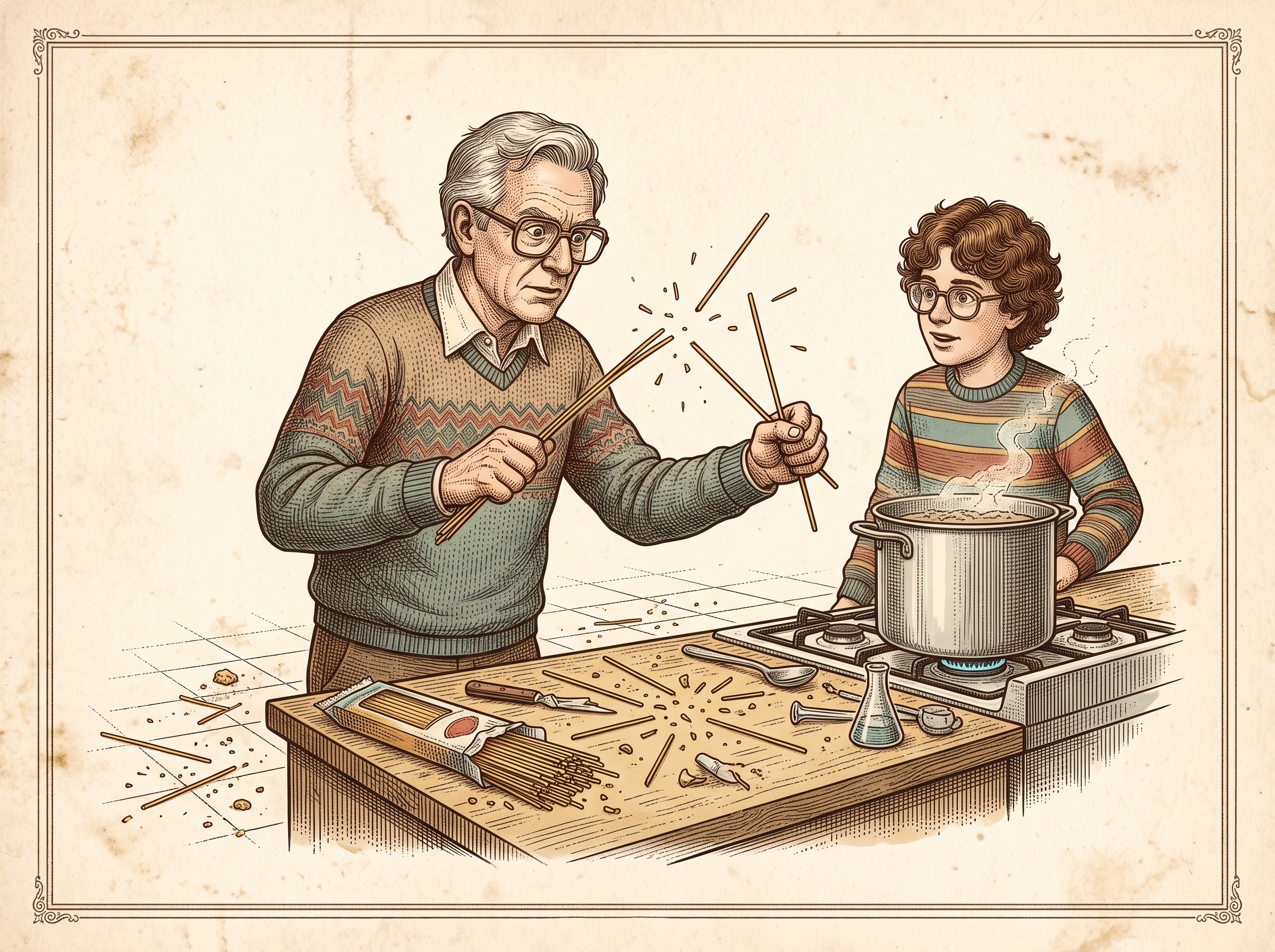
Sometime in the 1980s, one of the most celebrated physicists of the twentieth century stood in a kitchen holding a single stick of dry spaghetti by both ends. Richard Feynman bent it. It snapped — not into two pieces, but into three or more jagged fragments. He tried again. Same result. A couple of hours later, by his friend's account, the kitchen floor was covered in broken pasta, and the Nobel laureate still had no idea why.
By the Curiosities Desk · · 5 min read · Filed under Physics · Today’s round
What happened?
Feynman, who shared the 1965 Nobel Prize in Physics for his work on quantum electrodynamics, was famous for chasing puzzles that other people walked right past. One evening, while he and his friend W. Daniel Hillis — a computer scientist who pioneered massively parallel supercomputers — were making spaghetti for dinner, they noticed something odd. Bend a dry noodle until it breaks, and it almost never splits cleanly in half. It shatters.
So dinner turned into an experiment. The two men snapped strand after strand, trying to work out what was going on. Hillis later described the outcome in Christopher Sykes’s 1994 book No Ordinary Genius: after a couple of hours, they had “broken spaghetti all over the kitchen and no real good theory” to explain it. Feynman died in 1988 without ever solving it.
He wasn’t the only one bothered. The French physicist Pierre-Gilles de Gennes, after winning the 1991 Nobel Prize in Physics, reportedly mentioned the spaghetti mystery in television interviews as an example of a simple everyday question science still couldn’t answer.
The first real answer arrived in 2005. Basile Audoly and Sébastien Neukirch, physicists at the Université Pierre et Marie Curie in Paris, designed what they called an “equivalent catapult experiment.” Instead of bending a noodle until it snapped, they clamped one end, bent it just short of breaking, and then let the free end go — mimicking what a half of a freshly snapped strand would do in the instant after the first break. They filmed the results at 1,000 frames per second. Their paper in Physical Review Letters carried the wonderfully direct subtitle “Why Spaghetti Does Not Break in Half.” In 2006 it earned them the Ig Nobel Prize in Physics, the award for research that first makes people laugh and then makes them think.
But that only explained the problem. Could anyone actually beat it? In spring 2015, MIT student Ronald Heisser and project partner Edgar Gridello took on the challenge as a final project for a nonlinear dynamics class taught by mathematician Jörn Dunkel. Through trial and error, they found that when they twisted a noodle hard before bending it, it sometimes snapped cleanly in two.
Heisser wanted to know why. He built a machine with a clamp at each end: one clamp rotated to twist the spaghetti, while the other slid inward to bend it. He and fellow student Vishal Patil broke hundreds of sticks of Barilla No. 5 and No. 7 spaghetti, filming the fractures at up to a million frames per second. Their 2018 paper in the Proceedings of the National Academy of Sciences reported the recipe: twist the stick nearly 360 degrees, then slowly bring the ends together. Snap. Two pieces.
Why was it strange?
Common sense says a break should relieve stress. Once the noodle cracks in the middle, the strain is released, and everything should relax. As Neukirch told Science News, you would expect releasing stress to make a material less likely to break.
Spaghetti does the opposite. The first break makes more breaks happen. That’s a genuinely counterintuitive result, and it had been hiding in plain sight in kitchens for as long as people have been cooking dried pasta. Two Nobel-level physicists had noticed it and couldn’t crack it — pun very much intended.
Another ordinary thing with a strange past: The Slinky: The Walking Spring That Fell Off a Navy Workbench.
What did scientists learn?
Audoly and Neukirch’s footage showed that when a bent rod suddenly breaks, each half doesn’t simply spring back like a diving board. Instead, the release sends a bending wave — a ripple of curvature — racing along the rod and reflecting back from the held end. Where these waves overlap, the curvature spikes. By their calculations, the local bend could briefly become about three times as sharp as it was before the first break. The spaghetti, already near its limit, snaps again at those hot spots. Each new fragment gets its own ripples, and the result is a fracture cascade: one break triggering the next.
The MIT team extended that theory by adding twist. Patil’s mathematical model showed that twisting does two things. First, a twisted noodle breaks with less bending, so the “snap-back” is weaker. Second, when a twisted rod breaks, it also untwists, sending out a twist wave that travels faster than the bending wave. That twist wave carries energy away before the curvature can pile up enough to cause a second break. As Dunkel put it to MIT News, once it breaks the rod wants to be straight — “but it also doesn’t want to be twisted.” For a 10-inch stick, the model predicted a twist of about 270 degrees would do the job, in line with what the machine showed.
The same thread — Richard Feynman — continues in The Three Safes of Atomic Secrets That All Opened With the Same Number.
How does it affect us today?
The results apply to far more than dinner. Any long, thin, brittle rod can fail in the same cascading way, and researchers have pointed to everything from engineered nanotubes and multifiber structures to microtubules — the tiny structural rods inside living cells. Engineers who study how bridges, bones, and machine parts fracture into multiple pieces gain a new tool: the idea that adding or controlling twist can steer how, and how many times, something breaks.
It’s also a lasting argument for taking “silly” questions seriously. A puzzle that started as two friends making a mess of a kitchen now has a peer-reviewed theory, a working solution, and a place in the study of fracture mechanics.
Another object that did not start out as itself: The Frisbee Salesmen Who Charged a Dollar for an Invisible Wire.
Fun fact
The MIT method isn’t very practical for cooking. You need to twist the noodle almost a full turn before bending it — and even Dunkel admitted the two students who did the work probably didn’t want to see, break, or eat spaghetti for a while.
Sources
- Audoly, B. & Neukirch, S. (2005). “Fragmentation of Rods by Cascading Cracks: Why Spaghetti Does Not Break in Half.” Physical Review Letters 95, 095505. https://link.aps.org/doi/10.1103/PhysRevLett.95.095505
- Heisser, R. H., Patil, V. P., Stoop, N., Villermaux, E. & Dunkel, J. (2018). “Controlling fracture cascades through twisting and quenching.” PNAS 115(35). https://www.pnas.org/doi/10.1073/pnas.1802831115
- Chu, J. “MIT mathematicians solve age-old spaghetti mystery.” MIT News, August 13, 2018. https://news.mit.edu/2018/mit-mathematicians-solve-age-old-spaghetti-mystery-0813
- Weiss, P. “That’s the Way the Spaghetti Crumbles.” Science News, November 8, 2005. https://www.sciencenews.org/article/thats-way-spaghetti-crumbles
- “Physical Review Letter on Breaking Spaghetti Leads to 2006 Ig Nobel Award.” Phys.org / American Physical Society, October 2006. https://phys.org/news/2006-10-physical-letter-spaghetti-ig-noble.html