The 'Astronaut Drink' NASA Never Invented — and the Moonwalker Who Said It Sucks
In June 2013, Buzz Aldrin, the second person to walk on the Moon, stepped onstage at Spike TV's Guys Choice Awards to hand an award to skydiver Felix Baumgartner. Baumgartner's record jump had been sponsored by Red Bull, and Aldrin admitted he was a little jealous. Nobody had ever offered him a sponsorship, he said, not even the orange drink a generation of kids believed astronauts lived on. Then he gave his verdict on it, in two words: "Tang sucks."
By the Curiosities Desk · · 5 min read · Filed under Space · Today’s round
What happened?
Tang began on Earth, in a corporate kitchen. In 1957, food scientist William A. Mitchell and chemist William Bruce James, both working for General Foods, formulated and trademarked an orange-flavored powdered drink. Stir a spoonful into water and you got something like orange juice, with no squeezing, no refrigeration, and added vitamins C and A. It went into test markets in 1958 and reached the public in 1959.
Shoppers shrugged. Sales were slow, and for a few years Tang looked like one more convenience food that would quietly disappear.
Mitchell, for his part, was used to unusual assignments. Born in 1911 in Raymond, Minnesota, he earned a master’s degree in chemistry at the University of Nebraska and spent 35 years at General Foods, collecting more than 70 patents. During World War II he developed a tapioca substitute that, according to a Minnesota newspaper’s profile of his life, soldiers nicknamed “Mitchell Mud.” He also worked out quick-set Jell-O, powdered egg whites, and the first non-dairy whipped topping, Cool Whip. And in 1956, a year before Tang, he had figured out how to trap carbon dioxide inside hard candy. He patented it in 1961 as a “gasified confection.” The world later met it as Pop Rocks.
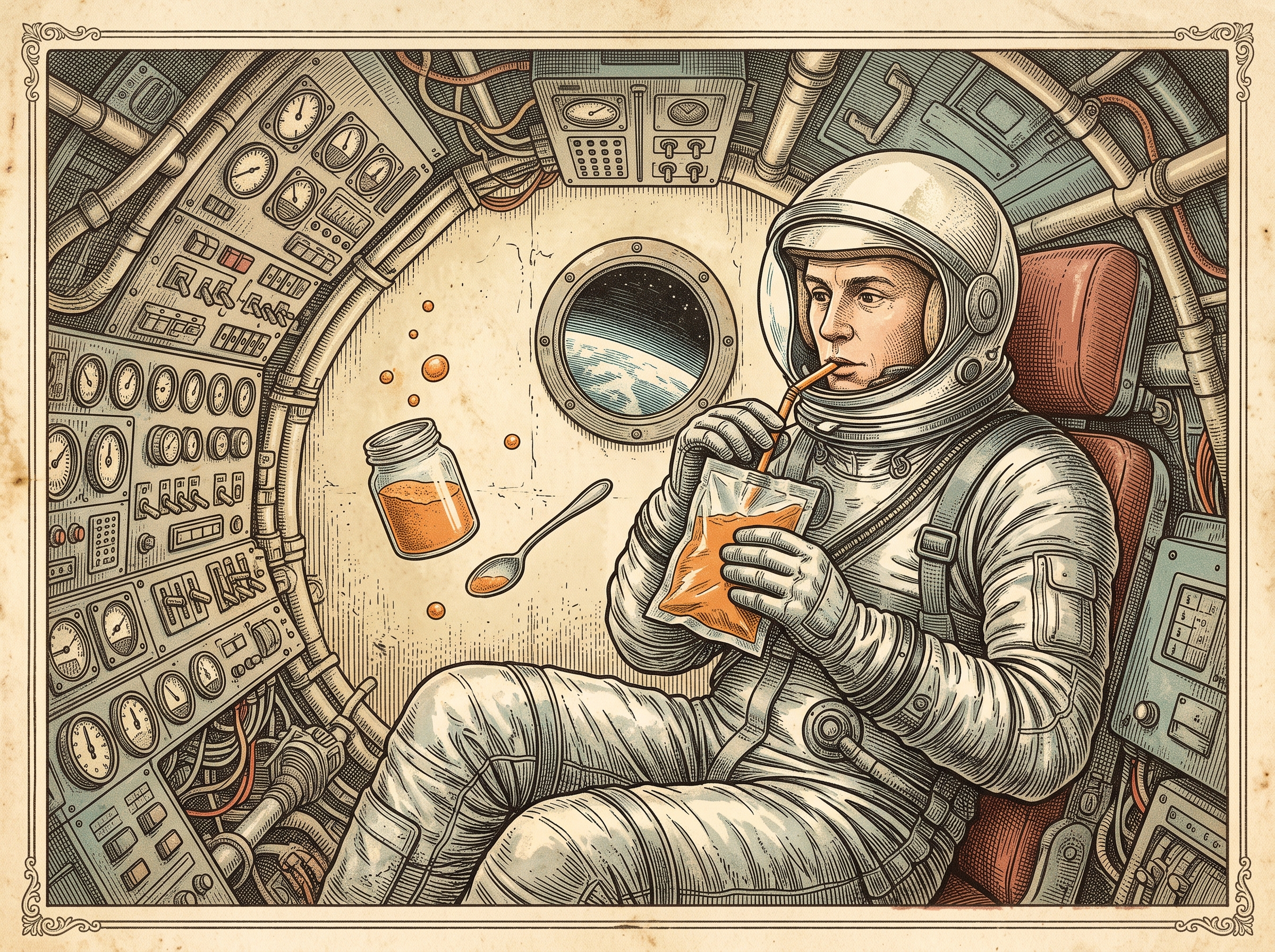
Then came the space program. In February 1962, John Glenn became the first American to orbit Earth, and part of his job aboard Friendship 7 was to test whether a person could eat and swallow normally in weightlessness. Nobody was sure. NASA’s own Spinoff office states that Glenn consumed Tang while in orbit, and says the flight brought “heightened public awareness of the drink and its association with space.” Tang also flew on some later Gemini missions.
General Foods made the most of it. Tang was advertised as the “space age” breakfast drink of the astronauts, and kids in the 1960s were told, as one NPR reporter later remembered it, that drinking it might help them grow up to be astronauts too. Sales took off.
There was one detail the ads didn’t stress: NASA hadn’t invented Tang or asked anyone to. As NASA food scientist Michele Perchonok explained to Space.com in 2006, General Foods was already making its travel drink mix, and NASA thought it was a good way to fly beverages. The agency bought an already-made, commercially available product. The packets astronauts actually used didn’t even carry the Tang name; NASA labeled the drinks by flavor.
Even Aldrin’s own flight may not have carried it. In his 1973 memoir Return to Earth, he wrote that the Apollo 11 crew had picked a grapefruit-orange drink, and that if Tang was on the flight, he was unaware of it.
Why was it strange?
Tang is one of the few products that became famous for something it didn’t do. Ask people to name a NASA invention and it still comes up, alongside Velcro and Teflon. NASA’s Spinoff FAQ answers all three the same way: no. Velcro came from a Swiss engineer in the 1940s, Teflon from DuPont in 1938, and Tang from General Foods in 1957.
So the “astronaut drink” was really a grocery-store drink that hitched a ride. Spaceflight didn’t create it. Spaceflight gave it a story, and the story sold better than the powder had alone.
And then one of the most famous astronauts in history, decades later, cheerfully told a TV audience he didn’t like it. Aldrin backed up the remark himself on Twitter, telling followers to watch the broadcast if they wanted to know what he thought of Tang.
The same thread — Space Food — continues in The Astronaut Ice Cream That Astronauts (Probably) Never Ate.
What did scientists learn?
Glenn’s flight answered a real question. Before 1962, some researchers worried that swallowing might fail without gravity to help food down. Glenn showed that it works. Swallowing is driven by muscles in the throat and esophagus (the tube from your mouth to your stomach), not by falling.
Drinks raised a different, more practical problem: weight and packaging. Every gram launched into orbit costs fuel, and liquids are heavy. A dry powder weighs very little and keeps for a long time without refrigeration. Astronauts add water once they’re in space. Early spaceflight food leaned heavily on this idea, called rehydration: remove the water on Earth, put it back in orbit. In weightlessness the drink also can’t sit in an open cup, so it has to be mixed and sipped from a sealed pouch.
That is why a product like Tang fit so neatly. It was light, shelf-stable, vitamin-fortified, and already on store shelves. NASA didn’t need to invent a drink. It needed one that already worked, and General Foods happened to have one.
Another ordinary thing with a strange past: The Crash-Test Foam That Invented Your Mattress.
How does it affect us today?
Tang is far from gone. In 2011, Kraft Foods said it had become a billion-dollar brand, with global sales nearly doubling since 2006, and in recent years its top markets have been Brazil, Argentina, and the Philippines. It is not usually offered aboard the International Space Station.
Its biggest legacy may be the myth itself. Because Tang, Velcro, and Teflon are so often credited to NASA, the agency’s Spinoff program spends real effort correcting the record, while pointing to the technologies that did grow out of space research. The Tang story is a good reminder to ask a simple question about any “invented for space” claim: did the space program create it, or just make it famous?
Another object that did not start out as itself: The Kitchen Microwave That Impersonated a Signal From Deep Space.
Fun fact
The same chemist gave the world Tang, Cool Whip, and Pop Rocks. According to his obituary, Pop Rocks was the invention that gave Mitchell “a measure of fame” and was “the most personally satisfying.”
Sources
- NASA Spinoff, “Frequently Asked Questions” (Tang, Velcro, and Teflon): https://spinoff.nasa.gov/faq
- Space.com, “To Moonwalker Buzz Aldrin, ‘Tang Sucks’” (2013): https://www.space.com/21538-buzz-aldrin-tang-spaceflight.html
- NPR, “Now He Tells Us: ‘Tang Sucks,’ Says Apollo 11’s Buzz Aldrin” (2013): https://www.npr.org/sections/thetwo-way/2013/06/13/191271824/now-he-tells-us-tang-sucks-says-apollo-11s-buzz-aldrin
- Linda Hall Library, “Scientist of the Day: William A. Mitchell”: https://www.lindahall.org/about/news/scientist-of-the-day/william-a-mitchell/
- Discover Magazine, Amy Shira Teitel, “No, NASA Didn’t Invent Tang”: https://www.discovermagazine.com/the-sciences/no-nasa-didnt-invent-tang
#William A. Mitchell #General Foods #space food #everyday objects