The Kitchen Microwave That Impersonated a Signal From Deep Space
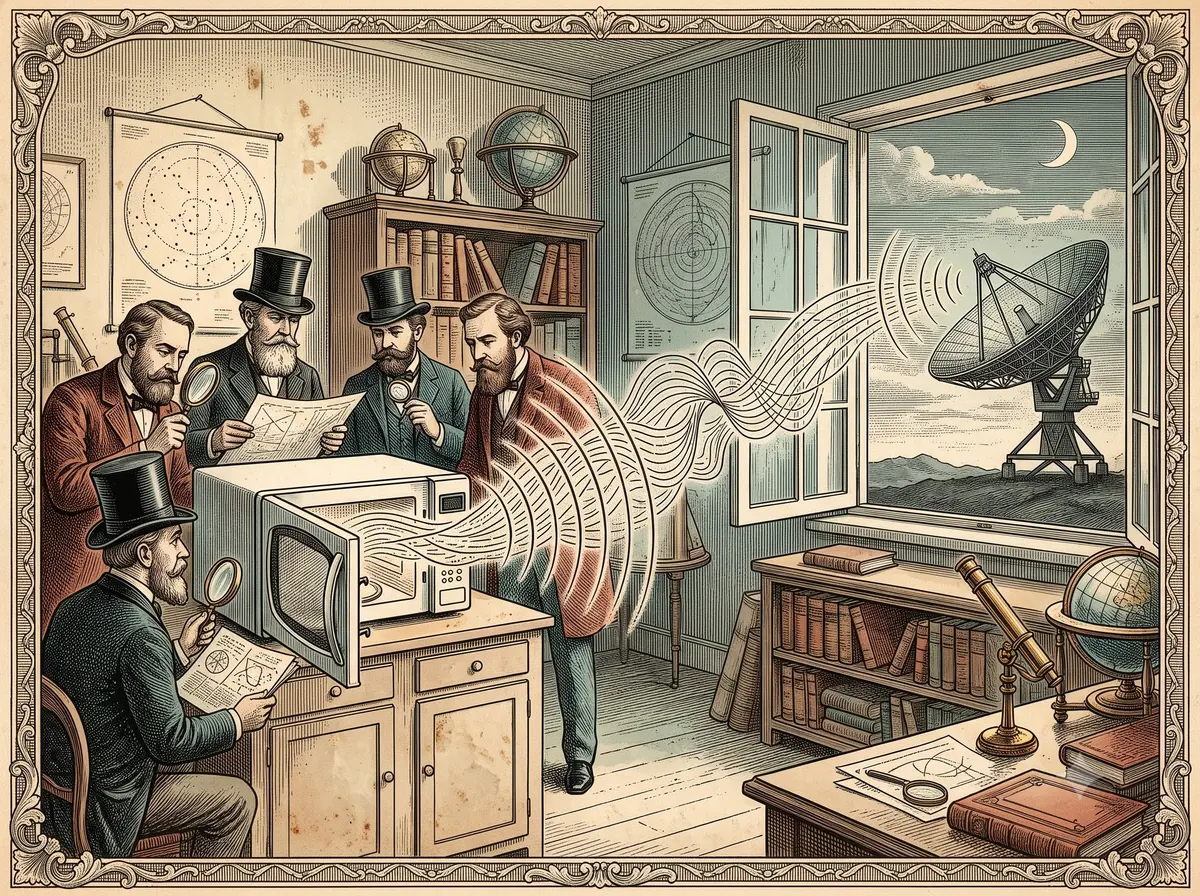
On March 17, 2015, some of the world's best radio astronomers stood in the staff kitchen of Australia's Parkes Observatory, running a microwave oven over and over while a 64-metre telescope listened outside. Then one of them did the thing every impatient person does: opened the door before the beep. Out in the control room, a signal bloomed in the data — the same "mystery signal from beyond the galaxy" that had haunted the observatory's records for 17 years.
By the Curiosities Desk · · 5 min read · Filed under Space · Today’s round
What happened: The Kitchen Microwave That Impersonated a Signal From Deep Space
The story starts with a real cosmic mystery. In 2007, astronomer Duncan Lorimer and his colleagues found a millisecond-long radio flash in archival data from the Parkes telescope — a burst so powerful and so distant-looking that it launched an entire new field of astronomy. It became known as the Lorimer burst, the first “fast radio burst,” or FRB.
Hoping to find more, a PhD student named Sarah Burke Spolaor combed through other old Parkes data. She found about eleven similar flashes lurking in recordings from 1998 to 2002 — but with a problem. Radio astronomers have a simple trick for telling a cosmic signal from local interference: the Parkes receiver watches 13 separate patches of sky at once, and a real signal from space should show up in only one of them. These new flashes appeared in all 13 at the same time. Whatever they were, they were coming from somewhere near the telescope — while doing an uncanny impression of something billions of light-years away.
In her 2011 paper, Burke Spolaor gave the impostor signals a name: perytons, after a mythical winged stag invented by the writer Jorge Luis Borges. The team floated possible culprits — lightning, solar activity, some quirk of the atmosphere — but nothing fit. Worse, the perytons’ resemblance to the Lorimer burst cast doubt on FRBs themselves. If a nearby something could fake a cosmic burst, maybe the famous one was fake, too.
The break came in December 2014, when CSIRO installed a radio-frequency interference monitor at Parkes — essentially a listening post for stray human-made signals around the site. In the week of January 19, 2015, three fresh perytons appeared, and new fast-detection software meant astronomers spotted each within a day instead of years later. When Emily Petroff and her colleagues checked the interference monitor, they found that every peryton arrived alongside a spike of emission at around 2.4 gigahertz — a frequency band notoriously crowded with consumer electronics, including the microwave oven.
Parkes had two of them: one in the staff kitchen, one in the visitors’ centre. The team ran the ovens normally. Nothing. Then, on March 17, they tried stopping an oven mid-cycle by yanking the door open — and perytons appeared in the telescope data, on demand. The escaping pulse came from the magnetron, the oven’s microwave-generating tube, during the fraction of a second it takes to power down. Wait for the beep and the oven stays polite; open the door early with the dish pointed the right way, and your leftovers photobomb the universe.
Why it was strange: The Kitchen Microwave That Impersonated a Signal From Deep Space
Radio pulses that cross deep space arrive smeared out in a precise way: lower frequencies lag behind higher ones after ploughing through the thin plasma between galaxies, an effect called dispersion. It’s the closest thing radio astronomy has to a passport stamp — local interference isn’t supposed to have it. The perytons did. A kitchen appliance, dying magnetron sputtering for a few milliseconds, produced a frequency sweep that mimicked a signal that had travelled for billions of years. That’s what made the mystery so stubborn: the fakes weren’t sloppy. They were wearing the one disguise astronomers trusted most.
The same thread — Radio Astronomy — continues in The Graduate Student, the ‘Little Green Men,’ and the Nobel That Got Away.
What scientists learned: The Kitchen Microwave That Impersonated a Signal From Deep Space
The 2015 paper did more than solve a whodunit. By pinning down exactly how the ovens produced perytons, Petroff’s team could show what the ovens couldn’t have produced: the original Lorimer burst, which appeared in a way and at a time the on-site ovens couldn’t explain. Clearing out the impostors made the case for fast radio bursts stronger, not weaker. The episode also became a textbook lesson in radio-frequency hygiene — observatories sit in radio-quiet zones for a reason, and even the staff kitchen counts as part of the experiment. Mostly, though, it showed science’s self-correction working as designed: the same community that found the strange signals did the unglamorous detective work to expose them.
Another ordinary thing with a strange past: The Astronaut Ice Cream That Astronauts (Probably) Never Ate.
How it reaches us today: The Kitchen Microwave That Impersonated a Signal From Deep Space
Fast radio bursts, vindicated, grew into one of astronomy’s hottest fields. Some sources have been caught repeating, several have been traced to distant galaxies, and in 2020 a burst was linked to a magnetar — an ultra-magnetized dead star — inside our own Milky Way, the leading suspect for what powers them. Because each burst carries that dispersion “passport stamp,” astronomers now use FRBs to weigh the invisible thin gas between galaxies. None of that confidence would have come easily while a kitchen appliance was muddying the evidence. And at radio observatories around the world, the microwave ovens are now shielded, replaced, or treated with the wariness normally reserved for solar flares.
Another object that did not start out as itself: The Crash-Test Foam That Invented Your Mattress.
Fun fact: The Kitchen Microwave That Impersonated a Signal From Deep Space
Borges’ peryton — the creature the signals were named after — is a winged stag with one unsettling trait: it casts the shadow of a man. The name, chosen in 2011 mostly for its ambiguity, turned out to be a perfect prophecy. The signals looked like they came from the heavens, but their shadow was human all along.
Sources: The Kitchen Microwave That Impersonated a Signal From Deep Space
- Petroff et al., “Identifying the source of perytons at the Parkes radio telescope,” MNRAS (2015)
- Burke-Spolaor et al., “Radio Bursts with Extragalactic Spectral Characteristics Show Terrestrial Origins,” The Astrophysical Journal 727:18 (2011)
- Emily Petroff, “How we found the source of the mystery signals at The Dish,” The Conversation (2015)
- Sky & Telescope, “Microwave Ovens Spark Radio Signals” (2015)
Related stories: The Kitchen Microwave That Impersonated a Signal From Deep Space
- The Melted Candy Bar That Invented the Microwave — A candy bar melted in a radar engineer’s pocket
- The Pigeon Mess That Turned Out to Be the Echo of the Big Bang — An inexplicable hiss turned out to be the echo of the Big Bang
- The Loose Cable That Made Neutrinos Outrun Light for Five Months — A loose fiber-optic cable made neutrinos appear to outrun light