Accidental Discoveries · Engineering
The Melted Candy Bar That Invented the Microwave
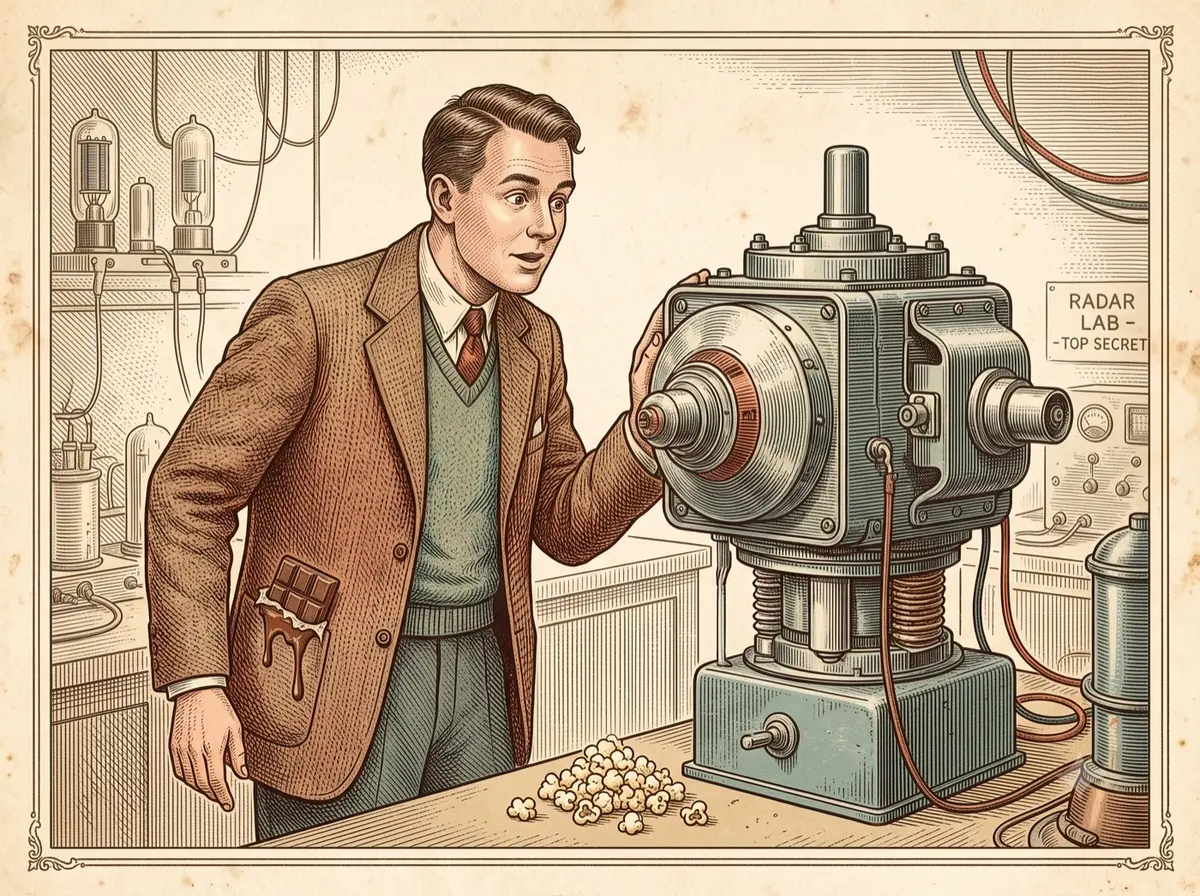
A self-taught engineer who never finished grammar school was standing in front of a humming radar tube one day in 1945 when he noticed something odd: the candy bar in his pocket had turned to goo. Most people would have cursed and reached for a napkin. He reached for a bag of popcorn.
By the Curiosities Desk · · 4 min read · Filed under Engineering · Today’s round
What happened: The Microwave
Percy Spencer was one of the world’s leading experts on radar tubes, working for the defense contractor Raytheon during World War II. He had grown up an orphan in rural Maine, left school early to support his family, and taught himself physics, chemistry, and calculus by reading textbooks during night shifts in the Navy. By 1945 he was running a division that built magnetrons — the vacuum tubes that generate the microwaves powering radar.
While standing near an active magnetron, Spencer noticed the candy bar in his pocket had melted. He wasn’t the first person to feel this warmth, but he was the first to get curious about why. He sent out for popcorn kernels and held them up to the tube. They popped — the world’s first batch of microwave popcorn. Next he tried an egg in a kettle, which promptly exploded in a colleague’s face. Spencer then sealed a magnetron to a metal box so the waves couldn’t escape, creating the first true microwave oven. Raytheon filed a patent for a microwave cooking device on October 8, 1945.
Why it was strange: The Microwave
A weapon-detection technology built to win a war ended up reheating leftovers. The radar program that produced Spencer’s magnetrons was, at one point, the U.S. military’s second-highest priority project of the war — ranked just behind the Manhattan Project. The same physics aimed at spotting enemy aircraft turned out to be very good at agitating water molecules in food.
It was also a strange origin for a kitchen staple because the first ovens were monstrous. Raytheon’s 1947 “Radarange” stood about six feet tall, weighed roughly 750 pounds, and cost around $5,000 — the equivalent of tens of thousands of dollars today. The compact countertop version most people could actually buy didn’t arrive until 1967.
It shares a shelf with The Rocket Scientist Whose Leaky Fridge Idea Became the Super Soaker, in The Mistakes That Became Things You Still Use.
What scientists learned: The Microwave
The deeper lesson is that microwaves heat food by exciting water and other polar molecules directly, rather than warming the air or a surface first as a conventional oven does. That’s why a microwave can cook the inside of a potato while the plate stays cool, and why it struggles with bone-dry foods. Spencer’s accidental observation effectively demonstrated dielectric heating in a kitchen-ready form, kicking off decades of research into how electromagnetic radiation interacts with matter.
Also in The Mistakes That Became Things You Still Use: The Cylinder That Weighed Too Much and Became Teflon.
How it reaches us today: The Microwave
Microwave ovens are now in the overwhelming majority of homes across the developed world, quietly reshaping how people eat, what the frozen-food aisle looks like, and how restaurants and convenience stores operate. The underlying magnetron technology also lives on in radar, satellite communications, and medical equipment. Not bad for a discovery that began with a ruined snack.
Another from The Mistakes That Became Things You Still Use: The Burrs Stuck to a Dog That Became Velcro.
Fun fact: The Microwave
For inventing one of the most widely used appliances on Earth, Spencer received no royalties — just a one-time $2 gratuity, the same token payment Raytheon gave every employee whose name appeared on a company patent.
Sources: The Microwave
- “Percy Spencer,” Wikipedia — https://en.wikipedia.org/wiki/Percy_Spencer
- Emily Conover, “1945: First Patent for the Microwave,” American Physical Society (APS News), October 2015 — https://www.aps.org/apsnews/2015/10/first-patent-for-microwave
- National Inventors Hall of Fame, Percy L. Spencer — https://www.invent.org/inductees/percy-l-spencer
- U.S. Patent 2,495,429 (Raytheon microwave cooking apparatus)
Related stories: The Microwave
- Part of The Mistakes That Became Things You Still Use
- The Kitchen Microwave That Impersonated a Signal From Deep Space — A mystery space signal that was staff opening the microwave early
- The Cylinder That Weighed Too Much and Became Teflon — A gas cylinder that weighed too much held the first Teflon
- The Rocket Scientist Whose Leaky Fridge Idea Became the Super Soaker — A leaky heat-pump idea turned into the Super Soaker