Accidental Discoveries · Engineering
The Rocket Scientist Whose Leaky Fridge Idea Became the Super Soaker
A stream of water shot clear across a home bathroom, and the man watching it — an aerospace engineer who worked on NASA's mission to Jupiter — froze mid-experiment. He was supposed to be building a better refrigerator. Instead he thought: *that would make a great squirt gun.*
By the Curiosities Desk · · 5 min read · Filed under Engineering · Today’s round
What happened: The Super Soaker
In 1982, Lonnie Johnson was moonlighting on a private project in his home. By day he was a systems engineer at NASA’s Jet Propulsion Laboratory, working on the Galileo mission to Jupiter; before that he had spent years in the U.S. Air Force running a section on nuclear power safety for spacecraft. His after-hours idea was a heat pump — a device that moves heat to warm or cool a space — that would use plain water as its working fluid instead of the chlorofluorocarbon refrigerants, then still common, that were known to damage the ozone layer.
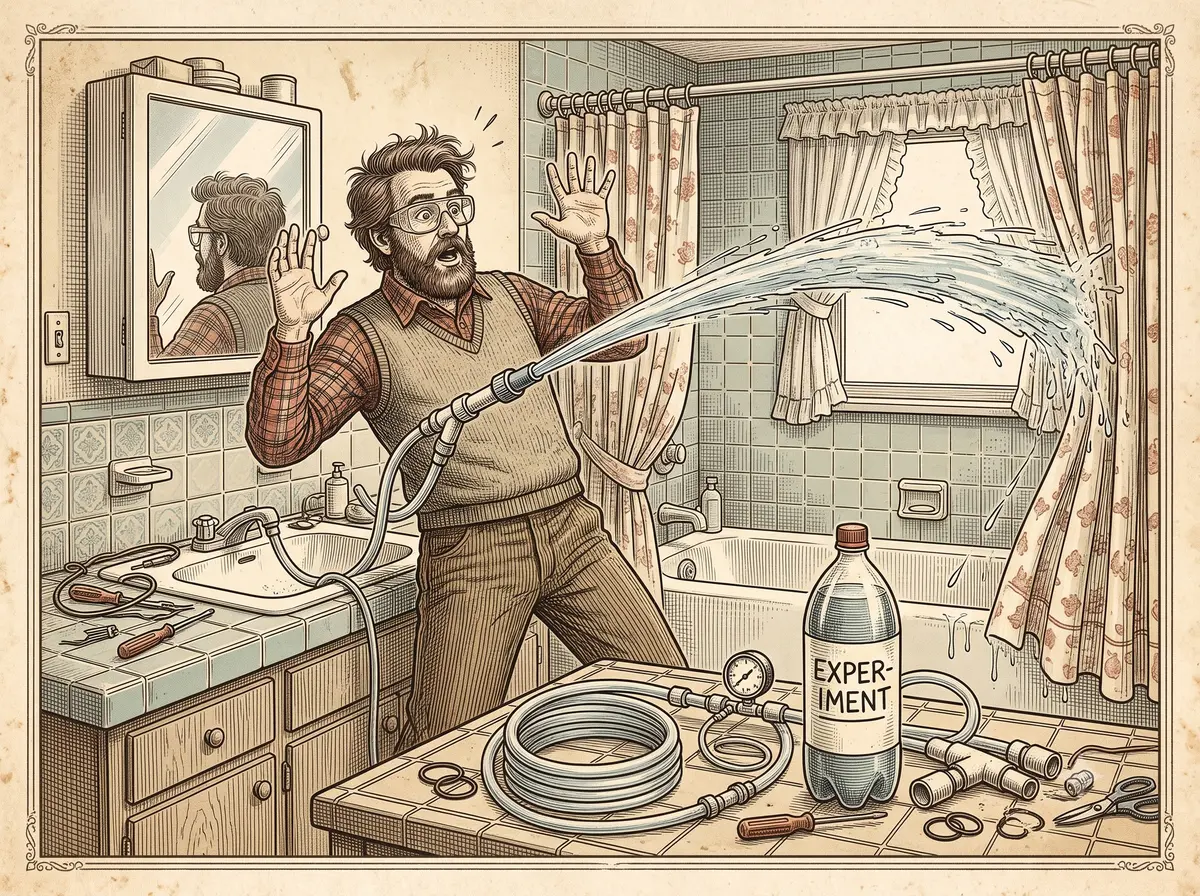
To test it, Johnson rigged a nozzle to his bathroom sink. When he turned it on, the pressurized water blasted across the room with enough force to flutter the curtains. The engineering point of the experiment was almost beside the point. What struck him was the sheer power of that jet, and how satisfying it looked. As he has told the story many times since, his first thought was that it would make a terrific water gun.
Johnson started building one. Working on a lathe in his home workshop, he assembled a prototype from Plexiglas, PVC pipe, O-ring seals, and — for a generous reservoir — a two-liter soda bottle. The key idea separated his design from every squirt gun before it. Ordinary water pistols squeezed a thin dribble straight from a trigger pump. Johnson’s gun pumped air to pressurize a large tank of water first, then released it all at once through a nozzle. His homemade version, which he still owns, looked like a prop from a science-fiction film and could throw a blast of water nearly 40 feet.
In 1986 he was granted U.S. Patent 4,591,071 for the invention, filed under the plain title “Squirt Gun.” Then came the hard part. For several years Johnson pitched his drenching machine to toy companies and collected polite rejections and stalled deals. The breakthrough came in 1989, when the Philadelphia toy maker Larami saw the potential. The company put it on shelves in 1990 under the name Power Drencher. Sales were modest at first. After some redesign and a rebrand to “Super Soaker,” backed by a cheeky television ad, the toy detonated: it became one of the best-selling toys in the world in the early 1990s and has earned more than a billion dollars over its lifetime.
Why it was strange: The Super Soaker
The strangeness is in the mismatch. The Super Soaker was not dreamed up by a toy designer chasing the next summer craze. It came from a man whose day job involved keeping nuclear systems safe on deep-space probes, working on a domestic appliance meant to help the ozone layer. A project about environmental refrigeration turned, in one accidental spray, into the archetypal backyard water fight.
It also violates the usual order of invention. We tend to imagine someone identifying a problem — kids want a better water gun — and then engineering a solution. Johnson did the reverse. He stumbled onto a solution, a surprisingly powerful jet of water, and only afterward went looking for the “problem” it happened to solve. The physics that made his refrigerator promising, storing energy in compressed fluid, was the very thing that made the toy fun.
It shares a shelf with The Melted Candy Bar That Invented the Microwave, in The Mistakes That Became Things You Still Use.
What scientists learned: The Super Soaker
The engineering lesson is about stored pressure. A traditional squirt gun converts each pull of the trigger directly into a weak squirt, so its range is limited by how hard a hand can squeeze. Johnson’s design decoupled those two steps. A hand pump slowly forces air into a sealed chamber above the water, raising the pressure well beyond what a trigger alone could manage. Pulling the trigger then opens a valve and lets that stored energy escape in a single, sustained, high-velocity stream. It is the same principle that lets a small effort, applied over time, produce a large burst all at once — the reason a bicycle pump can inflate a stiff tire, or a pressurized spray bottle can mist long after you stop pumping.
That principle was the actual patentable idea, not the plastic housing. The design showed how much more a toy could do once you separated the act of building up pressure from the act of releasing it.
Also in The Mistakes That Became Things You Still Use: The Cylinder That Weighed Too Much and Became Teflon.
How it reaches us today: The Super Soaker
Every high-powered water blaster on the market today descends from that pressurized-reservoir design; Johnson’s patent reset expectations for what a water gun could be. But the deeper legacy is what the toy paid for. Royalties from the Super Soaker and later Nerf dart blasters, which also use his air-pressure work, funded Johnson’s own research company and freed him to chase the ideas he cares about most. He has since worked on advanced batteries and on an engine that aims to turn heat directly into electricity without moving parts. In interviews he frames the water gun as the thing that bankrolled his real mission in clean energy. The toy that came from a refrigerator experiment is now helping fund the energy research the refrigerator was about in the first place.
Johnson holds more than 100 patents. The Super Soaker entered the National Toy Hall of Fame in 2015, and in 2022 Johnson was inducted into the National Inventors Hall of Fame.
The same thread — Toys — continues in The Wallpaper Cleaner Nobody Needed Anymore That Became Play-Doh.
Fun fact: The Super Soaker
Johnson’s 1986 patent didn’t just describe a water gun. It specified a battery-powered circuit and a water-flow-driven sound generator built to produce, in the patent’s own words, “futuristic space ray gun sound effects” while the gun was firing. The rocket scientist patented the sound effects too.
Sources: The Super Soaker
- The Accidental Invention of the Super Soaker — Smithsonian Magazine
- U.S. Patent 4,591,071, “Squirt Gun” — U.S. Patent and Trademark Office (primary source)
- Lonnie Johnson — National Inventors Hall of Fame
- Lonnie Johnson (inventor) — Wikipedia (used as a starting point; claims cross-checked against the sources above)
- Meet Lonnie Johnson, the Man Behind the Super Soaker — Smithsonian, Lemelson Center
Related stories: The Super Soaker
- Part of The Mistakes That Became Things You Still Use
- The Slinky: The Walking Spring That Fell Off a Navy Workbench — A spring fell off a workbench and walked into toy history
- The Wallpaper That Failed and Became Bubble Wrap — Textured wallpaper flopped and became bubble wrap
- The Weak Glue That Took Six Years to Find a Job — and Became the Post-it Note — A glue that would not stick properly took six years to find a job