Accidental Discoveries · Engineering
The Overheated Glass Plate That Bounced Off the Floor — and Became CorningWare
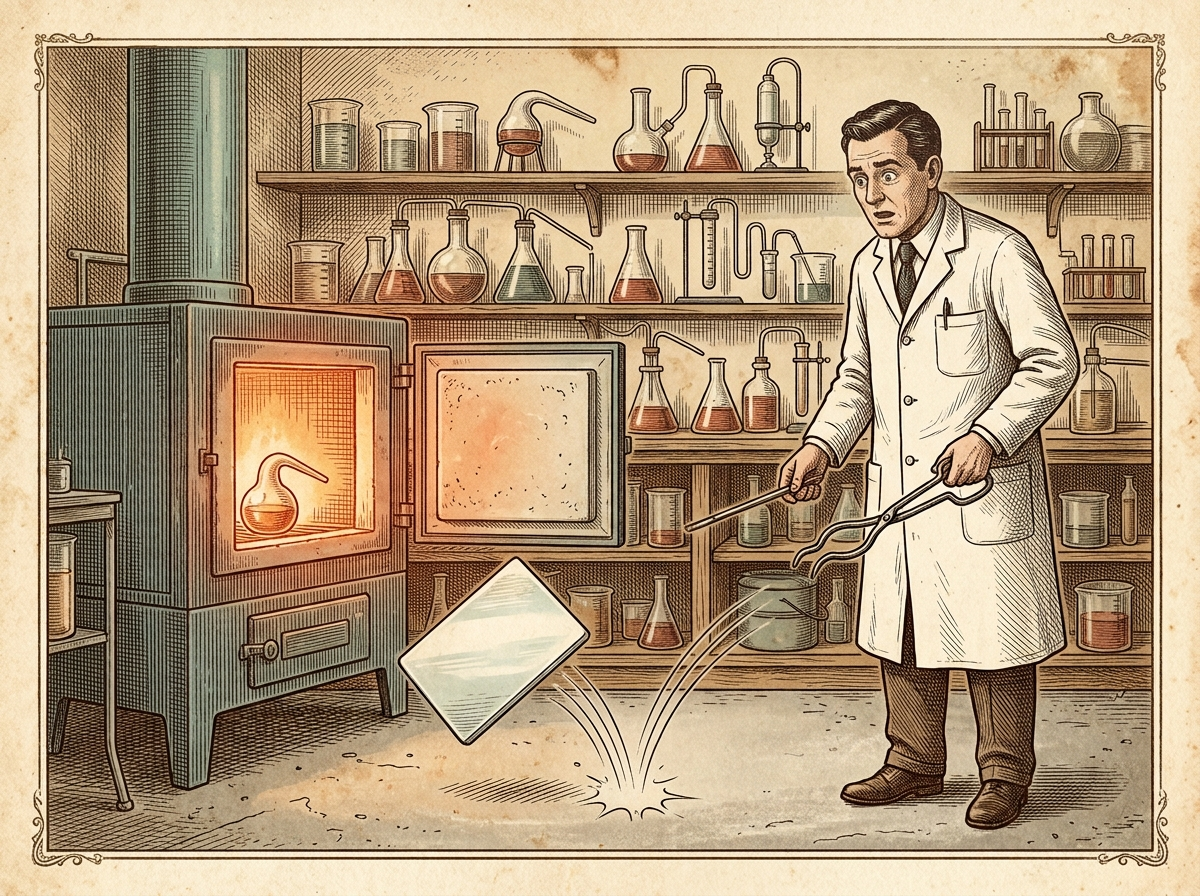
Sometime in the early 1950s, Corning chemist S. Donald Stookey opened a furnace expecting to find a puddle of ruined glass. The temperature controller had stuck, and the oven had climbed about 300 degrees Celsius past where he'd set it — hot enough, by every rule he knew, to melt his sample. Instead, a solid, milky-white plate sat on the shelf, still in its original shape. He reached in with tongs, the plate slipped, and it hit the concrete floor. It didn't shatter. As Corning tells the story, it bounced, "clanging like a piece of steel."
By the Curiosities Desk · · 5 min read · Filed under Engineering · Today’s round
What happened?
Stanley Donald Stookey was born in Hay Springs, Nebraska, in 1915. After earning a doctorate in chemistry at MIT in 1940, he joined Corning Glass Works in upstate New York, where he would spend the next 47 years.
His early specialty was photosensitive glass — glass that reacts to light a bit like photographic film. One of his inventions was called Fotoform, a lithium silicate glass. If you shined ultraviolet light through a stencil onto it and then heated it, tiny crystals formed only in the exposed areas. Those crystallized areas dissolved in hydrofluoric acid much faster than the surrounding glass, so you could etch extremely fine holes and patterns into a sheet. At the time, Stookey was exploring glasses for uses that included the young television-tube market.
Heat treatment was part of the routine. Stookey would put a plate of exposed Fotoform into a furnace set to about 600°C (around 1,100°F), let the crystals grow, and take it out.
One day, the furnace’s temperature controller got stuck in the “on” position. Instead of holding at 600°C, the furnace kept heating until it reached about 900°C (roughly 1,650°F). That was well above the temperature at which this glass should soften and slump.
Stookey’s colleague George Beall later wrote that Stookey expected “a molten pool of glass.” What he found was “an undeformed opaque and solid plate.” When he grabbed it with tongs, it slipped and fell onto the concrete floor — and survived, ringing like metal instead of breaking like glass.
The exact year is a little fuzzy. Corning’s own accounts place it in 1952, while the National Inventors Hall of Fame and several other histories give 1953. The bounce itself has become what Corning calls company “folklore,” and it comes to us through Corning’s retellings rather than a dated lab note. But the overheated plate and what it led to are well documented.
Why was it strange?
For centuries, glassmakers had treated crystals as the enemy. Glass is an amorphous solid — its atoms are jumbled, like a frozen liquid, rather than lined up in a neat repeating pattern. When crystals form in glass by accident (a defect called devitrification), they usually make it cloudy and weak, and the piece gets thrown out.
Stookey’s plate had done the opposite. It had crystallized almost completely, yet kept its exact shape and came out stronger than before. “It crystallized so completely that it could not flow,” he later wrote, “and was obviously much stronger than ordinary glass.”
He called it “a lucky accident.” The key was that the crystals hadn’t grown in a few random spots. Because of the earlier light exposure, they had started in countless places at once, evenly, all through the glass.
More mistakes that turned into useful things: The Mistakes That Became Things You Still Use.
What did scientists learn?
Stookey realized he had found a new way to make a ceramic: shape something as glass, which is easy to melt, pour, and press, and then use heat to turn it into a mostly crystalline solid. The overheated plate was mostly lithium disilicate crystals.
The trick is a step called nucleation — giving crystals lots of tiny starting points so they grow evenly through the whole piece instead of in a few large, weak clusters. In Fotoform, the light exposure created those starting points. But most glasses don’t respond to light that way, and metals like silver didn’t work as seeds in the tougher aluminosilicate glasses Corning wanted to use.
So Stookey went looking for other seeds. He found that titanium dioxide (titania), dissolved into the molten glass, worked remarkably well. Glass with titania could be formed into a shape, then heated in two stages — one to sprout crystal seeds, one to grow them — producing a fine-grained material that was hard, strong, and could handle sudden temperature changes.
He received the basic U.S. patent, No. 2,920,971, titled “Method of Making Ceramics and Product Thereof,” in 1960. Corning named the material family Pyroceram.
Another case of a ruined experiment worth a second look: The Cylinder That Weighed Too Much and Became Teflon.
How does it affect us today?
Pyroceram’s first big customers weren’t cooks. Its strength, heat resistance, and transparency to radar made it useful for missile nose cones — the radar housings at the tip of guided missiles.
Then came the kitchen. In 1958, Corning launched CorningWare, white cookware made from a glass-ceramic based on a crystal called beta-spodumene. Because it barely expands when heated, it could go from the freezer to the oven to the stovetop without cracking. Its blue cornflower pattern became a fixture of American kitchens for decades.
When Stookey received the National Medal of Technology in 1986, the citation credited his inventions with more than $500 million in annual sales and over 10,000 jobs. Glass-ceramics now show up in smooth-top stove surfaces, wood-stove windows, telescope mirrors, and dental crowns.
Another accident that changed everyday glass: The Unwashed Flask That Fell 11 Feet and Became Your Windshield.
Fun fact
The plate wasn’t the only thing Stookey survived. An avid fisherman, he was on a float plane that flipped over while landing on Great Bear Lake, above the Arctic Circle, in the 1950s, leaving everyone upside down in ice-cold water. A boat reached them in time, and he lived to 99.
Sources
- Beall, George H. “Dr. S. Donald (Don) Stookey (1915–2014): Pioneering Researcher and Adventurer”, Frontiers in Materials 3:37, 2016.
- Corning Incorporated. “S. Donald Stookey, 1915–2014”, Memorial Tributes: Volume 20, National Academy of Engineering, 2016.
- Stookey, S. Donald. “Method of Making Ceramics and Product Thereof”, U.S. Patent 2,920,971, issued January 12, 1960.
- National Inventors Hall of Fame. “S. Donald Stookey: Glass Ceramics”.
- National Science & Technology Medals Foundation. “Stanley D. Stookey”, 1986 National Medal of Technology.