Accidental Discoveries · Chemistry
The Unwashed Flask That Fell 11 Feet and Became Your Windshield
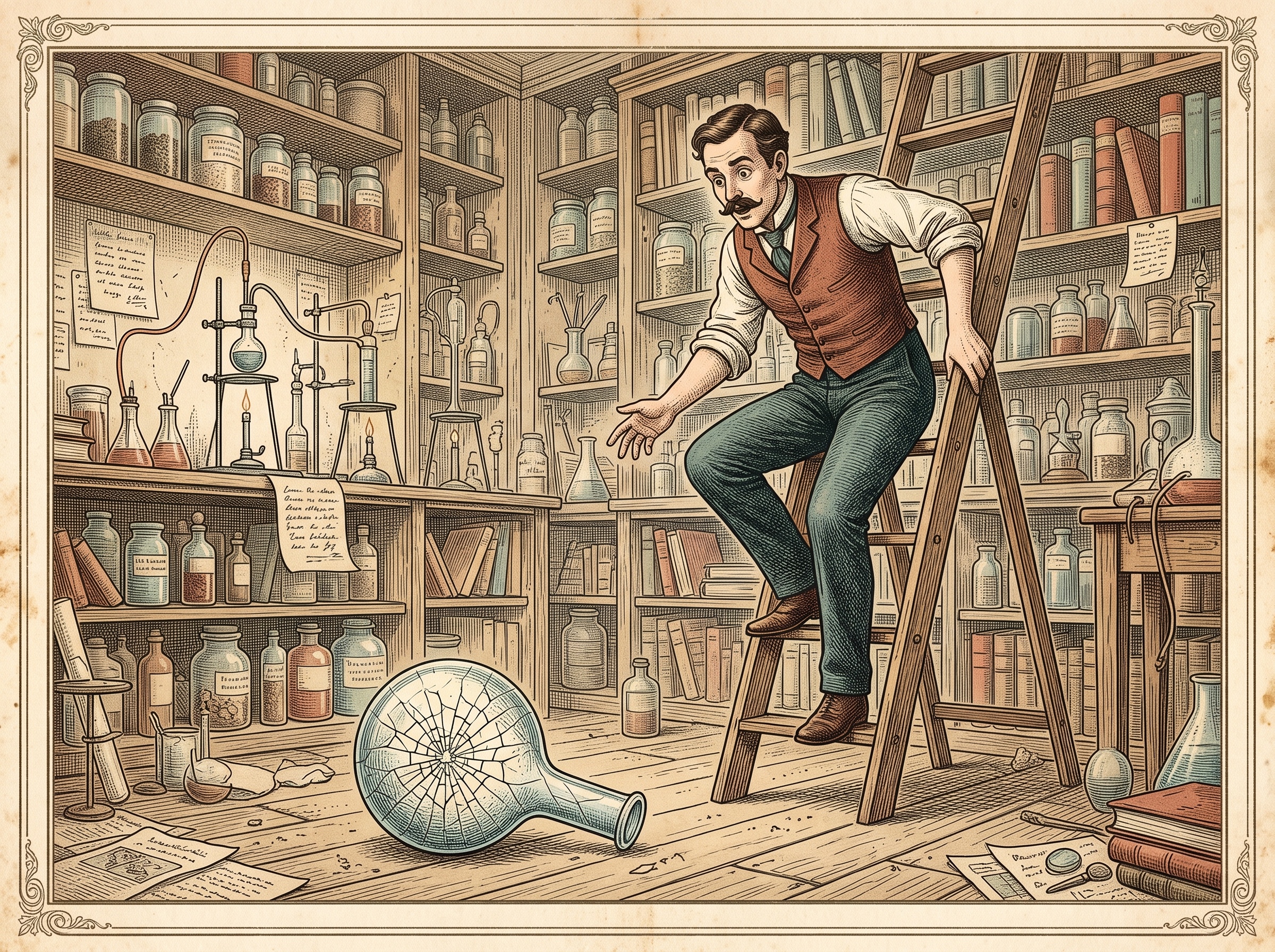
In November 1903, the French chemist Édouard Bénédictus was tidying his Paris laboratory when a one-liter glass flask slipped out of his hands and dropped about 3.5 meters (roughly 11 feet) to the floor. He bent down expecting a spray of shards. Instead he picked up a flask that was cracked all over, "starred" inside like Bohemian crystal, and yet still in one piece. Not a single splinter had come loose. So he did what any careful scientist would do: he wrote a label explaining exactly what had happened, stuck it on the broken flask, and put it back on the shelf.
By the Curiosities Desk · · 5 min read · Filed under Chemistry · Today’s round
What happened?
Bénédictus told the story himself in 1930, in the French trade journal Glaces et Verres, shortly before he died. He had been rearranging jars in his small physical chemistry lab, he wrote, when the flask escaped his grip and fell “from the full height of the room.”
The secret was what had once been inside it: a solution of alcohol and ether, a little acetone and amyl acetate, and a few grams of cellulose nitrate (also called nitrocellulose — cotton fibers treated with nitric and sulfuric acids, the same stuff used to make the early plastic celluloid). Nobody had washed the flask. Over time the solvents had evaporated, leaving a thin, tough plastic skin coating the inside of the glass. When the glass cracked, every fragment stayed glued to that skin.
Bénédictus said the solvents had been evaporating for fifteen years. That figure is hard to square with his age — he was only in his mid-twenties in 1903 — so the flask may have come with the lab, or the number may have grown in the retelling. Either way, the flask had clearly sat unwashed for a long time.
His label read, in translation: “November 1903; this flask fell from 3.5 meters high and was picked up by me in the state it is in now.” Then, by his own account, he “thought no more about it.”
Years later, two newspaper stories changed that. A few weeks apart, two young women were badly cut on the throat by shattered window glass in vehicle accidents — one in a taxi. Early cars used ordinary window glass, which breaks into long, knife-like pieces.
One evening after dinner, Bénédictus was turning those accidents over in his mind when, as he described it, the image of his old flask suddenly appeared, superimposed on his thoughts. He went to the lab, took the flask down, and sat with it. When dawn came, he said, he was still holding it — he had barely moved for nine hours, but he had worked out a plan. By the next evening he had made the first sheet of what he called Triplex glass, squeezed together in a letter-copying press, a common office machine of the day.
He filed French patent 405,881 on November 25, 1909, and on July 7, 1911, the Société du Verre Triplex was founded to develop and license his invention. A British licensee, Reginald Delpech, launched the English Triplex Safety Glass Company in 1912.
Why was it strange?
Glass had been around for thousands of years, and everyone “knew” what broken glass did: it flew apart. The breakthrough came not from a planned experiment but from a messy one — a flask that someone forgot to clean, dropped by accident, and then saved on a shelf for years.
It also wasn’t completely out of nowhere, and that’s worth saying. In 1902 a French company, Le Carbone, had patented coating glass objects with celluloid to make them less likely to crack, and in 1905–1906 an English solicitor named John Crewe Wood patented windscreen glass layered with Canada balsam, a natural tree resin. Bénédictus’s contribution was the version that worked well and caught on: two sheets of glass with a plastic film bonded in between. That’s why it was called Triplex — three layers.
Another time the mistake was the invention: The Ulcer Experiment That Splashed Out of Its Flask and Became Diet Soda.
What did scientists learn?
Glass is strong when you squeeze it but weak when you pull on it, and it has no way to stop a crack once one starts. That’s why ordinary panes fail all at once and fling out sharp pieces.
Laminated glass doesn’t stop the glass from cracking. What it changes is what happens next. The plastic interlayer is tough and stretchy, and it is bonded firmly to both glass sheets. When the glass breaks, the shards stay stuck to the film, producing the familiar spider-web pattern instead of flying debris.
The first interlayer, cellulose nitrate, had real problems. It yellowed in sunlight within months, so early windshields slowly turned amber, and it was flammable. In the late 1920s and early 1930s, manufacturers switched to cellulose acetate, which yellowed less. The lasting fix was polyvinyl butyral, or PVB — a clear, rubbery plastic invented by the Canadian chemists Howard Matheson and Frederick Skirrow in 1927. By the late 1930s it had largely replaced the older films in American safety glass.
Another accident worth keeping: The Glue Rejected for Being Too Sticky — That Later Hoisted a TV Host Into the Air.
How does it affect us today?
Triplex was expensive at first, and car makers were slow to adopt it. Its first big job was military: during World War I, laminated glass was widely used in the eyepieces of gas masks. Laws pushed it into cars afterward. Britain’s Road Traffic Act 1930 required safety glass in new cars’ windscreens, and in the US, Ford adopted safety glass across its cars.
Today, nearly every car windshield is laminated glass — typically two sheets of glass around a PVB layer. Side windows are often tempered glass instead, a different type of safety glass that is heat-treated so it crumbles into small, blunt cubes. Laminated glass also turns up in skylights, storefronts, hurricane-resistant windows, aircraft cockpits, and, in thicker stacks, bullet-resistant glass.
A close cousin: The Hot Stove Accident That Invented Modern Rubber.
Fun fact
Bénédictus was also an artist, writer, and composer. Today, many people know his name less for windshields than for Variations, a 1920s portfolio of bold Art Deco pattern designs that print collectors still prize.
Sources
- Michel, Jean-Marie. “Le verre renforcé Triplex (verre feuilleté de sécurité)”, Contribution à l’histoire industrielle des polymères en France. Société Chimique de France, 2012 (reprints Bénédictus’s own 1930 account from Glaces et Verres, no. 18, p. 9; in French).
- Bénédictus, Édouard. French patent FR 405,881, registered November 25, 1909 (cited in Michel, above).
- Schwarcz, Joe. “What Is Safety Glass?” McGill University Office for Science and Society, July 2, 2021.
- Matheson, Howard W., and Skirrow, Frederick W. “Vinyl ester resins and process of making same”, U.S. Patent 1,725,362 (filed 1927; issued 1929).
- “Laminated glass”, Wikipedia (overview and citations to the Le Carbone and John Crewe Wood patents).