Accidental Discoveries · Chemistry
The Glue Rejected for Being Too Sticky — That Later Hoisted a TV Host Into the Air
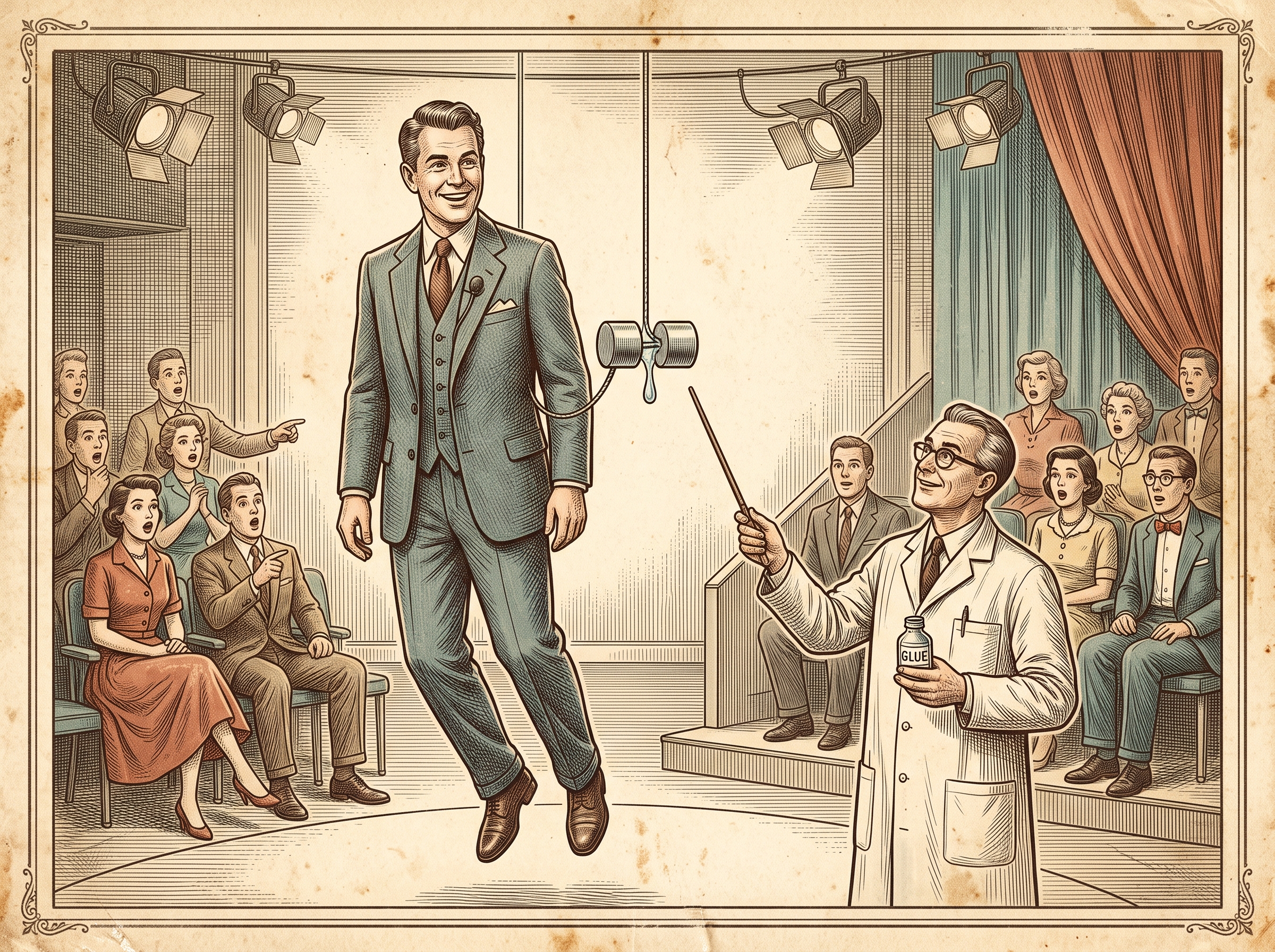
A game-show host rises off the stage on national television, dangling from a wire in front of the studio audience. Between his 150 pounds and that wire sits a joint between two pieces of metal — held together by a drop of clear liquid that a chemist had once given up on for being far too sticky to be useful.
By the Curiosities Desk · · 5 read · Filed under Chemistry · Today’s round
What happened?
In 1942, Harry Coover, a young chemist at Eastman Kodak in Rochester, New York, was working on a wartime problem. The U.S. military needed gunsights — the aiming lenses on rifles and other weapons — and Kodak’s team hoped to make them out of a clear, lightweight plastic instead of glass. Coover tested a family of chemicals called cyanoacrylates (pronounced sigh-an-oh-ACK-ruh-lates), a type of acrylic building block that can link up into long plastic chains.
They were a disaster. “Everything was sticking to everything,” Coover recalled decades later. The liquid glued itself to glassware, tools and fingers. As he remembered it, the government eventually cancelled the contract, and the cyanoacrylates were shelved as a nuisance. Kodak went on to make its wartime gunsights out of glass.
Nine years later, in 1951, Coover had moved to Tennessee Eastman, Kodak’s chemical plant in Kingsport, Tennessee, where he was overseeing a group of chemists. This time the goal was a tough, heat-resistant plastic for the canopies of jet aircraft. One of his researchers, Fred Joyner, was testing compounds on a refractometer — a lab instrument that measures how a liquid bends light by sandwiching a thin film of it between two precision glass prisms.
Joyner spread a cyanoacrylate between the prisms, took his reading, and then found he couldn’t pull them apart. The expensive prisms were bonded for good. According to Coover’s grandson, Joyner was distressed that the new equipment was ruined.
Coover, though, had now met this same stubborn chemical twice. Instead of seeing a spoiled instrument, he saw something no one had quite had before: a glue that set in seconds, at room temperature, without heat or clamping pressure. He and his team started sticking things together around the lab, and everything stayed stuck.
Kodak patented the discovery (U.S. Patent 2,768,109, for “alcohol-catalyzed” cyanoacrylate adhesives) and in 1958 began selling it under the unglamorous industrial name “Eastman 910.” A popular story holds that “910” came from its place on a list of compounds being tested; that’s widely repeated but hard to pin down, so treat it as company lore.
Then came the showmanship. Coover appeared on the CBS panel show I’ve Got a Secret, where contestants tried to guess a guest’s hidden fact. His secret was his glue. Host Garry Moore explained to the audience that the only thing between his 150 pounds and the wire lifting him would be one drop of glue — and then he was hoisted off the stage, dangling from metal bonded by Coover’s adhesive. The joint held.
Why was it strange?
Most inventions start with a goal and end with a product that meets it. Super Glue did the opposite: it failed its first job so badly that it was abandoned, and the failure was the whole point.
The very property that made cyanoacrylates useless for gunsights — they grabbed onto everything they touched — was exactly what made them priceless as an adhesive. It took a second accident, and a second pair of ruined lab objects, for anyone to flip the question from “How do we stop this sticking?” to “What else could this stick?”
There’s also a nice irony in the timeline. A chemical first studied to help soldiers aim would, two decades later, be carried onto battlefields for a very different reason.
Another accident worth keeping: The Oil-Well Gunk Drillers Hated That Became Vaseline.
What did scientists learn?
Ordinary glues mostly work by drying: a solvent such as water evaporates and leaves solid material behind. Cyanoacrylate works differently. It arrives as monomers — single, unlinked molecules — and turns solid through polymerization, the process of those small molecules snapping together into long chains.
The trigger is surprisingly humble: water. As Coover explained to Popular Science in 1989, essentially every surface carries at least a one-molecule-thin film of moisture, and that water (or any weak base) is the catalyst that sets the reaction off. Squeeze a thin layer of glue between two surfaces and the chains grow almost instantly, filling tiny pores and cracks and locking the pieces together.
That also explains the fingers. Skin is damp, so it’s one of the best surfaces the glue could possibly find. The same chemistry that bonded Joyner’s prisms is what glues your thumb to your index finger.
It also explains a limit: Super Glue sets best in thin films. A thick blob cures slowly from the outside in, which is why a single drop is usually better than a big squeeze.
Another time the mistake was the invention: The Seaweed Ash That Ate Its Own Vats — and Gave Up a New Element.
How does it affect us today?
The most surprising afterlife of Coover’s glue is in medicine. According to Coover, during the Vietnam War a general asked for the adhesive so medics could spray it onto serious wounds to stop the bleeding until soldiers reached a hospital. The Lemelson-MIT Program and the National Inventors Hall of Fame both credit this battlefield use with saving lives, though records of exactly how widely it was used are thin.
Household Super Glue isn’t the same as medical glue. Early versions could irritate tissue, so chemists tweaked the molecule. In August 1998, the FDA approved Dermabond, made from 2-octyl cyanoacrylate, to close certain cuts and surgical incisions in place of stitches. Doctors now use related adhesives in emergency rooms and operating rooms. (Mayo Clinic doesn’t recommend reaching for the hardware-store tube for your own cuts, so leave that to the medical versions.)
Coover went on to earn hundreds of patents, was inducted into the National Inventors Hall of Fame in 2004, and received the National Medal of Technology and Innovation from President Obama. He died in Kingsport in March 2011, at 94.
A close cousin: The Sweetener Discovered Because a Student Heard ‘Test’ as ‘Taste’.
Fun fact
The glue that was “too sticky” for the military was commercially launched as a serious industrial product, and it only got its famous consumer nickname, Super Glue, later on. Its first big public audience wasn’t a lab or a factory; it was a game-show crowd watching a man in a suit dangle from a single drop.
Sources
- Harry W. Coover — National Inventors Hall of Fame
- Harry Coover — Lemelson-MIT Program
- U.S. Patent 2,768,109: Alcohol-catalyzed α-cyanoacrylate adhesive compositions (Google Patents)
- Almanac: Super glue — CBS News Sunday Morning
- How a shot at making better gunsights became Super Glue instead — Popular Science