Accidental Discoveries · Chemistry
The Oil-Well Gunk Drillers Hated That Became Vaseline
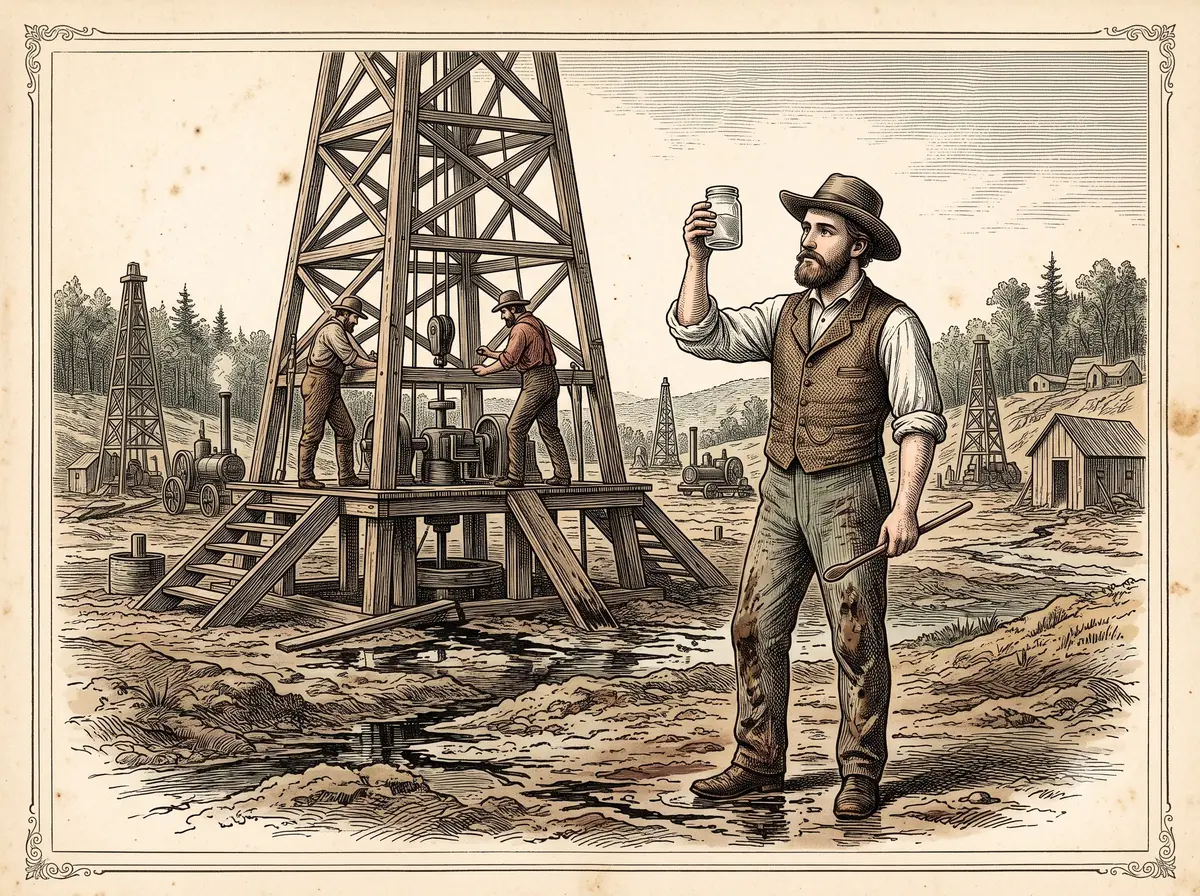
In the muddy oil fields of Titusville, Pennsylvania, drillers kept stopping work to scrape a waxy black gunk off their pump rods. It jammed the machinery, it stuck to everything, and everyone hated it — except the workers who had quietly discovered that if you smeared the stuff on a cut or a burn, it seemed to help. Watching all this was a 22-year-old chemist whose old job had just been destroyed by the very oil wells in front of him. He looked at the gunk everyone else was throwing away and decided to take some home.
By the Curiosities Desk · · 5 min read · Filed under Chemistry · Today’s round
What happened: Vaseline
Robert Augustus Chesebrough was born in London in 1837 to American parents and raised in New York City. As a young chemist, he made his living clarifying kerosene distilled from sperm whale oil — a perfectly respectable career, right up until 1859, when Edwin Drake struck petroleum in Titusville, Pennsylvania. Cheap rock oil made whale-oil kerosene obsolete almost overnight, and Chesebrough’s profession went with it. So he did the sensible thing: he traveled to Titusville to see what the new fuel could do for him.
What caught his attention wasn’t the oil. It was the nuisance. As the pumps worked, a pasty residue called “rod wax” built up on the pump rods and had to be cleaned off regularly. To the drillers it was a headache — with one exception. When a worker got cut or burned, the story went, rubbing rod wax on the injury eased the pain and the wound seemed to mend faster.
Chesebrough took samples back to his Brooklyn laboratory and spent years working out how to turn oil-well sludge into something pure enough to put on human skin. The key was filtration: he distilled petroleum down to its residuum — the thick leftover material at the bottom of the still — and filtered it through bone char until it came out as a smooth, translucent, odorless jelly. He patented his filtration process and a steam filter in 1865, opened his first factory in 1870, and on June 4, 1872, received U.S. Patent 127,568 for the product itself. The patent’s opening line is quietly historic: “I… have invented a new and useful Product from Petroleum, which I have named Vaseline.”
Then came the hard part: nobody wanted it. Druggists saw no reason to stock a jar of purified oil sludge. So, as the story is told in accounts of his life, Chesebrough became his own test subject and traveling roadshow — touring New York, burning or scarring his own skin with flame and acid in front of audiences, then coating the injuries with Vaseline and displaying his older, healed wounds as proof. Whatever one thinks of the method, it worked. By 1874, stores were reportedly selling more than 1,400 jars of Vaseline a day, and in 1875 he founded the Chesebrough Manufacturing Company to keep up.
Why it was strange: Vaseline
Almost everything about the origin is backwards. The most famous skin-care product in the world began as industrial waste — the stuff workers cursed and scraped into the mud. The chemist who refined it wasn’t looking for a medical product at all; he was an unemployed kerosene man salvaging a career. And his own patent barely mentions skin: it recommends Vaseline chiefly for oiling leather, lubricating machinery, and use as a hair pomade, with chapped hands almost an afterthought.
Strangest of all is what Vaseline doesn’t do. The drillers — and Chesebrough — believed the jelly healed wounds. It doesn’t, not directly. Petroleum jelly contains no medicine whatsoever. What it actually does is form a seal over the skin that locks moisture in and keeps dirt and air out, and it happens that a moist, protected wound is exactly what the human body needs to repair itself efficiently. The drillers had stumbled onto a real effect with an imaginary mechanism: the gunk wasn’t healing them, it was finally letting their skin heal itself.
Another accident worth keeping: The Unwashed Flask That Fell 11 Feet and Became Your Windshield.
What scientists learned: Vaseline
Chemically, Chesebrough’s insight was that the residuum left after distilling petroleum — the fraction everyone else discarded — was its own useful material, not just a worse version of the fractions above it. His bone-char filtration produced petrolatum: a semi-solid tangle of long hydrocarbon chains that melts near body temperature, doesn’t turn rancid, doesn’t react with much of anything, and rarely triggers allergic reactions. That inertness, the very blandness of the stuff, turned out to be its superpower.
Medicine took a century to catch up with the mechanism. Research on wound healing — most famously George Winter’s 1962 experiments showing wounds heal faster when kept moist — confirmed what the occlusive jelly had been quietly exploiting all along: a covered, hydrated wound re-grows skin cells faster than one left to dry out and scab. Petroleum jelly earned its place not as a drug, but as one of the best barriers ever made.
Another time the mistake was the invention: The Glue Rejected for Being Too Sticky — That Later Hoisted a TV Host Into the Air.
How it reaches us today: Vaseline
Dermatologists still recommend plain petroleum jelly constantly — for sealing minor wounds after procedures, softening cracked heels, taming chapped lips, and protecting skin in dry winters — precisely because it does so little: no fragrance, no active ingredients, almost no allergy risk. Petrolatum remains a base ingredient across ointments and cosmetics, and the “slugging” skincare trend that periodically sweeps social media is just Chesebrough’s oil-field gunk, rebranded for the smartphone era. Unilever, which now owns the brand, still sells Vaseline in more than 70 countries — roughly 150 years after drillers were flinging the raw material into the Pennsylvania mud.
A close cousin: The Seaweed Ash That Ate Its Own Vats — and Gave Up a New Element.
Fun fact: Vaseline
Chesebrough believed in his product to the very end — and we mean that literally. Shortly before his death in 1933 at age 96, he wrote: “I take more than a teaspoon daily and I believe I owe to it my approaching 97 years of age.” The eating-a-spoonful-a-day claim is confirmed by his own words, though the related legend that he once cured his pleurisy by having a nurse coat him in Vaseline head to toe has never been substantiated. (For the record: modern doctors would like you to admire his enthusiasm and absolutely not copy it — petroleum jelly is for the outside of you.)
Sources: Vaseline
- U.S. Patent 127,568, “Improvement in Products from Petroleum,” Robert A. Chesebrough, June 4, 1872 — the primary source, in which the name “Vaseline” first appears.
- Snopes fact-check: “Vaseline Inventor Ate Spoonful of Petroleum Jelly Every Day?”
- Vaseline (Unilever) — official brand history
- American Academy of Dermatology — “5 ways to use petroleum jelly for skin care”
- Wikipedia: Robert Chesebrough (with citations to Hall’s America’s Successful Men of Affairs, 1895, and Lindsay’s House of Invention, 2000)
Related stories: Vaseline
- The Chemist Who Forgot to Wash His Hands and Discovered Saccharin — A chemist skipped washing his hands and tasted sweetness
- The Hot Stove Accident That Invented Modern Rubber — A hot stove accident made rubber usable
- The Wallpaper Cleaner Nobody Needed Anymore That Became Play-Doh — A wallpaper cleaner nobody needed anymore became Play-Doh