The Wallpaper Cleaner Nobody Needed Anymore That Became Play-Doh
In a Cincinnati factory in the mid-1950s, industrial mixers were still churning out a soft, off-white putty designed to be rubbed across dirty wallpaper — a product that almost nobody wanted to buy anymore, because Americans had stopped heating their homes with coal. The company was months from the end. Then a nursery school teacher in New Jersey suggested that instead of cleaning walls with the stuff, they should let children squish it.
By the Curiosities Desk · · 5 min read · Filed under Chemistry · Today’s round
What happened: Play-Doh Originally Used For
Kutol Products was founded in Cincinnati in 1912 and, in the early twentieth century, became the largest wallpaper cleaner manufacturer in the world. That sounds like a strange thing to be the biggest in — until you remember what heating a house used to mean. Coal furnaces coated everything in a fine, greasy soot, and the wallpaper of the era was often too delicate to scrub with water. So people bought cans of soft dough and rolled it across their walls like a lint brush.
The formula that carried the company came out of a moment of nerve. According to the account in Tim Walsh’s Timeless Toys — the version the Strong National Museum of Play repeats — Kutol was near collapse in 1933 when salesman Cleo McVicker landed a contract with Kroger to supply ready-made wallpaper cleaner. Kutol had never made wallpaper cleaner. Cleo went back to the plant, and his brother Noah, a product developer, worked out a formula: a pliable, non-toxic, clay-like compound built mostly from flour, water, and salt. It kept the company alive for two more decades.
Then the fuel changed. After the Second World War, American households converted furnaces from coal to oil, gas, and electricity. Cleaner heat meant cleaner walls, and cleaner walls meant no reason to buy wallpaper cleaner. Sales collapsed. Cleo McVicker had died in a plane crash in 1949, and his son Joseph was left trying to keep a company alive around a product history had made pointless.
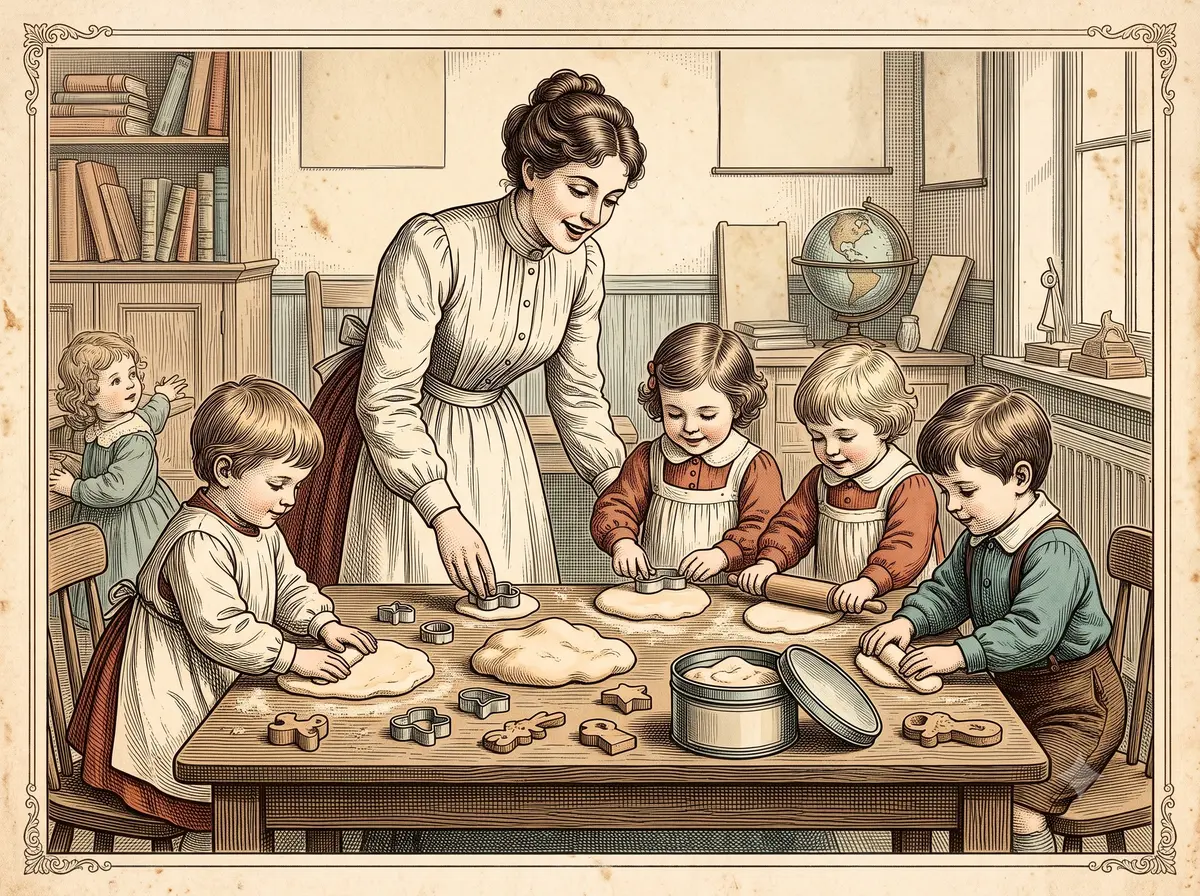
The rescue came from outside the business. Joseph’s sister-in-law, Kay Zufall, ran a nursery school in New Jersey. She had read that wallpaper cleaner could be used to make holiday decorations, and she was already hunting for something gentler than modeling clay, which was stiff and unfriendly for small hands. She had trouble even finding a can of Kutol’s cleaner, because production was winding down. When she got some, her students rolled it, cut it with cookie cutters, and built things all afternoon.
Zufall told her brother-in-law what she had seen. (Accounts differ slightly on the sequence: the Strong’s telling has McVicker traveling to the school to look at the children’s work himself.) The point is that no new invention was required. The same mixers, the same building, the same basic dough — tweaked, colored, and put in a different can. Zufall and her husband Robert also supplied the name. McVicker and his uncle Noah had been leaning toward “Rainbow Modeling Compound.”
In 1956, McVicker set up Rainbow Crafts as a Kutol subsidiary and began selling Play-Doh to Cincinnati-area schools. Washington’s Woodward & Lothrop department store was the first retailer to stock it; Macy’s and Marshall Field’s followed. The advertising budget was thin, so McVicker went to children’s television instead, and by 1958 the dough was appearing on Captain Kangaroo, Ding Dong School, and Romper Room. Bob Keeshan — the Captain himself — talked it up on air in exchange for a share of sales, an arrangement the Strong’s Christopher Bensch says ran for years without a contract. By 1964, Rainbow Crafts was shipping more than a million cans a year. General Mills bought the company in 1965, the same year the U.S. Patent Office finally granted patent 3,167,440 to Noah and Joseph McVicker for a “plastic modeling composition of a soft, pliable working consistency.”
Why it was strange: Play-Doh Originally Used For
Most invention stories run forward: someone wants a new thing and builds it. This one runs sideways. Nothing about the material changed in any fundamental way. What changed was the question being asked of it. For twenty years the dough’s virtues — soft, cohesive, non-toxic, doesn’t crumble, doesn’t stain, holds a shape — were engineering specs for cleaning soot off delicate paper. Read the same list with a four-year-old in mind and they describe an ideal toy. The product was sitting in the warehouse the whole time, filed under the wrong heading.
It shares a shelf with The Weak Glue That Took Six Years to Find a Job — and Became the Post-it Note, in The Mistakes That Became Things You Still Use.
What scientists learned: Play-Doh Originally Used For
The chemistry is humble and clever. Play-Doh’s non-toxic mixture is built from flour, water, salt, borax, and mineral oil. The wheat flour supplies starch and gluten, which form a soft network that deforms under pressure and stays deformed — plastic, in the engineering sense, meaning it holds a new shape instead of springing back. Salt and borax act as preservatives, and salt also helps hold onto water so the dough stays workable rather than hardening in an hour. Mineral oil keeps it from sticking to hands and walls.
That last property is the whole trick of the original job. Wallpaper cleaner works by being tackier than the wall but more cohesive than it is sticky: press it on and soot particles transfer onto the dough, then lift away with it, rather than smearing across the paper the way a damp cloth would. It is a dry, mechanical kind of cleaning, no solvent involved. The patent’s own emphasis is the same set of traits, restated for a new market: clean, non-sticky, non-staining, and slow-drying so it stays moldable for a long time. The recipe was later adjusted — at one point the salt was reduced so cans wouldn’t dry out so fast — but the mixture has largely stayed put.
Also in The Mistakes That Became Things You Still Use: The Chemist Who Forgot to Wash His Hands and Discovered Saccharin.
How it reaches us today: Play-Doh Originally Used For
More than three billion cans have been sold since 1956, and Play-Doh entered the National Toy Hall of Fame in 1998. Its longer legacy is arguably in classrooms: the material became a standard tool for early-childhood fine-motor and sensory work precisely because Zufall’s original test was pedagogical, not commercial. And the business lesson keeps getting retold, because it is genuinely useful — when your market evaporates, the answer may not be a new product but a new customer for the one you already make.
Another from The Mistakes That Became Things You Still Use: The Burrs Stuck to a Dog That Became Velcro.
Fun fact: Play-Doh Originally Used For
Play-Doh’s smell is legally protected. In 2018, Hasbro won a U.S. trademark registration on the scent itself, described in the filing as “a sweet, slightly musky, vanilla-like fragrance, with slight overtones of cherry, and the natural smell of a salted, wheat-based dough.” Scent trademarks are rare — proving a smell identifies your brand and nothing else is a high bar.
Sources: Play-Doh Originally Used For
- Patent US 3,167,440 — “Plastic modeling composition of a soft, pliable working consistency,” N. W. McVicker and J. S. McVicker, granted January 26, 1965 (primary source)
- The Strong National Museum of Play — “The History of Play-Doh: Good, Clean Fun!”
- Smithsonian Magazine — “The Accidental Invention of Play-Doh”
- National Toy Hall of Fame — Play-Doh (inducted 1998)
- The Washington Post — “Remember how Play-Doh smells? U.S. trademark officials get it.”
Related stories: Play-Doh Originally Used For
- Part of The Mistakes That Became Things You Still Use
- The Secret Rubber Substitute That Became Silly Putty — A failed rubber substitute that became a toy in an egg
- The Oil-Well Gunk Drillers Hated That Became Vaseline — Oil-well gunk that drillers hated became Vaseline
- The Billiard Ball Prize That Invented Plastic — A prize for a billiard ball substitute launched the plastic age