Everyday Objects · Engineering
The Burrs Stuck to a Dog That Became Velcro
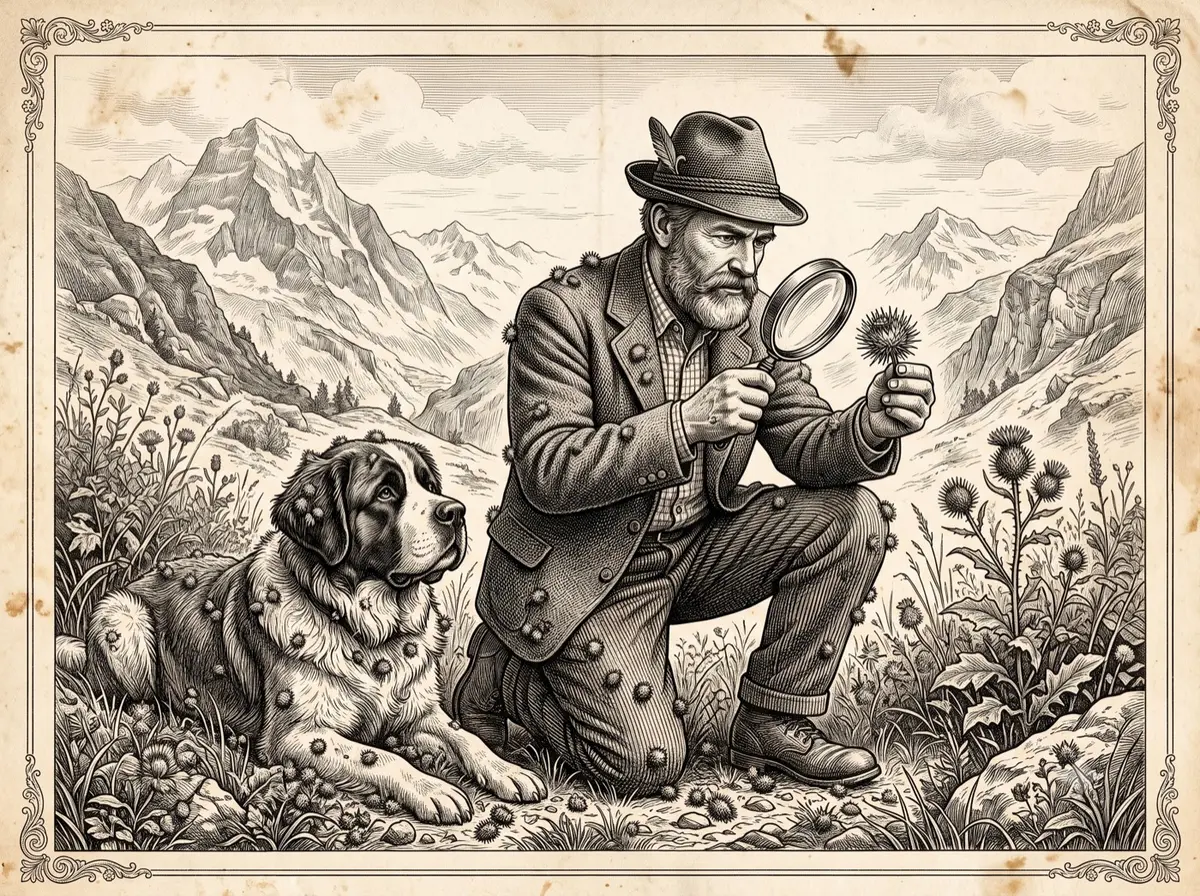
A man comes home from a walk in the mountains and finds his trousers and his dog covered in those maddening little burrs that cling to everything. Most people pick them off and curse. This man pulls one off, carries it to his microscope, and looks closely — and there, on a seed pod, he sees the design for a fastener that will one day hold together spacesuits, blood-pressure cuffs, children's shoes, and the inside of half the gadgets you own.
By the Curiosities Desk · · 5 min read · Filed under Engineering · Today’s round
What happened: The Burrs Stuck to a Dog That Became Velcro
The man was George de Mestral, a Swiss electrical engineer with a lifelong habit of tinkering. He had filed his first patent — for a toy airplane — as a boy of twelve. By the 1940s he was an adult inventor in Switzerland with an eye for everyday annoyances.
According to the story he told for the rest of his life, the idea arrived on a hunting trip in the Alps around 1941. Walking through the brush with his dog, de Mestral kept getting covered in burdock burrs, the seed pods of the burdock plant that grab onto fur and fabric and refuse to let go. Instead of simply pulling them off and moving on, he grew curious about why they stuck so stubbornly. He took one home and put it under a microscope.
What he saw was elegant and simple: the burr was covered in hundreds of tiny hooks, each ending in a little curved barb. Anything with a loop — a strand of wool, a curl of dog hair, the weave of his trousers — got snagged by those hooks. Pull the burr away and the hooks would catch again somewhere else. The plant had evolved a reusable, two-part grip: hooks on one side, loops on the other.
De Mestral became convinced he could copy it. He imagined two strips of fabric, one covered in stiff little hooks and the other in soft loops, that would lock together when pressed and peel apart when you wanted. Saying it was easy. Building it took the better part of a decade. Textile experts told him it couldn’t be done; weaving thousands of uniform, durable hooks by machine was a manufacturing nightmare. Working with a weaver in Lyon, France, de Mestral eventually found that nylon — a then-new synthetic — was the key. When nylon thread was woven into loops and heated under infrared light, it hardened into tough, springy hooks that held their shape. To make the hooks identical, he hit on the trick of weaving the loops and then trimming them with a blade so each one became a perfect little hook.
He named the result Velcro, stitching together two French words: velours (velvet) and crochet (hook). De Mestral patented his hook-and-loop fastener, securing a Swiss patent in the mid-1950s and a U.S. patent in 1955, and set up a company to manufacture it. The world, at first, shrugged.
Why it was strange: The Burrs Stuck to a Dog That Became Velcro
The strangeness of Velcro isn’t a freak accident or an explosion — it’s that the entire invention was plagiarized from a weed. De Mestral didn’t invent the hook-and-loop principle. A plant did, over millions of years of evolution, as a way to hitch its seeds onto passing animals and spread them far from the parent. De Mestral’s genius was simply that he looked at something everyone else found irritating and asked the right question. Where you and I see a nuisance to flick off a sweater, he saw a finished engineering blueprint.
That makes Velcro one of the founding stories of a whole field: biomimicry, the practice of solving human design problems by copying solutions that nature already worked out. The same impulse later gave us swimsuits modeled on sharkskin, building ventilation modeled on termite mounds, and adhesives modeled on gecko feet. Velcro got there first, decades before the word “biomimicry” existed.
There’s a second strangeness: how close the idea came to dying of indifference. Early Velcro looked cheap and unglamorous — limp strips of fuzzy fabric that the fashion world wanted nothing to do with. It took years, and an unlikely champion, before the world understood what it was holding.
It shares a shelf with The Wallpaper Cleaner Nobody Needed Anymore That Became Play-Doh, in The Mistakes That Became Things You Still Use.
What scientists learned: The Burrs Stuck to a Dog That Became Velcro
The deeper lesson is about how a good fastener actually works. Velcro succeeds because it distributes force cleverly. When you press the two strips together, thousands of hooks each grab a loop. Pull the strips straight apart by peeling from one edge and you only fight a few hooks at a time, so it opens easily with that satisfying riiip. But pull on the joint flat, in shear — trying to slide the strips past each other — and all those hooks resist at once, which is why a Velcro bond can hold a surprising amount of weight. Strong in one direction, weak in another, by design.
Engineers also learned a manufacturing lesson that outlived the original product. The hard part was never the concept; it was making thousands of microscopic features uniform, cheap, and durable at scale. Solving that — woven nylon loops, sliced into hooks — is the kind of unglamorous process problem that separates a clever idea from a product that actually ships.
Also in The Mistakes That Became Things You Still Use: The Chemist Who Forgot to Wash His Hands and Discovered Saccharin.
How it reaches us today: The Burrs Stuck to a Dog That Became Velcro
Velcro is now so ordinary it’s nearly invisible, which is the surest sign of a successful invention. It shows up on sneakers, jackets, backpacks, blood-pressure cuffs, surgical gowns, cable ties, car upholstery, and the orthopedic braces that hold injured joints. NASA helped popularize it: hook-and-loop fasteners were genuinely useful in spaceflight for keeping tools, food pouches, and equipment from drifting away in zero gravity. This led to a persistent myth that NASA invented Velcro. It didn’t — a Swiss engineer and a burdock plant did — but the space program’s visible use of it in the Apollo era helped turn a struggling product into a household name.
Because the word “Velcro” is a trademark owned by the company de Mestral founded, the generic product is properly called a hook-and-loop fastener — a distinction the brand still gently (and sometimes comically) reminds people about.
Another from The Mistakes That Became Things You Still Use: The Weak Glue That Took Six Years to Find a Job — and Became the Post-it Note.
Fun fact: The Burrs Stuck to a Dog That Became Velcro
George de Mestral reportedly came up with the name Velcro by simply gluing together velours and crochet — velvet and hook — which means the brand that built an empire on sticking things together was, fittingly, born from sticking two words together.
Sources: The Burrs Stuck to a Dog That Became Velcro
- Smithsonian Magazine, “How a Swiss Invention Hooked the World” — https://www.smithsonianmag.com/innovation/how-a-swiss-invention-hooked-the-world-49199355/
- Velcro Companies, “Our History” — https://www.velcro.com/about-us/history/
- U.S. Patent 2,717,437, George de Mestral, “Velvet Type Fabric and Method of Producing Same” (granted 1955) — https://patents.google.com/patent/US2717437A/en
- Encyclopaedia Britannica, “Velcro” — https://www.britannica.com/technology/Velcro
- AskNature (Biomimicry Institute), “Hooks Attach Securely: Common Burdock” — https://asknature.org/strategy/hooks-attach-securely/
Related stories: The Burrs Stuck to a Dog That Became Velcro
- Part of The Mistakes That Became Things You Still Use
- The Kingfisher That Redesigned the Bullet Train — A kingfisher’s beak fixed the bullet train’s sonic boom
- The Beetle That Explodes Inside a Predator’s Stomach — and Walks Away — A beetle that fires boiling chemicals out of its abdomen
- The Weak Glue That Took Six Years to Find a Job — and Became the Post-it Note — A glue that would not stick properly took six years to find a job