Strange Animals Scientists Studied · Engineering
The Kingfisher That Redesigned the Bullet Train
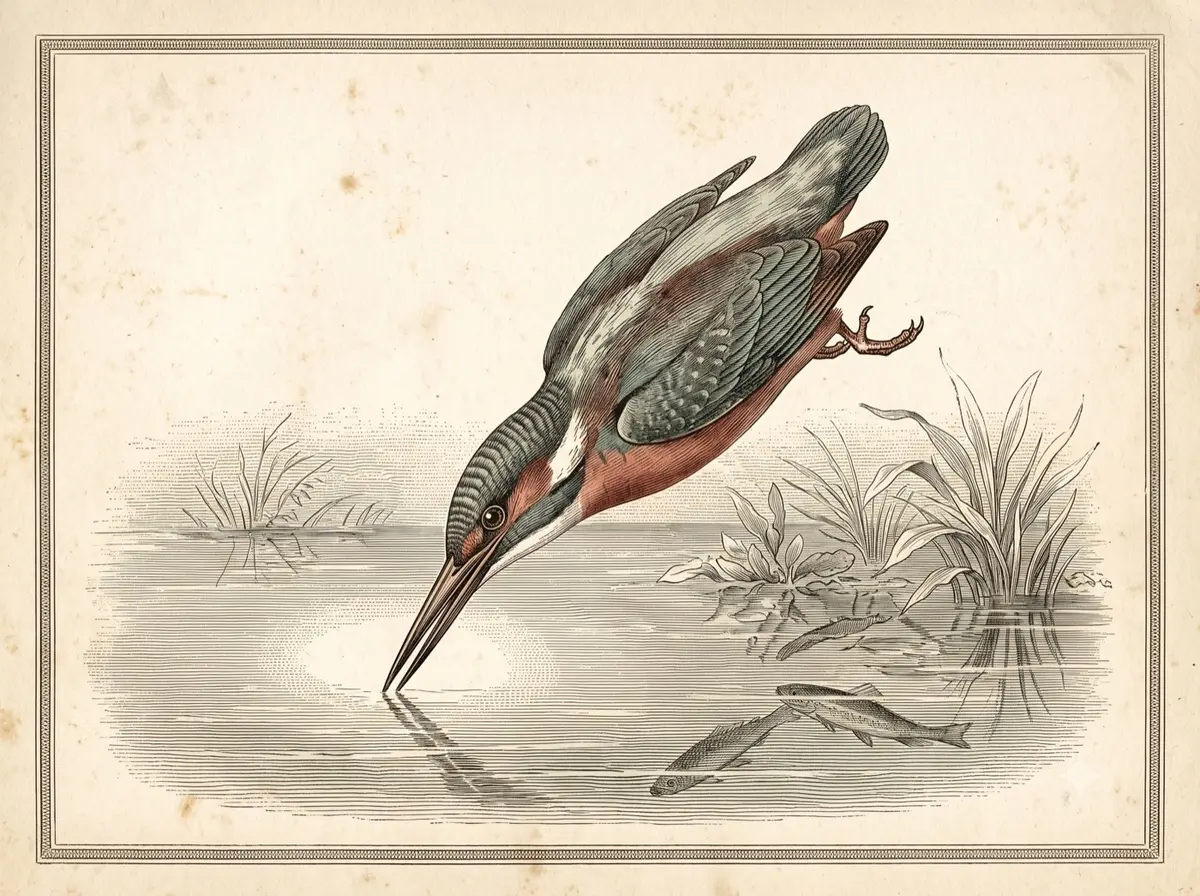
In the early 1990s, Japan's newest bullet train had a problem: every time it shot out of a tunnel, it launched a boom loud enough that people 400 meters away were filing noise complaints. The engineer tasked with fixing it, Eiji Nakatsu, didn't turn to a wind-tunnel textbook first. He thought about a kingfisher he'd watched on weekend birdwatching trips — a bird that dives headfirst from air into water, at speed, without so much as a splash.
By the Curiosities Desk · · 7 min read · Filed under Engineering · Today’s round
Part of Creatures That Changed Science
What happened: The Kingfisher That Redesigned the Bullet Train
By the early 1990s, JR West was racing to build a faster, quieter successor to its existing bullet trains for the Sanyō Shinkansen line between Osaka and Hakata. Roughly half of that route runs through tunnels, and at high speed, a train entering a tunnel compresses the air ahead of it into a pressure wave that travels down the tunnel and bursts out the far end as a thunderous “tunnel boom.” It was loud enough, and the vibrations strong enough, that residents near tunnel exits had complained to JR West directly. Japan’s noise regulations for rail were already among the strictest in the world, and the problem was bad enough that engineers had capped test runs below 350 km/h rather than risk it getting worse.
Eiji Nakatsu was the JR West engineer and general manager overseeing the new train’s development, and also, in his personal time, an active member of the Wild Bird Society of Japan. In a 2005 interview with the nonprofit Japan for Sustainability, Nakatsu recalled that a younger colleague, describing the sensation of a train entering a tunnel, said it felt as though the train had briefly “shrunk.” That offhand comment stuck with Nakatsu: the problem was really a sudden, violent change in air resistance. He started wondering whether any animal handled that same kind of transition as a matter of routine.
He landed on the kingfisher. The bird hunts by plunging from open air into water — two substances with very different resistance — to snatch fish before they can sense the disturbance and flee, and it does this with almost no splash. Nakatsu suspected the secret was in the beak: long, narrow, and gradually tapering rather than blunt. His team tested the idea by firing bullet-shaped projectiles of varying nose profiles down a pipe to measure the pressure waves they produced, then ran extensive computer simulations of trains entering tunnels using a supercomputer originally built for aerospace research. The shape that produced the smallest pressure spike turned out to be, in Nakatsu’s words, “almost identical to a kingfisher’s beak.” The result was the 500 Series Shinkansen’s distinctive 15-meter-long, needle-nosed front car — far longer and narrower than any previous bullet train design.
The nose wasn’t the only bird involved. The loudest noise on the earlier trains actually came from the pantograph, the diamond-shaped arm that reaches up to draw electricity from the overhead wire. Nakatsu had learned from an aircraft engineer, Seiichi Yajima, that owls fly almost silently, and that their near-silence appeared to come from small comb-like serrations along the leading edge of their wing feathers, which break up large, noise-generating air vortices into smaller, quieter ones. Working with a stuffed owl borrowed from the Osaka Municipal Tennoji Zoo, Nakatsu’s team ran wind-tunnel tests and spent, by his account, roughly four years adapting the same serrated-edge principle to a metal pantograph support. The redesigned “wing-shaped” pantograph, introduced in 1994, cut noise enough for the train to meet government limits at higher speeds.
The 500 Series Shinkansen entered regular passenger service in March 1997, reaching a top operating speed of 300 km/h — a first for scheduled Japanese rail service at the time.
Why it was strange: The Kingfisher That Redesigned the Bullet Train
Engineers had a fully modern toolkit at their disposal: supercomputer simulations, wind tunnels, pressure-wave testing rigs. And after all that computation, the mathematically optimal shape for slicing through a sudden change in air density turned out to already exist, unclaimed, on the front of a small blue-and-orange river bird. Nobody set out to copy a kingfisher. The resemblance emerged after the fact, when Nakatsu’s team compared their simulation results to the bird he’d been watching for years — a case of engineering arriving, by a completely independent and far more expensive route, at a solution nature had already settled on.
The same thread — Biomimicry — continues in The 7,500 Pounds of Hagfish That Slimed Five Cars and Closed a Highway.
What scientists learned: The Kingfisher That Redesigned the Bullet Train
The kingfisher’s dive and the owl’s silent wingbeat are both, at heart, solutions to fluid dynamics problems: how to move a solid body through a medium (water, air) while minimizing the turbulence and pressure disruption that gives away your approach or wastes energy. A kingfisher’s long, tapering beak lets it enter water gradually, so the surrounding fluid displaces smoothly instead of compressing into a shockwave-like splash. An owl’s serrated feather edges break large, noisy vortices into a cascade of smaller, quieter ones — a passive way of “muffling” airflow rather than fighting it. Later peer-reviewed research, including a 2019 study in the Journal of the Royal Society Interface using computational fluid dynamics, confirmed that diving kingfisher species show measurably lower drag and less bow-wave formation at the moment of water entry than similarly sized birds that don’t dive. Nakatsu’s team had independently rediscovered the same physics using bullets, pipes, and a supercomputer.
Another animal the lab could not ignore: The Twelve Leeches That Were Supposed to Ring a Bell When a Storm Was Coming.
How it reaches us today: The Kingfisher That Redesigned the Bullet Train
The 500 Series design cut air pressure buildup by about 30 percent and electricity consumption by roughly 15 percent compared to its predecessor, even while running about 10 percent faster — while also making for a noticeably smoother ride through tunnels, since sudden pressure changes were exactly what passengers had been feeling as ear-popping jolts. The vortex-generating serration principle from the pantograph work has since been applied well beyond trains, including in speed-skating suits and boots. More broadly, the Shinkansen redesign became one of the most frequently cited case studies in biomimicry — the practice of deliberately looking to biological solutions when solving engineering problems — and is still taught in design and engineering courses as a model for how that process can work in practice.
Another creature that ended up in the notes: The Beetle That Explodes Inside a Predator’s Stomach — and Walks Away.
Fun fact: The Kingfisher That Redesigned the Bullet Train
Nakatsu’s bird-watching didn’t stop with two solved problems. In the same 2005 interview, he mused about whether a seal’s stretchy, wrinkle-free skin might inspire a way to seal the gaps between train cars — an idea he pitched to manufacturers, who concluded the market was too small to justify developing it.
Sources: The Kingfisher That Redesigned the Bullet Train
- JFS Biomimicry Interview Series No. 6: “Shinkansen Technology Learned from an Owl?” — The Story of Eiji Nakatsu, Japan for Sustainability, 2005 — primary first-hand interview with Eiji Nakatsu
- The Beak That Inspired a Bullet Train, AskNature / The Biomimicry Institute — synthesis of the kingfisher design story with supporting citations
- Crandell, K. E., Howe, R. O., and Falkingham, P. L. “Repeated evolution of drag reduction at the air–water interface in diving kingfishers.” Journal of the Royal Society Interface 16, no. 154 (2019) — peer-reviewed CFD study of kingfisher diving hydrodynamics
- 500 Series Shinkansen, Wikipedia — service dates, top speed, and nose dimensions
Related stories: The Kingfisher That Redesigned the Bullet Train
- The Burrs Stuck to a Dog That Became Velcro — A dog covered in burrs became the hook-and-loop fastener
- The Beetle That Explodes Inside a Predator’s Stomach — and Walks Away — A beetle that fires boiling chemicals out of its abdomen
- The Windows That Took the Blame for a Plane Crash They Didn’t Cause — Square windows took the blame for crashes they did not cause