Strange Animals Scientists Studied · Engineering
The Ship-Sinking Clam That Taught an Engineer How to Dig Under the Thames
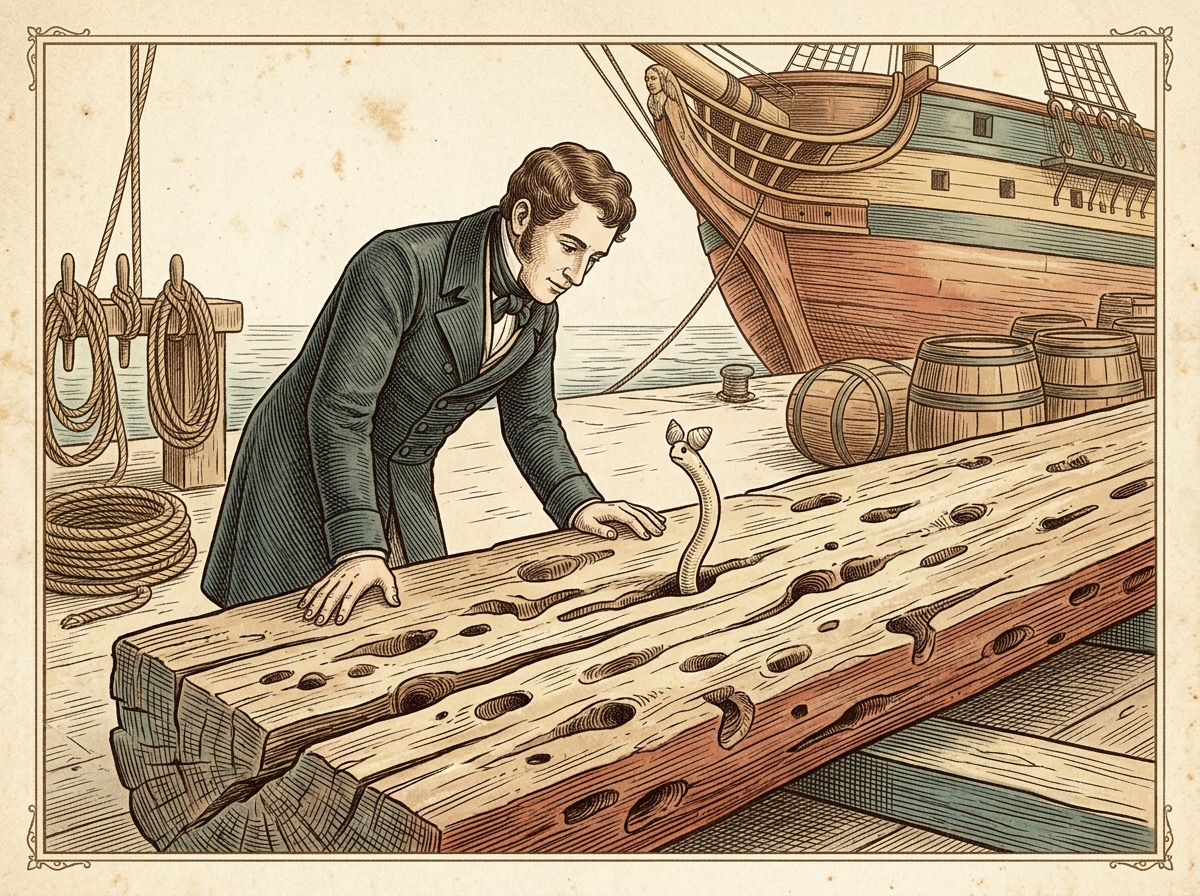
Somewhere in a British naval dockyard, an engineer is peering at a ruined piece of ship's timber, riddled with holes like Swiss cheese. The culprit is a soft, pale creature no thicker than a pencil, with a tiny pair of shells on its head. It has spent its life chewing a tunnel straight through solid oak. Marc Brunel, so the story goes, looked at this pest and saw the answer to a problem that had beaten every engineer in London: how to dig under a river without the river falling in.
By the Curiosities Desk · · 5 min read · Filed under Engineering · Today’s round
What happened?
In the early 1800s, London had a traffic problem. The Thames was crowded with ships, and the docks east of London Bridge had no crossing at all. A tunnel seemed like the obvious fix, but it had already been tried. Earlier attempts in the soft, waterlogged mud under the river had flooded and been abandoned. Soil like that doesn’t stay put while you dig it; it slumps, oozes, and lets the water in.
Marc Isambard Brunel was a French-born engineer who had fled the Revolution, worked as chief engineer of New York City, and then settled in Britain, where he did contract work for the Royal Navy, including at Chatham Dockyard. Shipyards were where you met Teredo navalis, the shipworm, and nobody liked meeting it. The shipworm drills into submerged wood and eats as it goes. It had sunk ships for centuries; Harvard’s Museum of Natural History notes that some of Columbus’s vessels on his fourth voyage were lost to its damage in 1503.
According to an account that has been repeated since the 1800s, Brunel studied how the shipworm worked. Its head carries two small, ridged shells that act like files, scraping away the wood in front of it. Behind it, the burrow gets lined with a hard, shell-like coating. Dig at the front, reinforce at the back, keep moving. The Brunel Museum, Wikipedia’s sources, and the German Patent and Trade Mark Office all present this as the inspiration for what came next, though they use careful words like “is said to” and “plausible.” We don’t have Brunel’s own diary entry of the moment, so treat the scene at the dock as a well-loved tradition rather than a recorded fact.
What is on record is the patent. In January 1818, Brunel and his partner, the naval officer Lord Thomas Cochrane, patented a “tunnelling shield” (British patent 4204 of 1818). The version built for the Thames was an enormous iron frame, divided into 12 frames of three levels each, making 36 small cells. Each frame weighed more than seven tons. One miner stood in each cell and removed a few boards at a time from the face in front of him, dug out a few inches of earth, and put the boards back. Screws then pushed his section of the shield forward, and bricklayers behind lined the fresh opening with brick. Like the shipworm, the shield chewed at the front and built the tunnel’s walls right behind itself.
Digging began at Rotherhithe in 1825. It was miserable work. Progress was often just a few feet a week, and the river kept breaking through. On 18 May 1827, the Thames flooded the tunnel. Brunel’s son, the 21-year-old Isambard Kingdom Brunel, went down in a diving bell to find the hole in the riverbed and plugged it with bags of clay. Then, to reassure investors, the Brunels did something wonderfully strange: on 10 November 1827, they hosted a banquet inside the drained tunnel, under the river, with the band of the Coldstream Guards playing.
Two months later, on 12 January 1828, a second flood killed six workers and nearly drowned Isambard, who was pulled out unconscious. Money ran out, and the half-finished tunnel was sealed off for years. Only a government loan of £247,000 in December 1834 restarted the work, with a new, heavier shield. The tunnel was finished in 1841, and on 25 March 1843 it opened to the public, 1,300 feet long, as the first tunnel known to have been built beneath a navigable river.
Why was it strange?
Engineers usually look to other engineers for ideas, not to pests. The shipworm was the enemy of every shipyard Brunel ever worked in, a creature navies spent fortunes trying to keep out of their hulls. Turning it into a design partner is the kind of sideways thinking that sounds like a joke until it works.
And the problem it helped solve was one experts had called close to impossible. The trick wasn’t digging faster. It was never exposing much loose ground at once, and never leaving a freshly dug space unsupported. A small clam had been doing exactly that for millions of years. Another animal that ended up redesigning a machine: The Kingfisher That Redesigned the Bullet Train.
What did scientists learn?
The shipworm isn’t a worm at all. It’s a bivalve, a two-shelled mollusk related to clams and mussels, with a long, soft body and a shell reduced to a small drilling tool on its head. Remarkably, it can live on wood thanks to bacteria housed in special cells in its gills, which help it break down cellulose (the tough fiber that makes up most of wood) that the animal couldn’t digest on its own.
Brunel’s insight was structural rather than biological: protect the working face, advance in small steps, and line the hole immediately. That principle, borrowing a solution from a living thing, is now called biomimicry. Burrs on a dog’s fur led to a similar leap: The Burrs Stuck to a Dog That Became Velcro.
How does it affect us today?
Brunel’s shield was the ancestor of almost every soft-ground tunnel since. Later engineers made the shield round, added compressed air to keep water out, and eventually built today’s giant tunnel boring machines, which still dig at the front and install the tunnel lining behind them as they go.
The Thames Tunnel itself is still working. Pedestrians used it at first, but in 1869 it became a railway tunnel, and today London Overground trains run through it between Wapping and Rotherhithe. Animals have helped engineers in odder ways, too: The Twelve Leeches That Were Supposed to Ring a Bell When a Storm Was Coming.
Fun fact
When the tunnel opened in 1843, about 50,000 people paid a penny each to walk through it on the first day, and more than a million came in the first 15 weeks. Not everyone was dazzled: because it had taken so long to finish, the press nicknamed it “the Great Bore.”
Sources
- Brunel Museum, “In Defence of Pests: Teredo Navalis” and “The Banquet in the Thames Tunnel” — the shipworm tradition, Chatham Dockyard, the 36-cell shield, and the 1827 banquet.
- German Patent and Trade Mark Office (DPMA), “The World’s First Underground” — Brunel and Cochrane’s 1818 patent, GB 4204/1818, and how the shield worked.
- Harvard Museum of Natural History, “Shipworm” — shipworm biology, its bacteria, and its history of sinking ships.
- World History Encyclopedia, “Thames Tunnel” — opening-day crowds, early visitor numbers, and the “Great Bore” nickname.
- “Thames Tunnel”, Wikipedia — used as a guide to dates, dimensions, floods, costs, and the later railway, following its citations to the Illustrated London News (25 March 1843) and Historic England’s listing.