Strange Animals Scientists Studied · Engineering
The $35 Ferret Hired to Clean a Particle Accelerator
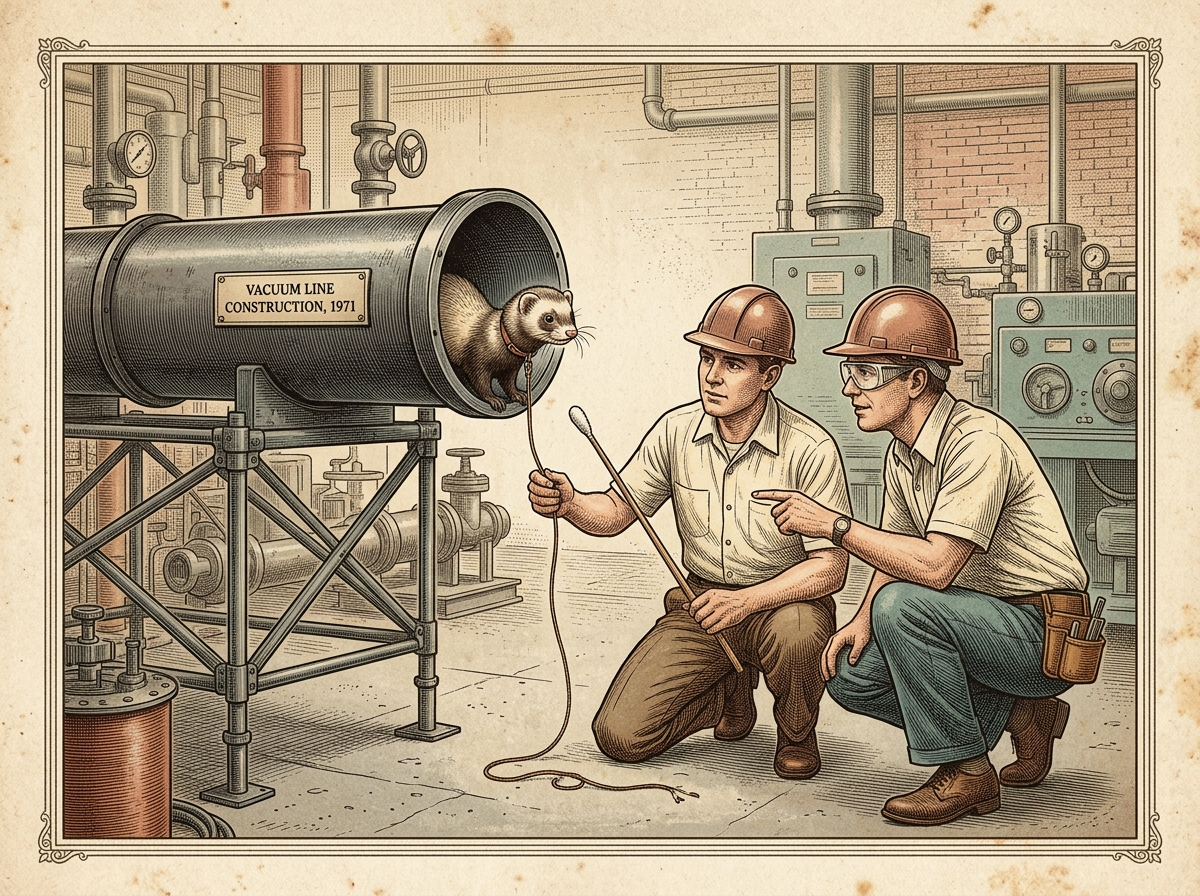
In 1971, at one of the most expensive physics laboratories on Earth, a crew of engineers stood at the mouth of a long steel pipe and waited for a ferret. She was 15 inches long, had cost $35, and wore a collar with a string tied to it. Her job was to run through the dark, come out the other end, and hand the string to the humans. Then they would pull a cleaning swab back through the pipe behind her. Her name was Felicia, and for a few months she was the lab's most famous employee.
By the Curiosities Desk · · 5 min read · Filed under Engineering · Today’s round
Part of The Animals Hired for a Job
What happened?
In the early 1970s, the National Accelerator Laboratory (NAL) in Batavia, Illinois, which was renamed Fermilab in 1974, was racing to finish its Main Ring. This was a particle accelerator: a four-mile loop of magnets wrapped around a vacuum pipe, built to speed protons up to 200 billion electron volts and smash them into targets. A vacuum pipe is a tube with nearly all the air pumped out, so the beam doesn’t crash into gas molecules along the way.
The ring didn’t cooperate. Physicist Ryuji Yamada later recalled that on April 22, 1971, six days after the last magnet was installed, two magnets were found shorted to ground. Over the following months, hundreds of the ring’s 1,014 magnets were swapped out. Cutting the old ones loose left behind slivers of stainless steel, and Yamada suspected that this metal debris was interfering with the beam. The pipe needed to be spotless, and the pipe was very long.
The engineering answer would have been a machine. Wally Pelczarski, a designer at the lab, was first asked to build a mechanical “meson-cleaner.” Then a British scientist on loan to the lab, Robert Sheldon, had another idea. In England, ferrets have long been sent down holes to chase rabbits out. Why not send one down a pipe?
According to the lab’s newsletter, the Village Crier, staff called the Brookfield Zoo, which pointed them to the Wild Game and Fur Farm in Gaylord, Minnesota. They asked for the smallest ferret available. Felicia arrived by special shipment: a female about 15 inches long, for a price of $35.
The plan was simple. Felicia wore a collar holding a strong string. She ran through a section of pipe, dragging the string behind her. At the far end, workers tied on a swab dipped in cleaning fluid and pulled it back through, and it came out covered in dust and steel specks. Atlas Obscura, drawing on period coverage, adds that she also wore a diaper, since anything a ferret left in a vacuum pipe would be one more thing in the beam’s way. She was paid in chicken, liver, fish heads and raw hamburger.
There was one hitch. By Yamada’s account, Felicia “refused to go inside the small, dark metallic hole” of the Main Ring itself. So she was reassigned to the Meson Laboratory, a building then under construction where the beam would later be sent for experiments. Its pipes were wider. The Village Crier reported on September 2, 1971, that she had already made three 300-foot runs there, with nine more planned. A technician, Don Richied, told the paper she had saved him a lot of time and effort.
Felicia became a celebrity. Local papers, the Chicago Tribune and Time magazine wrote about her. Then the pipes outgrew her. Felicia could manage about 300 feet at a time, while the Main Ring’s vacuum chamber came in segments of roughly 2,600 feet. Engineer Hans Kautzky built a replacement: a cable fitted with Mylar disks, shot through the pipe with compressed air and guided with a magnet. In December 1971 the newsletter ran the headline “Faithful Felicia Falls Victim to a Robot,” and she went into semi-retirement after about a dozen runs.
The Main Ring hit its 200 billion electron volt goal on March 1, 1972. Felicia did not live much longer. She had been boarding at a mink farm in nearby Winfield and with two lab employees, Charles Crose and Wally Pelczarski. In May 1972 she fell ill at Crose’s home. A veterinarian treated her, she seemed to rally, and then she died on May 9, 1972. A necropsy, an animal autopsy, found a ruptured abscess in her intestinal tract.
Why was it strange?
High-energy physics is supposed to be the domain of precise machines. NAL was spending hundreds of millions of dollars to build one of the most powerful accelerators in the world, and at one key moment, part of its cleaning plan depended on whether a ferret felt like going into a tunnel.
It also flipped the usual order of invention. Normally engineers try to make machines that copy animals. Here the lab tried a machine, then swapped in an animal, then went back to a machine once the animal hit her limits. Sheldon summed up the logic to the newsletter: “Her career depends on her size.”
She joins the lab’s other unlikely helpers in The Animals Hired for a Job.
What did scientists learn?
The deeper lesson is about how unforgiving a particle beam is. Protons in an accelerator travel around the ring many thousands of times a second. Yamada wrote that the steel slivers were slightly magnetic, so when the magnets ramped up, the slivers could be pulled into the gaps where the beam needed a clear path. A speck of metal that would be harmless in almost any other pipe becomes a real obstacle when it sits in the beam’s path on every lap.
That’s why the pipes had to be clean, and why the cleaning tools mattered. Felicia showed that a flexible, self-propelled “string carrier” could work in short, awkward sections. Kautzky’s air-driven device showed it could be done across long distances without anyone needing to coax a ferret. Yamada said it could clean the whole pipe, “though not perfectly.” The accounts don’t fully agree on what Felicia did and didn’t fix, and Fermilab’s own history pages preserve both versions.
For another animal recruited into a high-tech project, see The Bomb Three Pigeons Were Trained to Steer.
How does it affect us today?
Fermilab still runs accelerators, and no ferrets are on staff. Blowing a cord or a cleaning plug through a long tube with air pressure is now ordinary work: electricians use it to thread cable through conduit, and pipeline crews push cleaning devices nicknamed “pigs” through their lines. Felicia’s job, in other words, became routine engineering.
Her story has stayed with Fermilab, though. The lab still tells it in its history archive and its news site, and it has become a favorite example of the improvising that big science projects depend on. Building something new often means solving small, very physical problems that no theory predicted.
For a wartime animal experiment with a much worse ending, see The Bomb Full of Sleeping Bats That Burned Down Its Own Air Base.
Fun fact
When Felicia died, the lab’s newsletter announced that her body would be stuffed and mounted as a permanent symbol of NAL’s early days. Fermilab archivist Valerie Higgins told Atlas Obscura she has never found evidence that this happened. Nobody knows where Felicia ended up.
Sources
- Fermilab History and Archives Project. “Felicia Suffers Fatal Illness.” NAL Village Crier, May 18, 1972. https://history.fnal.gov/historical/people/felicia_fatal.html
- NAL Village Crier, September 2, 1971 (includes “Tiny Ferret Aids Construction of NAL Meson Lab”). Fermilab History and Archives Project. https://history.fnal.gov/criers/9-2-1971.pdf
- Fermilab History and Archives Project. “People: Felicia the Ferret.” https://history.fnal.gov/historical/people/people.html
- Yamada, R., and Beck, F. Recollections of the Main Ring period, Fermilab 50th anniversary site. https://50.fnal.gov/?p=4605
- Atlas Obscura. “The Ferret Who Helped Build a Particle Accelerator” (includes interview with Fermilab archivist Valerie Higgins). https://www.atlasobscura.com/articles/felicia-ferret-particle-accelerator-fermilab